
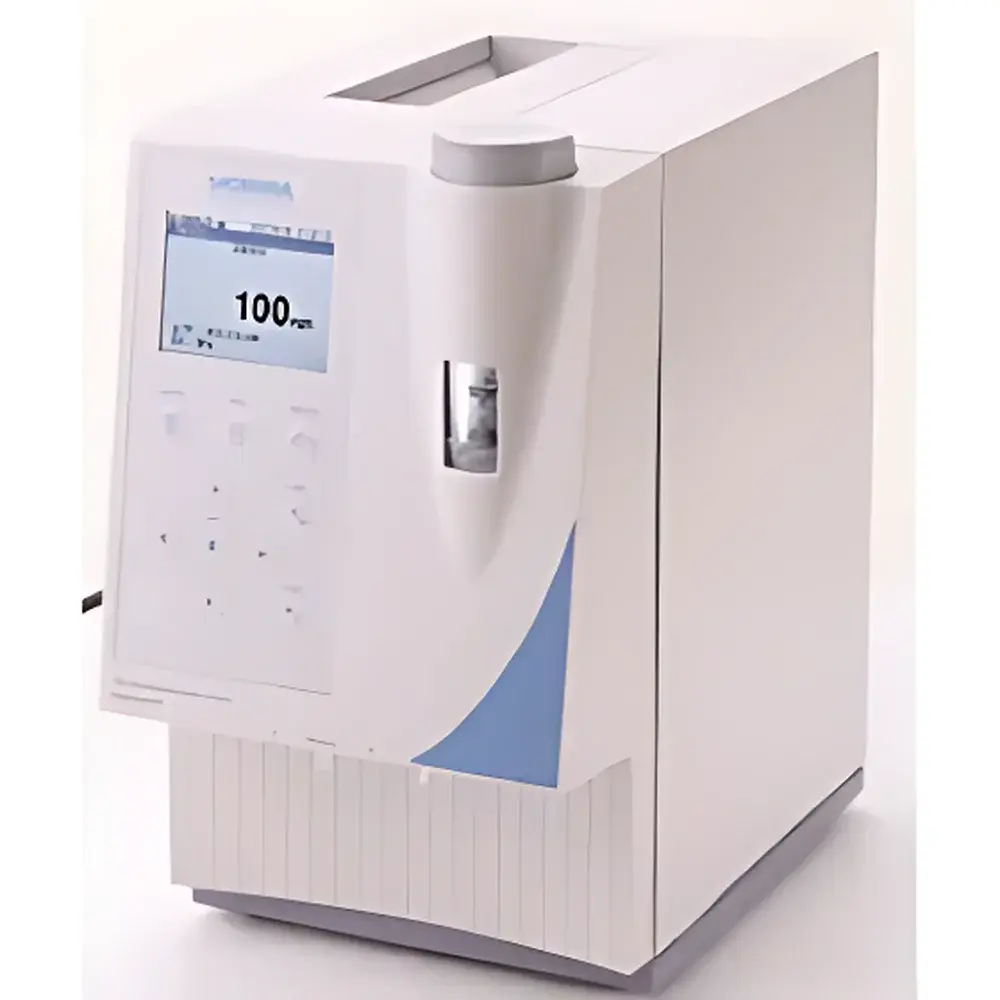
HORIBA OCMA-300/305 Oil-in-Water Analyzer
| Brand | HORIBA |
|---|---|
| Origin | Japan |
| Model | OCMA-300/305 |
| Measurement Principle | Non-Dispersive Infrared (NDIR) Spectrophotometry |
| Detection Range | 0–200 mg/L (as oil) |
| Extractant Solvents | OCMA-300 → S-316 (trichloroethylene substitute) |
| Display | Backlit LCD with digital readout |
| Interface | RS-232C port, printer interface |
| Data Logging | Timestamped measurement storage (date + time) |
| Repeatability | ±0.2 mg/L (0–9.9 mg/L), ±2.0 mg/L (10–99.9 mg/L), ±4.0 mg/L (100–200 mg/L) |
| Built-in Extraction Module | Yes |
| Self-Diagnostic Function | Yes |
| Compliance Context | Designed for ASTM D7066, ISO 9377-2, and EPA Method 1664-aligned workflows |
Overview
The HORIBA OCMA-300 and OCMA-305 are benchtop oil-in-water analyzers engineered for precise, field-deployable quantification of hydrocarbon contaminants in aqueous matrices. Based on non-dispersive infrared (NDIR) spectrophotometry, these instruments measure the characteristic C–H stretching absorption band near 2940 cm⁻¹—enabling selective detection of mineral oils, lubricants, diesel, and crude oil fractions dissolved or dispersed in water, seawater, or process effluents. Unlike gravimetric or fluorescence-based methods, NDIR delivers high specificity to aliphatic and aromatic hydrocarbons while minimizing interference from humic substances or suspended solids. The integrated solvent extraction module automates phase separation using standardized solvents—S-316 (a low-toxicity trichloroethylene alternative) for OCMA-300, and H-997 (a refined hexane blend) for OCMA-305—ensuring reproducible partitioning per ISO 9377-2 and EPA Method 1664 protocols. With a fixed dynamic range of 0–200 mg/L, the analyzer eliminates manual range switching, reducing operator error and calibration drift across environmental, industrial, and regulatory testing applications.
Key Features
- Integrated solvent extraction system with programmable agitation and phase separation timing
- NDIR optical path optimized for stability under ambient temperature fluctuations (10–40 °C operating range)
- Backlit monochrome LCD display with 4-digit resolution; readable under direct sunlight or low-light conditions
- Onboard data evaluation algorithm that rejects transient outliers and reports stabilized endpoint values after signal convergence
- Real-time self-diagnostic firmware: monitors detector voltage, lamp intensity, solvent flow integrity, and thermal sensor response—alerts via on-screen fault codes (e.g., “ERR-07: Solvent Level Low”)
- RS-232C serial interface compliant with standard ASCII command protocol for integration into LIMS or SCADA systems
- Printer interface supporting ESC/P-compatible thermal or dot-matrix units for GLP-compliant hardcopy output
- Internal memory stores up to 500 timestamped results (YYYY-MM-DD HH:MM format), each linked to measurement ID and operator code (if configured)
Sample Compatibility & Compliance
The OCMA-300/305 accommodates liquid samples including freshwater, seawater, cooling tower blowdown, bilge water, refinery wastewater, and cleaning rinse solutions. For solid-phase analysis (e.g., metal parts, textiles), surface swab extracts in designated solvents can be introduced manually post-extraction. Instrument design aligns with performance requirements of ASTM D7066 (standard test method for oil and grease in water by infrared spectroscopy), ISO 9377-2 (water quality—determination of hydrocarbon oil index—part 2: infrared spectrometric method), and EPA Method 1664B (n-hexane extractable material). While not inherently 21 CFR Part 11 compliant, audit-trail functionality—including immutable timestamps and operator-identifiable result logs—supports GxP-aligned documentation when deployed with validated SOPs and external electronic signature controls.
Software & Data Management
No proprietary PC software is required for basic operation; all configuration, calibration, and reporting occur via front-panel navigation. However, the RS-232C interface enables bidirectional communication using terminal emulation (e.g., PuTTY, Tera Term) for remote parameter adjustment, firmware updates, and bulk data export in CSV format. Each exported record includes sample ID, measured concentration (mg/L), date/time stamp, instrument serial number, and calibration status flag. For regulated environments, laboratories may integrate OCMA-300/305 outputs into validated data acquisition platforms that enforce electronic signatures, change control, and automated backup—fulfilling ALCOA+ (Attributable, Legible, Contemporaneous, Original, Accurate, Complete, Consistent, Enduring, Available) data integrity principles.
Applications
- Environmental monitoring: Quantifying oil leakage at hazardous waste sites, stormwater outfalls, and sediment pore water
- Marine operations: Verifying compliance of oily bilge water discharge per MARPOL Annex I regulations
- Refinery & petrochemical QA/QC: Assessing oil/water separator efficiency and emulsion stability in produced water streams
- Automotive service facilities: Monitoring sump drain water and parts washer effluent prior to municipal sewer discharge
- Manufacturing process control: Measuring residual cutting oil on machined components or textile substrates pre-washing
- Tank farm maintenance: Validating cleanliness of cleaned storage tanks via rinse water analysis per API RP 2510 guidelines
FAQ
What solvent types are compatible with OCMA-300 vs. OCMA-305?
OCMA-300 requires S-316 (a chlorinated hydrocarbon replacement meeting IARC Group 3 classification), while OCMA-305 uses H-997—a low-aromatic, high-purity hexane formulation optimized for reduced background absorbance.
Can the instrument analyze seawater without matrix correction?
Yes. The NDIR method exhibits minimal salinity interference up to 35 g/kg total dissolved solids; no salt compensation routine is embedded, as empirical validation confirms <±3% bias across typical marine salinities.
Is calibration traceable to NIST standards?
Calibration is performed using certified oil-in-water reference standards (e.g., AccuStandard OIL-1000 series), which are themselves traceable to NIST SRM 2781 (mineral oil in water). Users must maintain their own calibration certificate chain per ISO/IEC 17025 requirements.
How frequently should the optical cell be cleaned?
Under normal use (≤10 samples/day), wipe the quartz cell windows with lint-free tissue and reagent-grade acetone every 50 analyses; inspect for solvent residue or film buildup before each batch.
Does the analyzer support multi-point calibration?
No. It employs a single-point zero-and-span calibration protocol per ASTM D7066 Section 9.3—requiring only one certified standard at mid-range (e.g., 100 mg/L) and solvent blank. Linearity is factory-verified across 0–200 mg/L and documented in the Certificate of Conformance.
Related Products







