
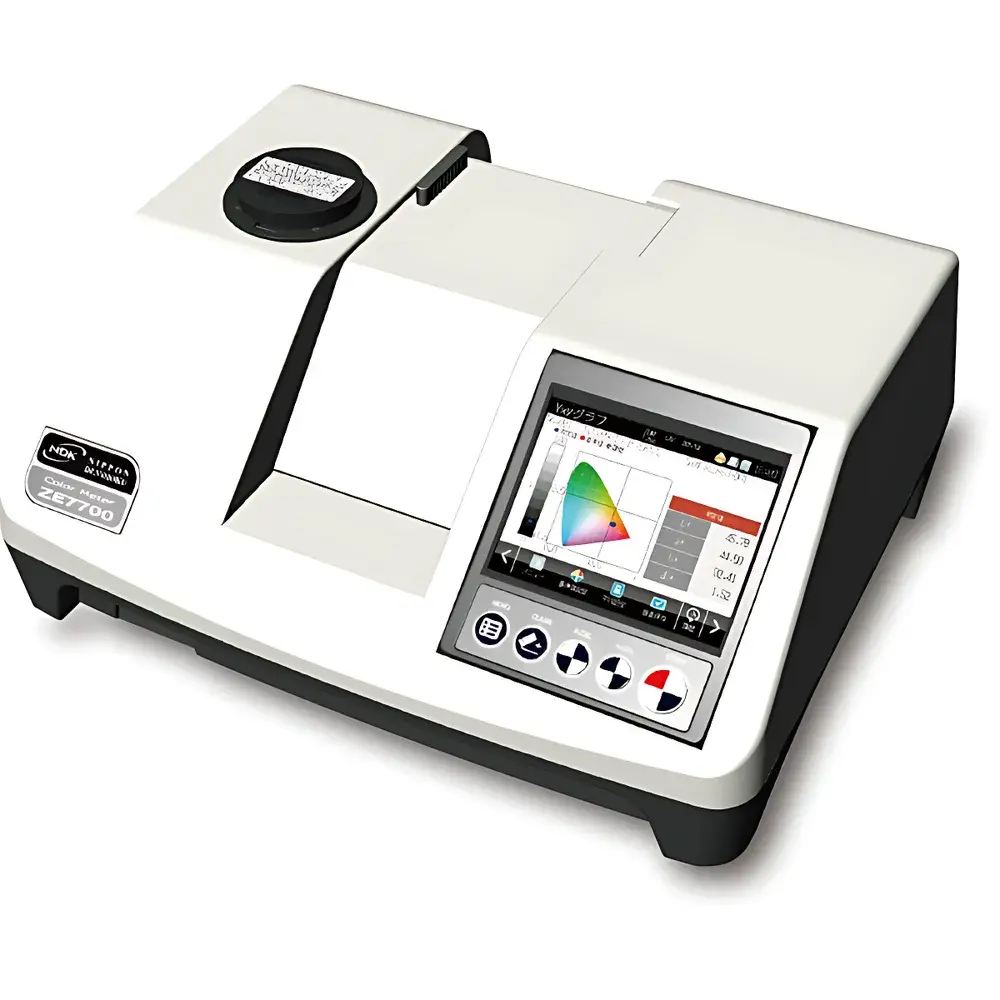
NIPPON DENSHOKU ZE7700 Benchtop Color Difference Meter
| Brand | NIPPON DENSHOKU |
|---|---|
| Origin | Japan |
| Model | ZE7700 |
| Instrument Type | Benchtop |
| Light Source | White LED |
| Spectral Range | 400–700 nm (10 nm interval) |
| Repeatability | ΔE*ab ≤ 0.03 |
| Illumination/Viewing Geometry (Reflectance) | 8°/diffuse |
| (Transmittance) | 0°/diffuse |
| Measurement Time | ~6.5 s |
| Aperture Sizes (Reflectance) | LAV Φ22 mm (Φ28 mm), MAV Φ6 mm (Φ10 mm), SAV Φ4 mm (Φ6 mm) |
| Aperture Size (Transmittance) | Φ12 mm |
| Display | 5.7″ TFT color LCD |
| Data Storage | 100 reference + 2000 measurement records internal memory |
| Interface | USB, parallel port, SD slot |
| Power | AC 100–240 V, 50/60 Hz, ≤25 VA |
| Dimensions & Weight | 425 × 350 × 188 mm, ~8 kg |
Overview
The NIPPON DENSHOKU ZE7700 is a high-precision benchtop color difference meter engineered for rigorous industrial and laboratory color quality control. It operates on the principle of spectral reflectance and transmittance measurement using a dual-beam, post-dispersion optical architecture with a diffraction grating monochromator and CMOS linear image sensor. This design ensures stable photometric response across the visible spectrum (400–700 nm at 10 nm intervals), minimizing drift and enabling traceable, reproducible color quantification under standardized CIE illuminants and observer conditions. The instrument supports both reflective and transmissive measurements—critical for evaluating heterogeneous sample forms including solids, liquids, powders, granules, films, and translucent sheets—without requiring hardware reconfiguration. Its optical geometry complies with ISO 7724-1 (8°/diffuse for reflectance; 0°/diffuse for transmittance), ensuring compatibility with international color specification workflows in regulated industries.
Key Features
- Dual-beam optical system with real-time reference compensation, delivering high photometric stability and long-term repeatability (ΔE*ab ≤ 0.03)
- White LED light source with rated lifetime ≥20,000 hours—eliminates lamp aging effects and reduces calibration frequency
- Three interchangeable aperture sizes for reflectance (LAV/MAV/SAV) and dedicated Φ12 mm transmittance port, enabling optimized signal-to-noise ratio across diverse sample types
- Large-opening transmittance chamber (110 mm door width) with spring-loaded sliding sample stage—accommodates rigid plates up to 25 mm wide, cuvettes up to 10 mm path length, and disposable tubes
- 5.7-inch full-color TFT LCD with multi-tab interface: simultaneous display of L*a*b*, Yxy, CDA, metamerism index, and spectral deviation plots
- Comprehensive CIE-compliant color space support: XYZ, xyz, L*a*b*, L*C*h*, Lab, LCh, plus specialized indices including YI (ASTM E313-05/D1925), WI (CIE/ASTM), TW, MI, APHA, and Gardner
- Multi-standard color difference algorithms: ΔE*ab, ΔE*94, ΔE00, ΔE(CMC), and user-definable tolerance limits per component (ΔL*, Δa*, Δb*) or total ΔE
Sample Compatibility & Compliance
The ZE7700 accommodates physically diverse specimens without auxiliary optics: flat solids (coatings, plastics, ceramics), free-flowing powders (pharmaceutical excipients, pigments), viscous liquids (inks, syrups), thin films (packaging laminates), and transparent media (optical filters, pharmaceutical solutions). Its open transmittance chamber and modular cuvette holder support ASTM D1003 (haze/transmittance), ISO 11475 (paper brightness), and USP (color of solutions) protocols. Reflectance geometry meets ISO 7724-1 and JIS Z 8722; transmittance mode aligns with ISO 13655 and CIE Publication 15. The instrument’s firmware and data handling architecture are compatible with GLP/GMP environments—audit trails, user access control, and electronic signature readiness can be implemented via optional color management software compliant with FDA 21 CFR Part 11 requirements.
Software & Data Management
Internal memory stores 100 reference standards and 2000 measurement records. All data—including spectral curves, chromaticity coordinates, and pass/fail status—are exportable as CSV files via USB or FAT32-formatted SD card. The included PC software enables advanced analysis: batch statistical reporting (mean, SD, CPK), spectral comparison overlays, tolerance zone mapping in L*a*b* space, and generation of compliance certificates aligned with ISO 9001 or IATF 16949 documentation requirements. Calibration verification reports include date/time stamps, operator ID, standard tile ID, and deviation logs—supporting traceability to NIST-traceable ceramic standards (e.g., NPL or PTB-certified tiles). Firmware updates preserve historical calibration coefficients and user-defined settings.
Applications
The ZE7700 serves as a primary color verification tool across sectors where spectral fidelity directly impacts regulatory acceptance or consumer perception. In coatings and automotive OEM supply chains, it validates batch-to-batch consistency against AAMA 2604 or ISO 12944 specifications. For pharmaceutical solid dosage forms, it supports USP visual appearance assessment and color uniformity testing per ICH Q5C. Food manufacturers use its APHA/Gardner scales to monitor caramelization or oxidation in beverages and edible oils. Polymer compounders rely on its ΔE00 tolerance mapping for masterbatch blending validation. Cement producers apply its YI and WI metrics to quantify raw material whiteness per ASTM C1423. Its robust mechanical design (8 kg mass, vibration-damped base) ensures stability in production-floor environments.
FAQ
What CIE illuminants and observers does the ZE7700 support?
It includes A, C, D65, F6, F8, and F10 illuminants, with selectable 2° and 10° standard observer functions.
Can the ZE7700 measure metamerism?
Yes—it calculates the Metamerism Index (MI) by comparing color differences under two user-selected illuminants simultaneously.
Is the instrument suitable for measuring opaque powders?
Yes, using the LAV aperture (Φ22 mm) with integrated sample press plate to ensure consistent packing density and surface homogeneity.
Does the ZE7700 meet FDA 21 CFR Part 11 requirements?
Out-of-the-box, it provides audit-ready data export; full Part 11 compliance (electronic signatures, role-based access) requires the optional validated color management software package.
How often must the instrument be calibrated?
Annual calibration against certified ceramic standards is recommended; daily verification using the built-in white tile is required per ISO 17025-aligned SOPs.





