
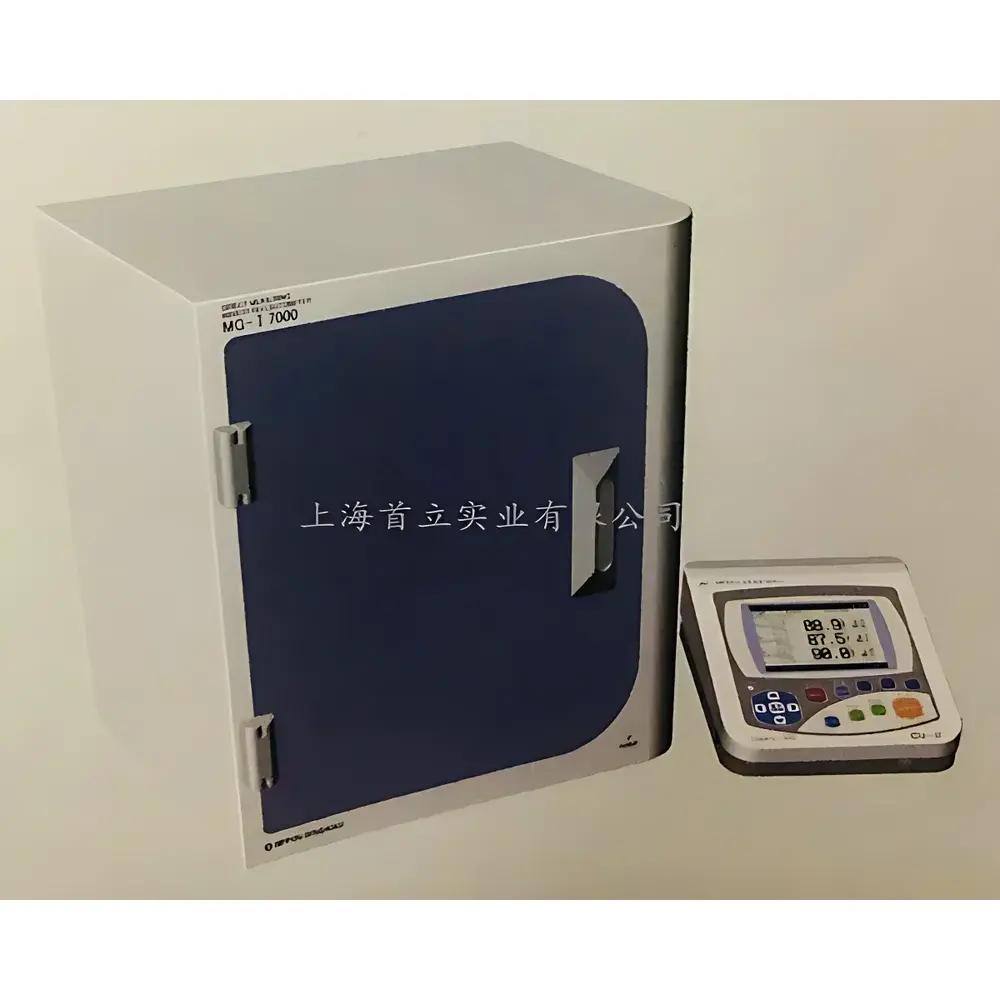
NIPPON DENSHOKU MG-I 7000 Direct-Measurement Specular Reflectometer
| Brand | NIPPON DENSHOKU |
|---|---|
| Origin | Japan |
| Model | MG-I 7000 |
| Illumination Angle | 25° |
| Receiving Angle | 25° |
| Standard Calibration Geometry | 0°–0° |
| Reflectance Range | 0.0–100.0% |
| Light Source | 5 V, 9 W Halogen Lamp (White LED optional) |
| Measurement Time | Approx. 1 s |
| Aperture Diameter | Φ40 mm |
| Reflectance Repeatability | Standard Deviation ≤ 0.1% (10 consecutive measurements within 10 s) |
| Display | Reflectance (%), ΔReflectance (%) |
| Compliance | ISO 5740 |
| Power Supply | 100 V AC, 50/60 Hz |
| Optical Unit | 40 VA, Measurement Unit: 26 VA |
| Dimensions (Optical Unit) | 463 mm (W) × 325 mm (D) × 500 mm (H), 19 kg |
| Dimensions (Measurement Unit) | 350 mm (W) × 360 mm (D) × 110 mm (H), 5 kg |
| Optional | Data Transfer Software, LED Light Source Module |
Overview
The NIPPON DENSHOKU MG-I 7000 is a precision-engineered direct-measurement specular reflectometer designed in strict accordance with ISO 5740 — the international standard governing reflectance testing of automotive rearview mirrors. Unlike indirect or comparative reflectance instruments, the MG-I 7000 implements a fixed-geometry, absolute measurement principle: illumination and detection are both configured at precisely 25° relative to the surface normal (25°/25° geometry), enabling traceable, calibration-independent quantification of specular reflectance. This optical architecture eliminates reliance on reference standards during routine operation, significantly reducing operator-induced variability and supporting high-throughput quality control in regulated manufacturing environments. The system comprises two physically separated modules — an optical unit housing the light source, collimating optics, and detector assembly, and a dedicated measurement unit containing the control electronics, real-time processing engine, and user interface. Its robust mechanical design ensures long-term angular stability and thermal drift resistance, critical for maintaining metrological integrity across shifts and ambient temperature fluctuations.
Key Features
- ISO 5740-compliant 25°/25° specular reflectance geometry for automotive mirror certification and supplier qualification
- Direct absolute measurement mode — no reference tile required for daily operation, minimizing calibration drift and procedural error
- Large sample chamber accommodating specimens up to 300 mm × 300 mm (custom fixtures available for curved or mounted rearview mirrors)
- Dual light source compatibility: factory-installed 5 V, 9 W halogen lamp (CIE illuminant A spectral profile) with optional white LED module for enhanced lifetime and reduced thermal load
- High-speed acquisition: full reflectance value output in ≈1 second, enabling integration into inline inspection stations or rapid batch screening
- Onboard statistical evaluation: automatic calculation of mean reflectance and ΔR (difference between successive readings), with internal storage for up to 100 measurement records
- Front-panel tactile interface with large LCD display — optimized for gloved operation in production cleanrooms or paint shop environments
Sample Compatibility & Compliance
The MG-I 7000 is validated for planar and gently curved specular surfaces including electroplated metals (e.g., Cr/Ni on ABS, Cu/Sn on steel), polished stainless steel, aluminized glass, and injection-molded polymer mirrors. It supports measurement of both unmounted substrates and fully assembled interior/exterior rearview mirrors per SAE J964 and ECE R46 requirements. All optical components comply with ISO 9001:2015 manufacturing controls, and the instrument’s measurement uncertainty budget has been independently verified against NMIJ (National Metrology Institute of Japan) traceable standards. Full documentation packages—including Factory Acceptance Test (FAT) reports, ISO/IEC 17025-aligned calibration certificates, and installation qualification (IQ) templates—are provided to support GLP, IATF 16949, and OEM Tier-1 audit readiness.
Software & Data Management
Optional PC-based data transfer software enables bidirectional communication via RS-232 or USB virtual COM port. The application supports automated report generation (PDF/CSV), time-stamped audit logs with operator ID fields, and configurable pass/fail thresholds aligned with customer-specific AQL limits. When deployed in regulated environments, the software package may be configured to meet FDA 21 CFR Part 11 requirements — including electronic signatures, role-based access control, and immutable audit trails for all measurement parameter changes or result exports. Raw intensity data (not just %R) is accessible for advanced spectral analysis or correlation studies with other optical characterization tools (e.g., gloss meters, colorimeters).
Applications
- Automotive Tier-1 suppliers performing final mirror reflectance verification prior to shipment to OEM assembly plants
- Electroplating and surface finishing facilities monitoring process consistency across chrome, aluminum, and silver deposition lines
- Quality assurance labs validating compliance of replacement mirrors against ISO 5740, GB/T 22757, and JIS D 5101
- R&D departments evaluating anti-fog coating efficacy by tracking reflectance stability under humidity cycling
- Government metrology institutes conducting inter-laboratory comparison exercises for specular reflectance proficiency testing
FAQ
Does the MG-I 7000 require annual recalibration?
Yes — NIPPON DENSHOKU recommends annual traceable recalibration using certified reflectance standards (NIST-traceable SRM 2011 or equivalent). Certificate includes uncertainty budget per GUM (Guide to the Expression of Uncertainty in Measurement).
Can the instrument measure curved mirrors without distortion correction?
The MG-I 7000 measures local specular reflectance at the illuminated spot (Φ40 mm). For convex/concave mirrors, results represent point-wise performance; curvature-induced angular deviation is outside the scope of ISO 5740 and must be addressed separately per ECE R46 Annex 3.
Is the white LED option spectrally equivalent to the halogen lamp?
No — the LED module provides broader spectral uniformity (400–700 nm) but differs from CIE Illuminant A. It is intended for stability-critical applications where thermal management outweighs strict colorimetric fidelity.
What is the minimum sample thickness supported?
No minimum thickness requirement — the optical path is non-contact and surface-normal. Samples as thin as 0.1 mm (e.g., metallized PET film) can be measured if mechanically stable in the chamber.
How is measurement repeatability validated?
Per ISO 5740 Annex B: 10 consecutive readings on a stable reference mirror yield standard deviation ≤ 0.1%, verified during factory acceptance and documented in the supplied calibration report.





