
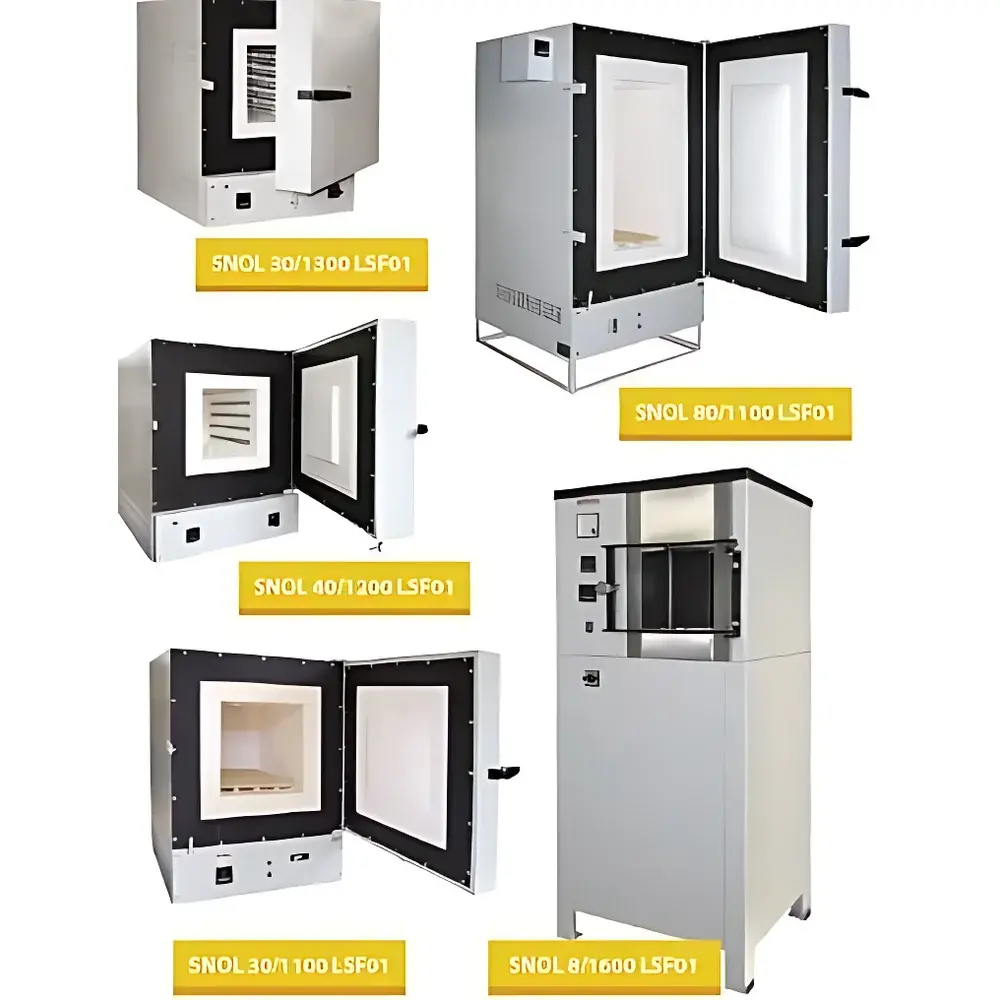
SNOL High-Temperature Fibrous Insulated Box Furnace (1100–1600 °C)
| Origin | Imported |
|---|---|
| Manufacturer Type | Authorized Distributor |
| Model Series | SNOL 1100/1300/1600 |
| Temperature Range | 1100–1600 °C |
| Temperature Uniformity | ±0.5 °C |
| Internal Chamber Dimensions (W×D×H) | 300×450×600 mm |
| External Dimensions (W×D×H) | 740×880×1250 mm |
| Heating Power | Up to 8.4 kW |
| Chamber Volume | Up to 80 L |
| Net Weight | Up to 170 kg |
| Control Interface | RS232 / RS485 / USB |
| Safety Features | Overtemperature Protection, Audible Alarm, Process Monitoring Window (Ø35 mm, rated to 1100 °C) |
Overview
The SNOL High-Temperature Fibrous Insulated Box Furnace is a precision-engineered laboratory furnace designed for controlled thermal processing in research, quality control, and industrial R&D environments. Operating across three distinct temperature classes—1100 °C, 1300 °C, and 1600 °C—this furnace employs high-purity ceramic fiber insulation to achieve rapid heating, exceptional thermal stability, and minimal energy consumption. Its core architecture follows the principle of resistive heating within a low-thermal-mass chamber, where heating elements are strategically configured: vacuum-sealed molybdenum disilicide (MoSi₂) elements for 1100 °C models; groove-mounted MoSi₂ elements for 1300 °C variants; and high-density tubular MoSi₂ elements with optimized geometry for sustained operation at 1600 °C. The furnace complies with fundamental thermal safety and electromagnetic compatibility requirements per IEC 61000-6-3 and IEC 61000-6-4, and its design supports integration into GLP-compliant workflows when paired with validated data logging and audit-trail-capable software.
Key Features
- High-efficiency fibrous ceramic insulation (alumina-silica based), offering low thermal conductivity (<0.15 W/m·K at 1000 °C) and negligible outgassing under vacuum or inert atmospheres
- Three-element configuration strategy matched to maximum operating temperature: vacuum-encapsulated, groove-mounted, or tubular MoSi₂ heating elements—each selected for long-term stability and resistance to thermal cycling fatigue
- Digital microprocessor-based temperature controller with PID algorithm, 0.1 °C resolution, and programmable ramp/soak profiles (up to 16 segments)
- Ceramic fiber-reinforced alumina floor plate (≥99.5% Al₂O₃), rated for continuous use at full temperature and resistant to thermal shock
- External housing finished with electrostatically applied RAL 7035 light gray powder coating for corrosion resistance and cleanroom-compatible surface integrity
- Integrated overtemperature cut-off (independent from main controller), audible alarm, and fail-safe door interlock system
- Optional forced-draft chimney with axial fan for active off-gas removal during degreasing, binder burnout, or sintering processes
- RS232, RS485, and USB interfaces enable bidirectional communication with LIMS or SCADA systems; compatible with third-party data acquisition platforms supporting Modbus RTU and ASCII protocols
Sample Compatibility & Compliance
The SNOL furnace accommodates a broad range of sample geometries and materials—including metal alloys, ceramics, composites, battery cathode precursors, and pharmaceutical excipients—within its standardized chamber configurations. All models support inert (N₂, Ar), reducing (H₂/N₂), or vacuum atmospheres (down to 10⁻² mbar with optional vacuum pump interface). The furnace’s construction meets mechanical safety requirements per EN 61000-1-2 and thermal hazard mitigation guidelines outlined in ASTM E119 for laboratory-scale heating equipment. When equipped with NIST-traceable calibration certificates and time-stamped digital logging, it satisfies documentation prerequisites for ISO/IEC 17025-accredited testing laboratories and supports 21 CFR Part 11 compliance through secure user authentication and electronic signature-ready software add-ons.
Software & Data Management
The furnace operates natively with SNOL’s proprietary FurnaceControl Suite (v3.2+), a Windows-based application enabling real-time temperature graphing, multi-channel profile editing, and automated report generation in PDF or CSV format. Data logging resolution is configurable from 1 second to 60 minutes; all records include metadata such as operator ID, ambient conditions, and calibration status. Optional firmware upgrade enables encrypted data export, role-based access control (admin/operator/auditor), and audit trail functionality compliant with FDA 21 CFR Part 11 Annex 11 requirements. Raw thermocouple voltage outputs (Type S or B) are accessible via analog output terminals for integration with external DAQ systems.
Applications
This furnace serves critical functions across multiple technical domains: sintering of advanced ceramics and refractory metals; ashing of organic matrices in environmental and food testing labs; heat treatment of tool steels and Ni-based superalloys; calcination of catalyst supports and battery electrode materials; pre-firing of dental and biomedical zirconia components; and thermal aging studies per ASTM D3045 and ISO 2578. Its precise thermal uniformity (±0.5 °C across working zone) and repeatable ramp rates make it suitable for method development in USP and Ph. Eur. 2.2.41 thermal analysis protocols.
FAQ
What type of thermocouple is used for temperature measurement?
Standard configuration uses a dual-wire Type S (Pt/Pt–10% Rh) thermocouple with ceramic protection sheath; optional Type B available for 1600 °C models.
Can the furnace be operated under vacuum or controlled atmosphere?
Yes—standard flanged ports (KF25 or CF35) allow connection to vacuum pumps or gas manifolds; optional quartz observation window (up to 1100 °C) and gas inlet/outlet fittings are available.
Is calibration traceable to national standards?
Factory calibration includes a NIST-traceable certificate; on-site recalibration services with uncertainty reporting are offered annually.
What maintenance is required for long-term reliability?
Annual inspection of heating element integrity, thermocouple drift verification, and insulation compression assessment is recommended; no routine lubrication or consumable replacement is needed.
Does the furnace support remote monitoring via Ethernet or Wi-Fi?
Ethernet connectivity is available via optional RS485-to-Ethernet gateway; Wi-Fi is not supported due to electromagnetic interference constraints in high-temperature environments.



