
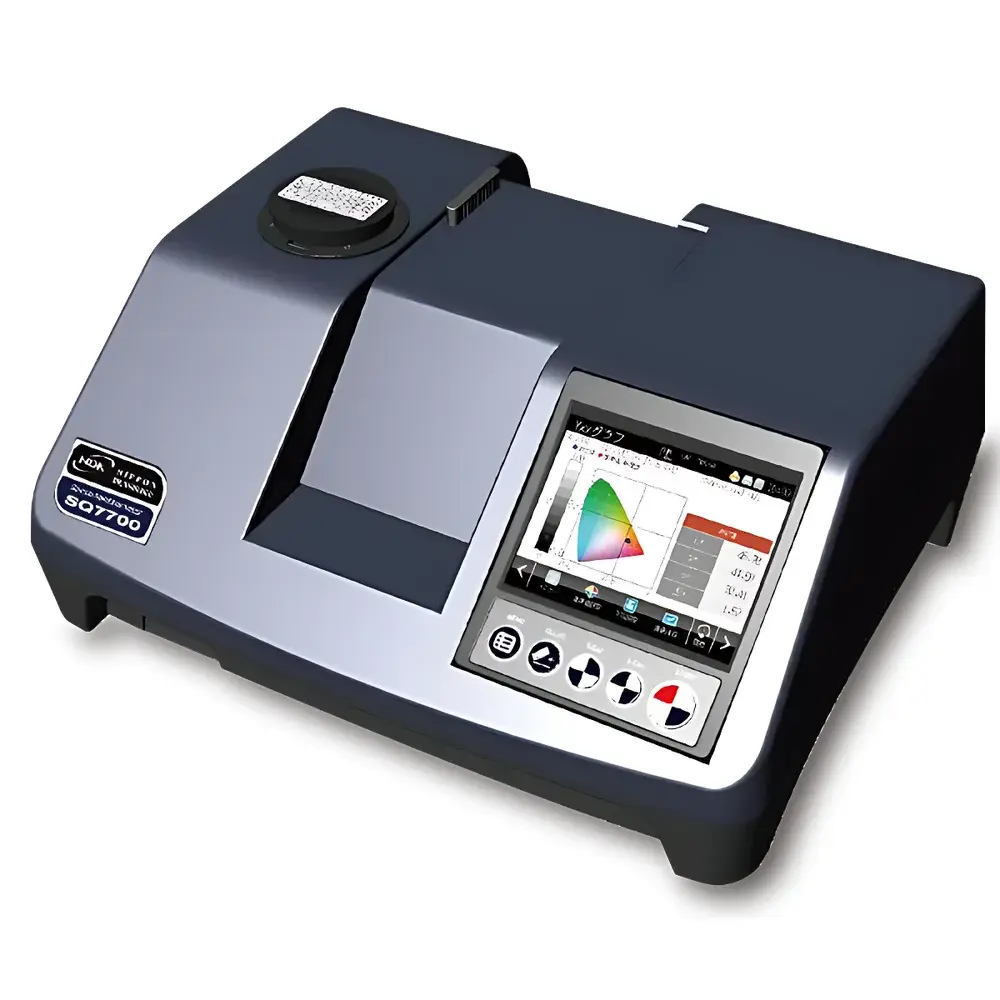
NIPPON DENSHOKU SQ7700 Desktop Spectrophotometer
| Brand | NIPPON DENSHOKU |
|---|---|
| Origin | Japan |
| Model | SQ7700 |
| Product Type | Spectrophotometric Colorimeter |
| Instrument Type | Benchtop |
| Optical Geometry | d/8° integrating sphere |
| Light Source | White LED |
| Spectral Range | 380–780 nm |
| Measurement Interval | 5 nm |
| Reflectance/Transmittance Mode | Dual SCI & SCE |
| Display | Large color LCD with capacitive touch panel |
| Data Storage | SD card (user-removable) |
| Compliance | JIS Z8722, JIS Z7801-4, JIS Z8781-6, JIS Z8715, ASTM E308, ASTM E313, ASTM D1925 |
| Optional Capabilities | APHA & Gardner color measurement (with accessory kit) |
Overview
The NIPPON DENSHOKU SQ7700 is a benchtop spectrophotometric colorimeter engineered for high-precision, repeatable spectral measurement across the visible spectrum (380–780 nm at 5 nm intervals). It operates on the principle of diffuse illumination and hemispherical collection using an 8° viewing angle geometry within an integrating sphere — conforming to ISO/CIE standard d/8° configuration. The instrument employs a stable, long-life white LED light source with calibrated spectral output, eliminating warm-up drift and enabling consistent inter-instrument agreement. Its dual-mode optical path supports both Specular Component Included (SCI) and Specular Component Excluded (SCE) measurements without mechanical reconfiguration, allowing users to evaluate color appearance under standardized illuminants while independently assessing surface texture effects such as gloss or haze. Designed for industrial quality control laboratories, the SQ7700 delivers spectral reflectance and transmittance data essential for color formulation, batch-to-batch consistency verification, and regulatory compliance in regulated sectors including pharmaceuticals, food, coatings, plastics, and specialty chemicals.
Key Features
- Dual-measurement capability: Simultaneous SCI and SCE modes enabled via internal optical switching — no manual aperture changes or recalibration required.
- High-resolution spectral acquisition: 5 nm data interval across full 380–780 nm range, supporting CIE 1931 XYZ tristimulus calculation, ΔE*ab, ΔE*00, and multiple color difference formulas per ISO 11664 and ASTM E308.
- Robust sample handling architecture: Wide-opening sliding door design accommodates irregular solids, powders, liquids in cuvettes, films, and textured substrates; integrated sample clamp ensures reproducible positioning.
- Intuitive human interface: 7-inch full-color TFT-LCD with capacitive multi-touch overlay enables gesture-based navigation, real-time spectral curve visualization, and on-screen color simulation against reference standards.
- Traceable data management: Internal memory and removable SD card support export of raw spectral data (.csv), graphical reports (.png), and instrument configuration files — all timestamped and user-ID tagged.
- Regulatory-ready operation: Compliant with GLP/GMP-aligned workflows through optional audit trail logging, electronic signature support, and calibration certificate traceability to NIST-traceable standards.
Sample Compatibility & Compliance
The SQ7700 accepts opaque solids (e.g., painted panels, plastic pellets), translucent materials (e.g., gels, films), transparent liquids (e.g., solvents, syrups), and particulates (e.g., pigments, cement clinker) using application-specific holders. Optional accessories include liquid cell holders (10 mm pathlength), powder cells with pressure plates, and APHA/Gardner color measurement kits compliant with ASTM D1209 and ASTM D6166. All optical measurements adhere to JIS Z8722 (diffuse/8° geometry), JIS Z7801-4 (color difference evaluation), and ASTM E308 (computation of CIE tristimulus values from spectral data). Instrument validation follows IQ/OQ protocols aligned with ISO/IEC 17025 requirements for testing laboratories.
Software & Data Management
The embedded firmware supports direct spectral data export in ASCII-compliant CSV format, compatible with third-party statistical process control (SPC) platforms and L*a*b* database systems. On-device analysis includes spectral comparison overlays, metamerism index calculation, whiteness/yellowness indices (ASTM E313), and colorant strength estimation. Optional PC software (ColorCalc Pro) provides advanced features: multi-instrument network synchronization, custom tolerance ellipses (CIEDE2000), historical trend charting, and automated report generation compliant with FDA 21 CFR Part 11 when deployed with validated electronic signature modules.
Applications
- Coatings & Inks: Batch release testing against master standards; pigment dispersion uniformity assessment; weathering-induced hue shift quantification.
- Pharmaceuticals: Tablet coating color consistency per USP ; excipient color stability monitoring under ICH Q5C guidelines.
- Food & Beverage: Fruit juice browning index (Absorbance at 420 nm); dairy product yellowness (b* value tracking); packaging film transmission uniformity.
- Chemicals & Polymers: Resin yellowness index (YI E313); catalyst residue impact on polymer hue; solvent clarity grading (APHA).
- Cement & Construction Materials: Raw mix homogeneity verification; finished product shade matching per ASTM C150.
FAQ
Does the SQ7700 support APHA and Gardner color scales?
Yes — with the optional APHA/Gardner measurement kit (including calibrated liquid cells and reference standards), the instrument calculates APHA (ASTM D1209) and Gardner (ASTM D1544) indices directly from transmittance spectra.
Is calibration traceable to national standards?
Each unit ships with a factory calibration certificate traceable to JCSS-accredited standards; optional annual recalibration services include NIST-traceable verification reports.
Can the SQ7700 measure metallic or pearlescent coatings?
While optimized for non-fluorescent, non-directional surfaces, the d/8° geometry provides acceptable repeatability for many effect pigments; for gonio-apparent materials, a dedicated multi-angle spectrophotometer is recommended.
What spectral data formats are exportable?
Raw reflectance/transmittance (%/nm), CIE XYZ, L*a*b*, ΔE*ab, and user-defined indices can be exported as CSV; spectral curves and comparison charts are saved as PNG.
Is the instrument suitable for GLP-regulated environments?
Yes — when configured with password-protected user roles, audit trail logging, and electronic signature modules, it meets core functional requirements for GLP-compliant color testing per OECD Principles of Good Laboratory Practice.




