
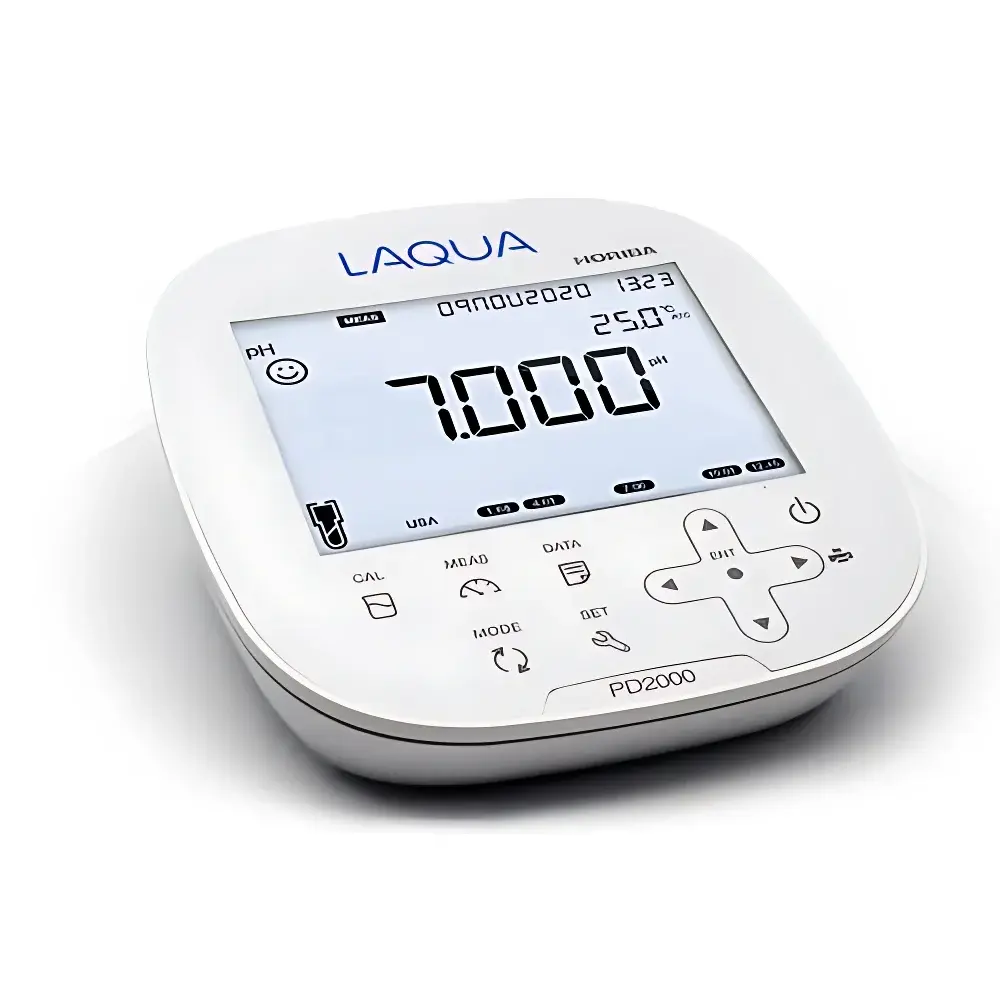
HORIBA LAQUA PD2000 Benchtop Multiparameter Water Quality Analyzer
| Brand | HORIBA |
|---|---|
| Origin | Japan |
| Model | PD2000 |
| Instrument Type | Laboratory Water Quality Analyzer |
| Measured Parameters | pH, ORP, Ion Concentration, Dissolved Oxygen (DO), Biochemical Oxygen Demand (BOD), Temperature (°C/°F) |
| pH Range | −2.000 to 20.000 |
| pH Resolution | 0.1 / 0.01 / 0.001 |
| pH Accuracy | ±0.003 |
| ORP Range | ±2000.0 mV |
| ORP Resolution | 0.1 mV |
| ORP Accuracy | ±0.2 mV |
| Ion Range | 0.000 µg/L to 9999 g/L |
| Ion Units | µg/L, mg/L, g/L, ppm, ppt, mmol/L, mol/L |
| DO Range | 0.0–60.00 mg/L / 0.0–600.0% |
| DO Resolution | 0.01 mg/L, 0.1% |
| DO Accuracy | ±0.1 mg/L or ±1.0% |
| Temperature Range | −30.0 to 130.0 °C |
| Temperature Accuracy | ±0.5 °C |
| Memory Capacity | 2000 data sets with timestamp |
| Communication | USB (DAS20 software), RS232C (printer) |
| Display | 5″ backlit 320-segment LCD |
| Power | AC adapter (100–240 V, 50–60 Hz) |
| Dimensions | 155 × 150 × 67 mm |
| Weight | 770 g |
Overview
The HORIBA LAQUA PD2000 is a high-precision benchtop multiparameter water quality analyzer engineered for rigorous laboratory environments where regulatory compliance, measurement reproducibility, and long-term operational stability are critical. Built upon HORIBA’s legacy in electrochemical sensor design and metrological traceability, the PD2000 implements potentiometric (pH/ORP/ion), galvanic amperometric (dissolved oxygen), and thermistor-based temperature measurement principles—each calibrated against internationally recognized reference standards including NIST, DIN, and USP. Its architecture supports simultaneous acquisition of five core water quality parameters—pH, oxidation-reduction potential (ORP), specific ion concentration (e.g., Na⁺, F⁻, NH₄⁺), dissolved oxygen (DO), and temperature—with full environmental compensation (salinity, barometric pressure, and thermal drift). Designed for GLP-compliant workflows, the instrument features audit-ready data logging, time-stamped records, and password-protected configuration control—making it suitable for accredited environmental testing labs, municipal water quality control centers, and academic research facilities conducting ASTM D888, ISO 5814, ISO 10523, and EPA Method 4500-OH⁻–F compliant analyses.
Key Features
- Triple-resolution pH measurement (0.1 / 0.01 / 0.001) across an extended range of −2.000 to +20.000, enabling accurate analysis of highly acidic or alkaline industrial effluents and geological leachates.
- Up to six-point pH calibration with selectable buffer sets (USA, NIST, NIST2, DIN, Custom), supporting segmented and averaged slope calculation for enhanced linearity verification per ISO/IEC 17025 requirements.
- Galvanic-type DO probe with integrated Pt1000 temperature sensor—eliminating external thermal lag and enabling real-time compensation per ISO 5814:2012 for BOD₅ determination.
- Five-day BOD protocol with seed correction algorithm compliant with APHA Standard Methods 5210B and EPA 40 CFR Part 136, supporting both unseeded and seeded dilution approaches.
- Multi-unit ion concentration quantification (µg/L, mg/L, g/L, ppm, ppt, mmol/L, mol/L) with up to five-point calibration and slope diagnostics—validated for routine monitoring of nitrate, fluoride, ammonium, and chloride in drinking water per WHO and EU Directive 98/83/EC.
- Real-time stability indicators (electrode status, temperature drift, signal noise), auto-hold trigger, and adjustable auto-off (up to 30 min) to minimize operator dependency and energy consumption.
- 2000-point internal memory with ISO 8601-formatted timestamps, synchronized via built-in real-time clock (RTC); data exportable via USB to DAS20 software for statistical evaluation, trend plotting, and PDF report generation.
Sample Compatibility & Compliance
The PD2000 is validated for aqueous matrices including potable water, wastewater, surface water, groundwater, seawater (with salinity compensation up to 40.0 ppt), and process streams in pharmaceutical, food & beverage, and power generation industries. All electrochemical sensors meet IEC 61000-4 electromagnetic compatibility standards and operate within defined uncertainty budgets traceable to NMI-certified references. The instrument’s firmware architecture complies with FDA 21 CFR Part 11 requirements for electronic records and signatures when used with DAS20 software under controlled access protocols. Calibration alerts (configurable up to 90 days), audit trails for parameter changes, and read-only data export modes support ISO/IEC 17025:2017 Clause 7.7 (Ensuring Validity of Results) and EU Annex 11 (Computerized Systems).
Software & Data Management
Data acquisition and post-processing are enabled through HORIBA’s DAS20 desktop application (Windows-compatible), which provides secure USB communication, customizable report templates (PDF/CSV/XLSX), statistical summaries (mean, SD, RSD, confidence intervals), and calibration certificate generation. The software enforces role-based user authentication, supports electronic signature capture, and maintains immutable logs of all instrument configurations and measurement events—fulfilling ALCOA+ (Attributable, Legible, Contemporaneous, Original, Accurate, Complete, Consistent, Enduring, Available) data integrity principles. RS232C interface allows direct printing of measurement records to serial printers without intermediate storage, reducing data transcription errors in QA/QC documentation.
Applications
- Regulatory compliance testing for EPA Clean Water Act (CWA) discharge permits and Safe Drinking Water Act (SDWA) monitoring programs.
- BOD₅ and COD surrogate validation in wastewater treatment plant performance assessment (ASTM D5210, ISO 10260).
- Ion-specific monitoring in semiconductor ultrapure water loops (e.g., Cl⁻ < 0.1 µg/L detection capability with optimized electrode conditioning).
- Acid mine drainage characterization requiring robust pH and ORP measurement under redox-active conditions.
- Method development and validation studies in ISO/IEC 17025-accredited laboratories seeking scope expansion for multi-analyte water testing.
- Educational use in university environmental engineering labs for hands-on instruction in electroanalytical techniques and quality assurance practices.
FAQ
Does the PD2000 support GLP-compliant data handling?
Yes—the instrument includes password-protected settings, timestamped data logging with RTC synchronization, and audit-trail-capable firmware. When paired with DAS20 software, it satisfies key GLP requirements for data integrity, operator accountability, and system validation.
Can the PD2000 perform simultaneous measurements of all five parameters?
No—measurements are sequential per parameter channel, but switching between modes (pH → DO → ion) is executed via intuitive soft-keys with automatic sensor recognition and zero cross-talk interference.
Is the galvanic DO probe field-replaceable and certified for traceable calibration?
Yes—the integrated DO/temperature probe (model LAQUA DO-110) is NIST-traceable, supplied with factory calibration certificate, and designed for on-site replacement without recalibration of the main unit.
What regulatory standards does the PD2000 help satisfy in routine water testing?
It supports method execution aligned with ASTM D1293 (pH), D3222 (ORP), D3694 (ion), D888 (DO), ISO 5814 (DO), ISO 10523 (pH), and EPA Methods 4500-B (pH), 4500-Cl⁻ (ion), and 4500-O (DO).
How is temperature compensation handled for ion and DO measurements?
Automatic temperature compensation (ATC) is applied in real time using the integrated Pt1000 sensor; for ion measurements, the instrument applies the Nernst equation with configurable thermal coefficient (α), while DO compensation follows the Stern–Volmer relationship incorporating salinity and atmospheric pressure inputs.







