
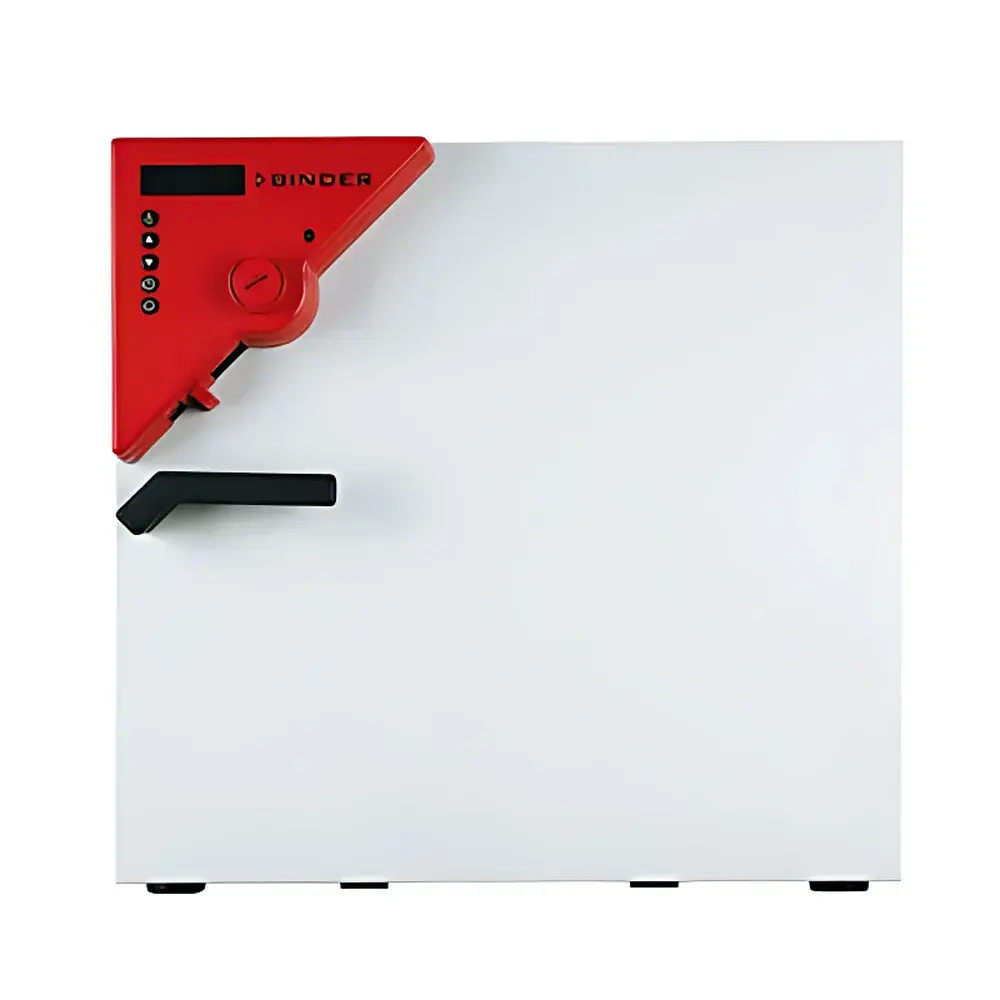
Binder ED, FD, FED & FP Series Precision Laboratory Drying Ovens
| Origin | Germany |
|---|---|
| Manufacturer Type | Authorized Distributor |
| Origin Category | Imported |
| Model Series | Binder ED, FD, FED, FP |
| Pricing | Available Upon Request |
| Chamber Volumes (ED) | 23 L, 53 L, 115 L, 240 L, 400 L, 720 L |
| Chamber Volumes (FD) | 23 L, 53 L, 115 L, 240 L |
| Chamber Volumes (FED/FP) | 53 L, 115 L, 240 L, 400 L, 720 L |
| Temperature Range (ED) | Ambient +5 °C to 300 °C |
| Temperature Control Accuracy (ED) | ±1 °C |
| Timer Range | 0–99 h |
| Safety Class | DIN 12880, Dual-Stage Independent Overtemperature Protection |
| Ventilation | Rear 50 mm exhaust duct + front adjustable air damper |
| Standard Interior | Chrome-plated wire shelves (2 pcs) |
Overview
The Binder ED, FD, FED, and FP Series represent a family of precision-engineered laboratory drying ovens designed for reproducible thermal processing in research, quality control, and production environments. These instruments operate on fundamental principles of convective heat transfer—either natural convection (ED) or forced convection via high-efficiency axial turbine systems (FD, FED, FP)—to achieve uniform temperature distribution, rapid thermal response, and long-term stability. Each series is constructed with Binder’s proprietary APT.Line™ preheating chamber technology, which thermally isolates the inner chamber from the outer housing to minimize thermal gradients and improve energy efficiency. The ovens comply with DIN 12880 for laboratory heating equipment safety and are engineered for continuous operation under GLP/GMP-aligned workflows, supporting traceable, auditable thermal protocols in regulated industries including pharmaceuticals, electronics, polymers, and materials science.
Key Features
- APT.Line™ preheating chamber architecture ensures minimal thermal lag and superior temperature homogeneity (±0.5 °C typical at 120 °C, per DIN 12880 validation)
- Forced-convection models (FD/FED/FP) integrate digitally controllable axial turbines with variable speed and directional airflow optimization for load-insensitive thermal uniformity—even at full capacity
- Dual-stage independent overtemperature protection (DIN 12880 Class 2), featuring visual and audible alarm outputs plus automatic heater cutoff
- Front-access adjustable air damper and rear 50 mm exhaust port enable precise ventilation control for moisture removal, solvent evaporation, or inert atmosphere purging
- DS digital controller (ED) or multifunctional programmable controller (FED/FP) with ramp-soak programming, user-defined heating profiles, and adjustable heating power modulation
- Stainless steel interior chamber with electropolished finish; corrosion-resistant chrome-plated wire shelving (standard configuration: 2 shelves)
- Compliance-ready design: supports 21 CFR Part 11–compatible data logging when integrated with optional Binder C-Control software and external validation hardware
Sample Compatibility & Compliance
The ED, FD, FED, and FP ovens accommodate a broad spectrum of sample types—including glassware, metal substrates, polymer films, ceramic wafers, electronic components, and pharmaceutical excipients—without compromising thermal integrity. Natural convection (ED) is optimal for delicate samples sensitive to airflow-induced oxidation or mechanical disturbance (e.g., calibration standards, reference materials). Forced-convection variants support accelerated drying, sterilization (160–180 °C dry-heat cycles per ISO 15883-5), and thermal aging per ASTM D573 and IEC 60068-2-1/2. All models meet CE marking requirements and conform to EN 61010-1 for electrical safety. Optional accessories—including inert gas inlets, humidity sensors, and calibrated PT100 probe ports—facilitate customization for ISO/IEC 17025-accredited laboratories and FDA-regulated manufacturing processes.
Software & Data Management
Binder’s C-Control software (optional) enables remote monitoring, real-time graphing, and secure audit-trail generation for temperature profiles, alarms, and operator actions—fully compliant with 21 CFR Part 11 when deployed with electronic signatures and role-based access control. Data export is supported in CSV and PDF formats for integration into LIMS or ELN platforms. For standalone operation, the FED and FP controllers store up to 10 user-defined programs with up to 16 segments each (ramp, soak, hold), including slope-controlled heating rates (0.1–10 °C/min) and dynamic power adjustment to prevent overshoot during low-thermal-mass transitions. All controllers retain settings after power interruption and feature password-protected parameter locking for SOP enforcement.
Applications
- Moisture content determination (ASTM D229, ISO 293)
- Dry-heat sterilization of glassware and stainless tools (USP , EN 554)
- Thermal curing of adhesives, coatings, and composite laminates
- Accelerated aging studies for packaging materials and elastomers
- Preconditioning of test specimens prior to tensile, impact, or dielectric testing
- Stabilization of reference standards and calibration artifacts
- Residual solvent removal in semiconductor wafer processing and PCB manufacturing
FAQ
What distinguishes the ED series from the FD, FED, and FP models?
The ED series relies on natural convection and is optimized for static thermal storage, gentle drying, and applications requiring minimal air movement. In contrast, FD/FED/FP employ forced convection with high-torque axial turbines, enabling faster heating, tighter uniformity, and greater process repeatability—especially under variable or heavy loading conditions.
Can these ovens be validated for GMP use?
Yes. With optional calibrated PT100 probes, IQ/OQ documentation packages, and C-Control software with 21 CFR Part 11 functionality, all series support formal qualification in pharmaceutical and medical device manufacturing environments.
Is inert atmosphere operation possible?
All models can be equipped with an optional inert gas inlet kit (N₂ or Ar), allowing controlled purge cycles and oxygen-free thermal processing for oxidation-sensitive materials.
How is temperature uniformity verified across chamber volumes?
Binder provides factory-generated temperature mapping reports per DIN 12880 Annex B, and users may perform periodic verification using NIST-traceable multi-point data loggers placed at defined geometric locations (center, corners, mid-height).
Are replacement shelves and interior liners available?
Yes. Stainless steel solid shelves, perforated trays, and custom-sized interior liners are available as OEM spare parts with documented material certifications (316L SS, RoHS-compliant finishes).



