
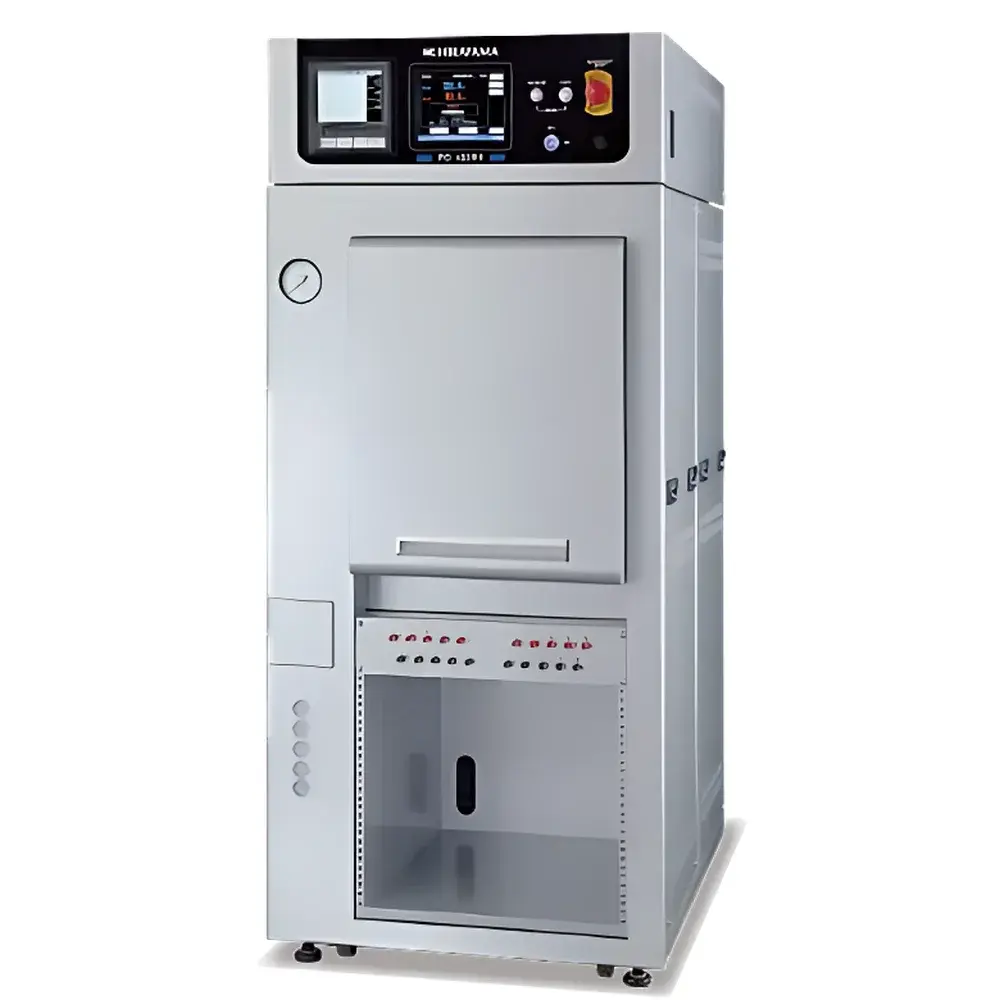
Hirayama PC-R9 Series High-Accelerated Stress Test (HAST) Chamber
| Brand | Hirayama |
|---|---|
| Origin | Japan |
| Model | PC-R9 Series (PC-304R9, PC-422R9, PC-304R9D, PC-422R9D) |
| Chamber Capacity | 304 L / 422 L |
| Dual-Chamber Configuration | Standard (Dual-Tank System) |
| Pressure Range | Up to 300 kPa (gauge) |
| Temperature Range | 105–130 °C |
| Humidity Range | 85–100 % RH |
| Control Method | PID-controlled steam saturation with real-time pressure/temperature/humidity feedback |
| Compliance | Designed per JIS C 60068-2-66, JEDEC JESD22-A110, MIL-STD-202G Method 108, and IEC 60068-2-66 |
| Interface | RS-485, Ethernet (Modbus TCP), optional USB and SD card slot for data logging |
Overview
The Hirayama PC-R9 Series High-Accelerated Stress Test (HAST) Chamber is an engineered environmental stress screening system designed to replicate and accelerate failure mechanisms associated with moisture ingress and thermal stress in hermetically sealed and surface-mount electronic components. Unlike conventional temperature-humidity storage tests, HAST applies elevated temperature, high relative humidity, and controlled overpressure—typically 105–130 °C, ≥85 % RH, and up to 300 kPa (gauge)—to significantly reduce test duration while maintaining physical correlation with real-world field failures such as corrosion, electrochemical migration (ECM), intermetallic growth, and die-attach degradation. The system operates on saturated steam dynamics within a dual-tank architecture: one chamber serves as the test environment, while the second functions as a dedicated steam generator and condensate management reservoir—enabling rapid stabilization, minimized air entrapment, and precise control of partial pressure gradients critical for reproducible ECM acceleration.
Key Features
- Dual-chamber (dual-tank) configuration ensures stable steam saturation, eliminates residual air pockets, and supports repeatable pressure ramping profiles per JEDEC JESD22-A110 requirements.
- Full-color capacitive touchscreen interface with intuitive navigation, multilingual support (English, Japanese, Chinese), and embedded application-level remote operation via Ethernet or optional Wi-Fi module.
- Three configurable operating modes: Standard HAST (static pressure), Dynamic HAST (cyclic pressure ramping), and Preconditioning Mode (low-pressure humidification prior to pressurization).
- Integrated automatic condensate drainage system with cooling water tank and self-priming pump—designed to maintain consistent chamber dew point and prevent water accumulation on DUT surfaces.
- Onboard programmable logic controller (PLC) enables full sequence automation: pre-heat, pressurization, dwell, depressurization, and post-test purge—all with adjustable ramp rates and hold tolerances.
- External storage support (SD card or USB drive) for secure archival of test logs, parameter histories, alarm events, and user-defined programs—each timestamped and checksum-verified.
- Standard communication interfaces include RS-485 (Modbus RTU) and Ethernet (Modbus TCP), enabling integration into centralized lab management systems (LMS) or MES platforms for audit-ready traceability.
Sample Compatibility & Compliance
The PC-R9 Series accommodates a broad range of electronic assemblies, including printed circuit boards (PCBs), ball grid arrays (BGAs), quad flat no-leads (QFNs), wafer-level chip-scale packages (WLCSP), and automotive-grade modules. Its chamber geometry and internal airflow design minimize thermal stratification and ensure uniform exposure across heterogeneous board layouts. All models are constructed with SUS316L stainless steel chambers and fluoropolymer-sealed gaskets to resist acidic condensate corrosion during prolonged high-humidity operation. The system is configured and validated to meet international qualification standards including JIS C 60068-2-66 (HAST method), JEDEC JESD22-A110E (accelerated moisture resistance testing), MIL-STD-202G Method 108 (moisture resistance), and IEC 60068-2-66. Optional calibration certificates (NIST-traceable sensors) and IQ/OQ documentation packages are available for GLP/GMP-regulated environments requiring FDA 21 CFR Part 11-compliant electronic records.
Software & Data Management
Hirayama’s proprietary HASTControl™ software (v3.2+) provides local and remote supervision through Windows-based desktop clients or web-browser access (HTTPS). It supports real-time multi-parameter visualization (temperature, pressure, RH, elapsed time), configurable alarm thresholds with email/SMS notification (via SMTP gateway), and automated report generation in PDF/CSV formats compliant with ISO/IEC 17025 reporting guidelines. All data entries—including operator ID, program name, start/stop timestamps, deviation flags, and sensor calibration status—are cryptographically signed and stored with immutable audit trails. Data export adheres to ASTM E2500-13 Annex A3 for analytical instrument data integrity, supporting retrospective analysis and regulatory submission readiness.
Applications
- Qualification testing of lead-free solder joints and Cu–Sn intermetallic formation kinetics under accelerated humidity stress.
- Evaluation of conformal coating efficacy against dendritic growth and leakage current development on HDI PCBs.
- Reliability screening of power semiconductor modules used in EV inverters and industrial motor drives.
- Failure mode analysis (FMA) of MEMS sensors exposed to cyclic thermal-moisture loading in automotive ADAS systems.
- Process validation for plasma-enhanced atomic layer deposition (PE-ALD) barrier layers in advanced packaging.
FAQ
What distinguishes HAST from standard THB (Temperature-Humidity-Bias) testing?
HAST replaces ambient-pressure humidification with pressurized saturated steam, reducing test time by up to 10× while preserving failure physics fidelity—particularly for latent defects related to moisture diffusion through mold compound or underfill.
Is the PC-R9 Series suitable for testing non-hermetic plastic-encapsulated microcircuits (PEMs)?
Yes; the system’s precise control of partial water vapor pressure (up to 300 kPa gauge) enables accelerated evaluation of moisture-induced failures in PEMs without requiring hermetic sealing—provided test protocols align with JEDEC JESD22-A110E Annex B guidance.
Can test programs be exported and shared between multiple PC-R9 units?
Yes; all programs, including step definitions, sensor setpoints, and dwell durations, are saved in a vendor-neutral XML schema and fully interoperable across PC-R9 Series instruments regardless of firmware revision.
Related Products



