
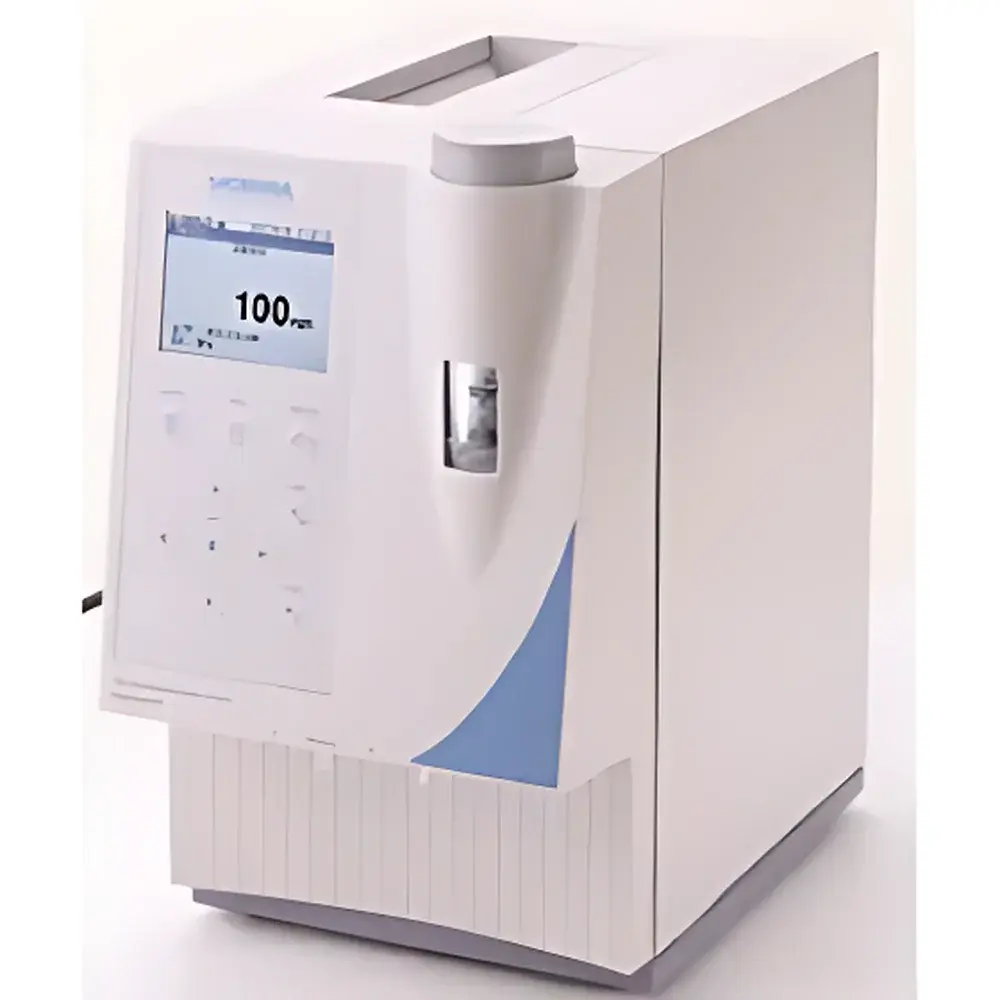
HORIBA OCMA-500 Oil Content Analyzer
| Brand | HORIBA |
|---|---|
| Origin | Japan |
| Model | OCMA-500 |
| Measurement Units | mg/kg, mg/g, mg/PC |
| Solvent Consumption per Extraction | 2 mL less than OCMA-300 |
| Sample Volume per Test | 4 mL less than OCMA-300 |
| Extraction Vessel | Backlit glass chamber |
| Data Storage Capacity | >50 records |
| Interface | RS-232, USB |
| Display | 3.5-inch backlit color LCD (320 × 240 resolution) |
| Power Input | 100 VAC / 60 VA or 240 VAC / 90 VA |
| Standard Accessories | Water-separating filter (Ø40 mm, 5 pcs), PE transfer pipettes (2.5 mL, 5 pcs), 220 V power cord (1 pc), 10 mL heavy oil vial, 25 µL micro-syringe, OCMA-500 user manual |
Overview
The HORIBA OCMA-500 Oil Content Analyzer is a benchtop infrared (IR) spectrophotometric instrument engineered for precise, routine quantification of total hydrocarbon content in aqueous and solid-phase environmental and industrial samples. Based on the principle of infrared absorption at the characteristic C–H stretching band near 2930 cm⁻¹, the OCMA-500 delivers trace-level oil-in-water and oil-in-soil measurements in compliance with standardized methodologies including EPA Method 1664A, ISO 9377-2, and JIS K 0102. Unlike gravimetric or UV-based alternatives, the OCMA-500 eliminates interferences from natural organic matter and suspended solids through selective solvent extraction followed by IR detection—ensuring high specificity, reproducibility, and minimal matrix effects across wastewater, cooling water, bilge water, soil leachates, and industrial process streams.
Key Features
- Multi-unit reporting capability: Direct readout in mg/kg, mg/g, and mg/PC—enabling seamless alignment with regulatory reporting requirements across environmental monitoring, petrochemical QA/QC, and manufacturing compliance protocols.
- Optimized reagent economy: Reduced solvent consumption (2 mL less per extraction vs. OCMA-300) and smaller sample volume requirement (4 mL less per analysis) lower operational costs and minimize hazardous waste generation—supporting ISO 14001-aligned laboratory sustainability goals.
- Backlit extraction chamber: Precision-machined borosilicate glass vessel with uniform edge illumination enhances visual confirmation of phase separation and emulsion stability during n-hexane (or alternative EPA-approved solvent) extraction—critical for method validation and operator training.
- Enhanced human-machine interface: 3.5-inch color TFT-LCD (320 × 240 px) provides high-contrast visualization of real-time spectra, calibration curves, and pass/fail status indicators—even under ambient laboratory lighting conditions.
- Energy-efficient architecture: Dual-voltage power supply (100 VAC / 60 VA or 240 VAC / 90 VA) supports global deployment without external transformers; thermal management ensures stable detector response over extended run times.
- Dual communication interface: RS-232 legacy compatibility coexists with native USB 2.0 connectivity—facilitating direct data export to LIMS, Excel, or validated analytical software suites compliant with FDA 21 CFR Part 11 audit trail requirements.
Sample Compatibility & Compliance
The OCMA-500 accommodates liquid matrices (e.g., wastewater, coolant, condensate) and solid-phase samples (soil, sludge, filter media) following standard solvent extraction procedures per ASTM D7066 or ISO 16703. Its optical path design and spectral algorithm are validated for linear dynamic range up to 100 mg/L oil-equivalent in water and up to 10,000 mg/kg in dried soil. Instrument performance meets GLP documentation standards, and all calibration, verification, and maintenance activities are traceable via internal timestamped logs. The system supports IQ/OQ/PQ documentation packages for regulated environments requiring GMP or ISO/IEC 17025 accreditation.
Software & Data Management
Onboard firmware enables full method storage, multi-point calibration curve generation (linear or quadratic), blank subtraction, and automatic dilution factor application. Internal memory retains ≥50 test records with full metadata: date/time stamp, operator ID (via optional keypad input), sample ID, unit selection, raw absorbance values, and calculated concentration. USB export generates CSV files compatible with statistical process control (SPC) platforms and automated report generation tools. When integrated into networked lab infrastructures, the OCMA-500 supports secure data forwarding to centralized databases with configurable encryption and access controls—meeting HIPAA and GDPR data integrity prerequisites where applicable.
Applications
- Environmental compliance testing: Effluent discharge monitoring per NPDES permits, landfill leachate screening, and stormwater runoff assessment.
- Industrial hygiene: Detection of hydrocarbon contamination in metalworking fluids, transformer oils, and hydraulic systems.
- Wastewater treatment optimization: Real-time tracking of oil removal efficiency across API separators, coalescers, and dissolved air flotation units.
- Soil remediation verification: Quantitative post-excavation analysis of excavated soils prior to off-site disposal or on-site reuse.
- Pharmaceutical facility environmental monitoring: Detection of lubricant residues in HVAC condensate or cleanroom utility water systems.
FAQ
What extraction solvents are compatible with the OCMA-500?
n-Hexane is the primary solvent specified in EPA 1664A; alternatives such as cyclohexane or Freon substitutes may be used if validated per ISO 9377-2 Annex B.
Can the OCMA-500 be calibrated using certified reference materials?
Yes—NIST-traceable mineral oil standards (e.g., AccuStandard OIL-1000) are recommended for initial calibration and periodic verification.
Is method validation support available from HORIBA?
HORIBA provides application notes, IQ/OQ templates, and technical bulletins aligned with ISO/IEC 17025 clause 7.2 and USP Analytical Instrument Qualification guidelines.
Does the OCMA-500 meet FDA 21 CFR Part 11 requirements?
While the instrument itself does not include electronic signature functionality, its USB data export and audit-ready logging support integration into Part 11-compliant LIMS environments when paired with appropriate access control and electronic record policies.
How often should the water-separating filter be replaced?
Filter replacement is recommended after every 10 extractions or immediately upon visible saturation—whichever occurs first—to maintain consistent phase separation efficiency.







