
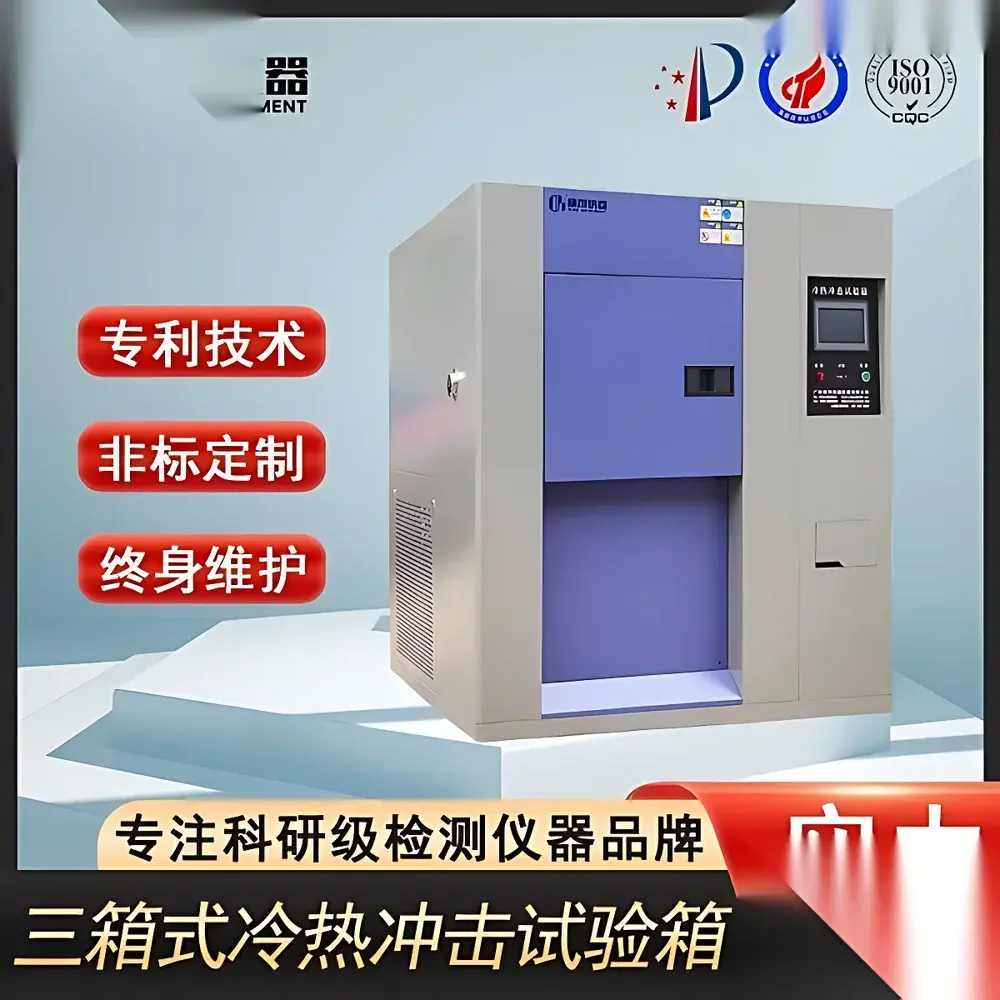
Tri-Stage Thermal Shock Test Chamber
| Brand | Other Brands |
|---|---|
| Origin | Imported |
| Manufacturer Type | General Distributor |
| Price | USD 11,200 (FOB) |
| Power Supply | AC 380 V ±10%, 50/60 Hz |
| Refrigerants | R404A & R23 (EPA-approved) |
| Compressor | Tecumseh or Copeland High-Performance Hermetic Units |
| Cooling System | Dual-Stage Cascade Mechanical Refrigeration with Water-Cooled Condenser |
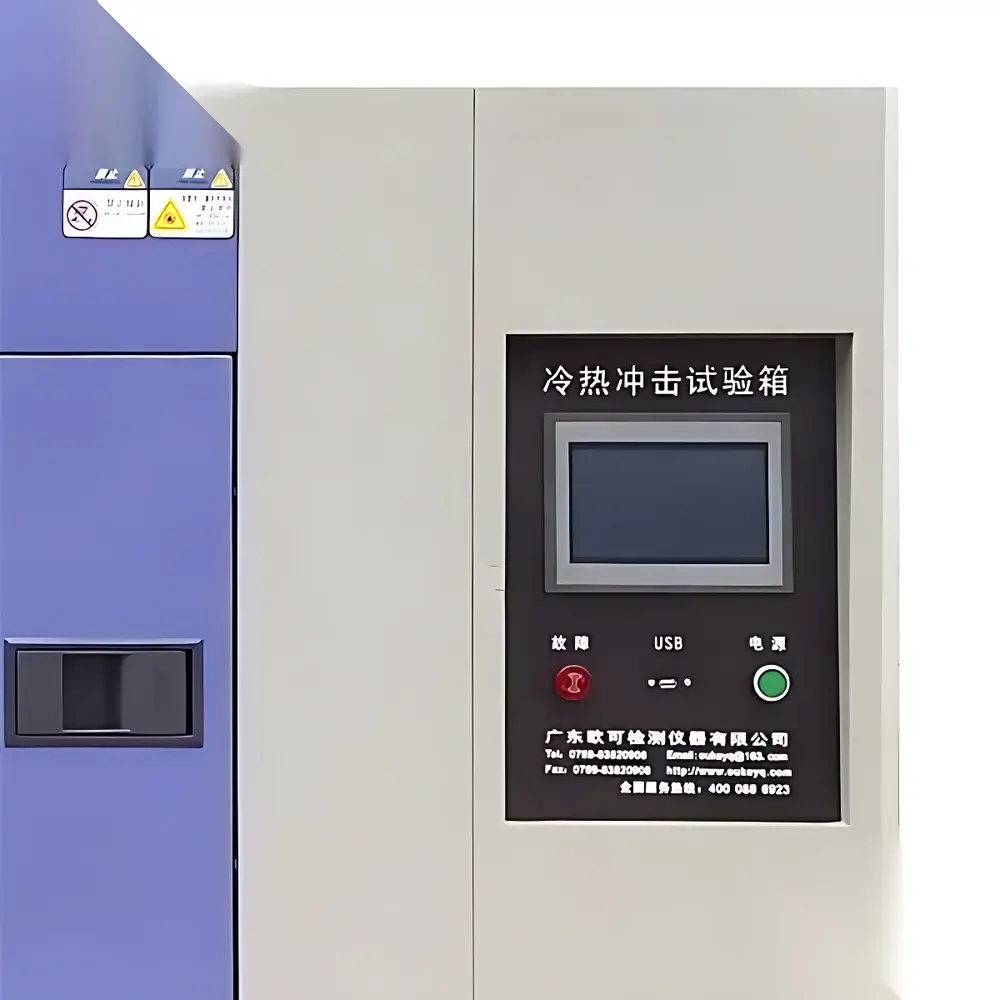
| Temperature Control | Touchscreen LCD Controller with RS232 Interface |
| Compliance | GB/T 2423.1–1989 (Test A), GB/T 2423.2–1989 (Test B), IEC 60068-2-1, MIL-STD-2164A, GJB 1032–1990, GJB 234–1985 |
Overview
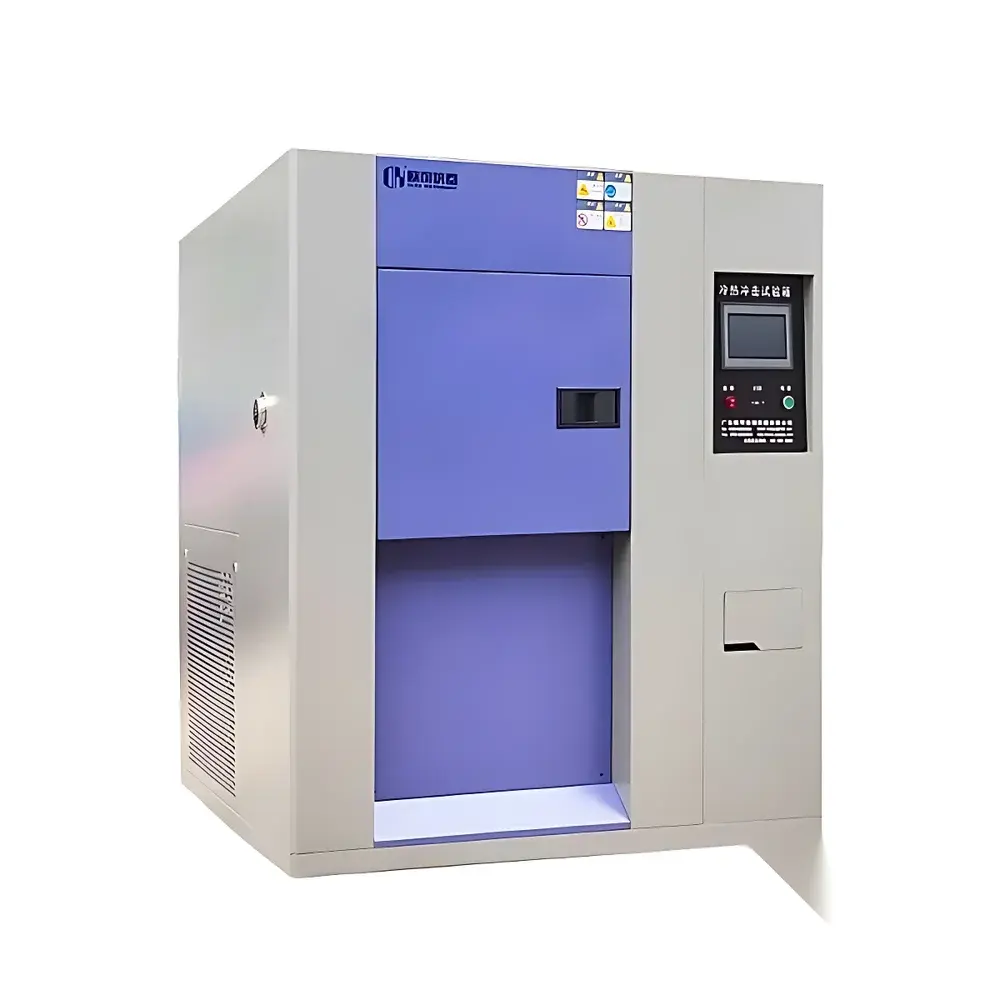
The Tri-Stage Thermal Shock Test Chamber is an engineered environmental stress screening (ESS) system designed to evaluate product reliability under rapid, extreme temperature transitions between high-temperature, low-temperature, and ambient zones. Unlike single- or dual-chamber thermal shock systems, this tri-compartment architecture physically isolates hot, cold, and transfer zones—eliminating thermal cross-contamination and enabling precise, repeatable shock profiles with transition times as fast as 10 seconds between extremes. It operates on the principle of forced air convection combined with cascade refrigeration to achieve stable setpoints across a wide operational range (typically −70 °C to +180 °C). The chamber is calibrated for traceable thermal uniformity (±2 °C per IEC 60068-3-5) and is widely deployed in qualification testing for electronic assemblies, automotive ECUs, aerospace components, polymer-based enclosures, and optoelectronic modules where thermal expansion mismatch and interfacial delamination are critical failure modes.
Key Features
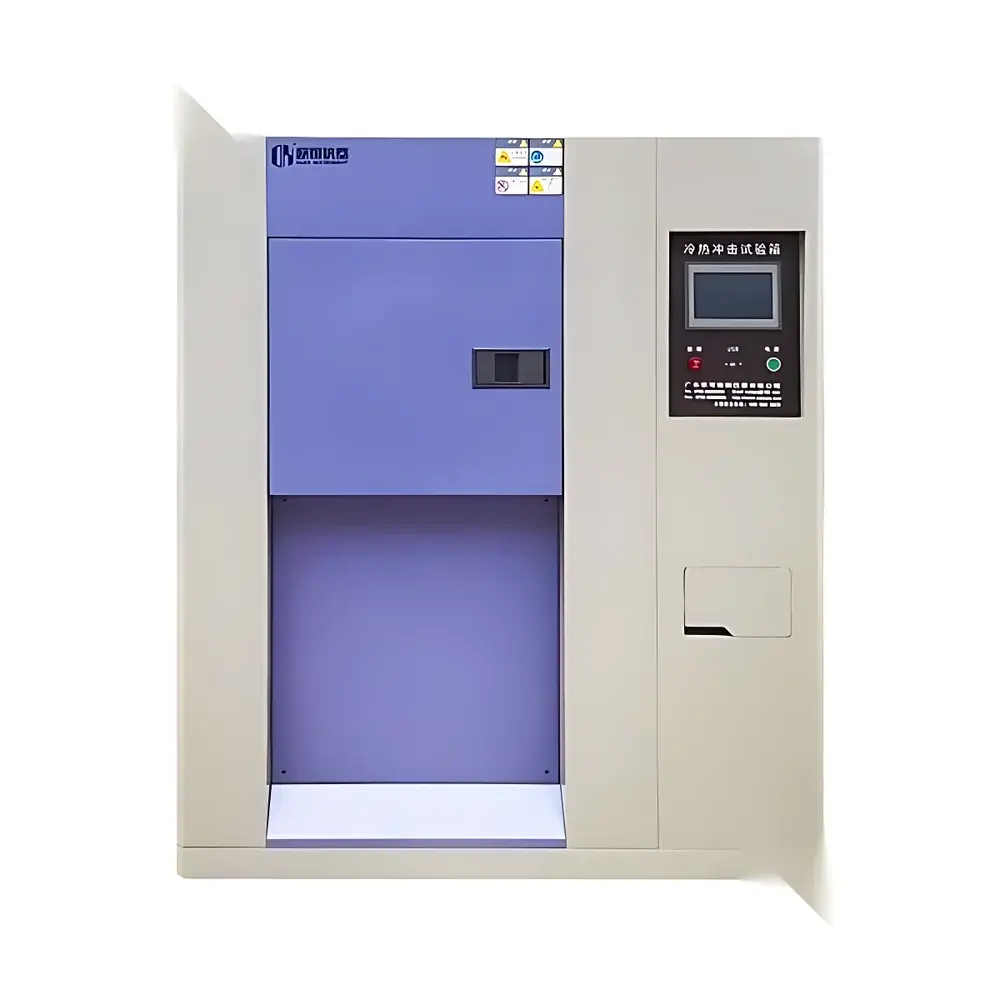
- Three physically segregated chambers: high-temperature zone (up to +180 °C), low-temperature zone (down to −70 °C), and neutral transfer zone—ensuring zero thermal carryover during specimen transfer.
- Dual-stage cascade refrigeration system using environmentally compliant R404A (high-stage) and R23 (low-stage) refrigerants, integrated with water-cooled condensers for stable heat rejection under continuous duty cycles.
- Touchscreen LCD controller with intuitive graphical interface, real-time trend logging, and programmable multi-step thermal shock profiles—including dwell time, ramp rate, cycle count, and automatic recovery sequences.
- RS232 serial communication port supporting bi-directional data exchange with external PCs or data acquisition systems; compatible with standard SCPI command sets for automated test integration.
- Full-capillary automatic capacity modulation system—dynamically adjusts refrigerant flow based on thermal load without mechanical valves—enhancing energy efficiency and long-term compressor reliability.
- Structural insulation: 150 mm thick polyurethane foam with high-density closed-cell structure (thermal conductivity ≤0.022 W/m·K) and seamless welded inner chamber walls to prevent condensation-induced corrosion.
Sample Compatibility & Compliance
This chamber accommodates specimens up to 500 mm × 500 mm × 500 mm (W×D×H) with standardized mounting rails and optional load trays. It supports both powered and unpowered device-under-test (DUT) configurations, with provision for external power feedthroughs and sensor cable ports. All operational parameters—including temperature deviation, uniformity, and transition time—are validated per IEC 60068-3-5 and ISO/IEC 17025-accredited procedures. The system meets the technical requirements of MIL-STD-2164A (Environmental Stress Screening of Electronic Equipment), GJB 1032–1990 (Chinese military ESS standard), and GB/T 2423.1–1989 / GB/T 2423.2–1989 (national equivalents of IEC 60068-2-1 and -2-2). Full calibration certificates and uncertainty budgets are provided upon delivery, supporting GLP-compliant test documentation and audit readiness.
Software & Data Management
The embedded controller firmware includes built-in data logging at user-selectable intervals (1 s to 60 min), storing up to 10,000 hours of timestamped temperature history per channel. Export formats include CSV and Excel-compatible .xls files via USB or RS232. Optional PC-based software enables remote monitoring, alarm notification (email/SMS via gateway), and compliance reporting aligned with FDA 21 CFR Part 11 requirements—including electronic signatures, audit trails, and role-based access control. Raw data archives retain full metadata (operator ID, test plan version, chamber serial number, calibration status), facilitating traceability across product lifecycle stages from design validation to production lot release.
Applications
- Accelerated life testing of solder joints, conformal coatings, and PCB laminates under repeated thermal cycling.
- Qualification of automotive sensors and infotainment modules per AEC-Q200 and ISO 16750-4.
- Reliability assessment of lithium-ion battery packs and thermal interface materials (TIMs).
- Validation of hermetic seals in MEMS devices and medical electronics exposed to sterilization cycles.
- Material compatibility screening for elastomers, thermoplastics, and composite adhesives used in avionics enclosures.
- Environmental stress screening (ESS) in high-reliability manufacturing lines, including burn-in and HALT precursor protocols.
FAQ
What is the typical temperature transition time between chambers?
Transition time from +150 °C to −65 °C (or vice versa) is ≤15 seconds for unloaded chambers per IEC 60068-2-14, verified with NIST-traceable surface thermocouples.
Can the chamber be integrated into an automated test cell?
Yes—RS232 interface supports SCPI commands for start/stop, setpoint adjustment, status polling, and fault reset; optional Ethernet/IP or Modbus TCP modules available for factory automation systems.
Is calibration traceable to national standards?
All temperature sensors are calibrated against PT100 reference probes certified to ISO/IEC 17025 by an ILAC-accredited laboratory; full calibration report with measurement uncertainty included.
What maintenance is required for the cascade refrigeration system?
Annual preventive maintenance includes oil analysis, refrigerant purity verification, condenser coil cleaning, and controller firmware update—no routine refrigerant topping required under normal operation.
Does the system support custom test profiles beyond standard MIL or IEC methods?
Yes—the controller allows creation of user-defined multi-zone profiles with variable dwell times, non-linear ramps, conditional branching, and pass/fail logic triggers based on real-time sensor feedback.



