
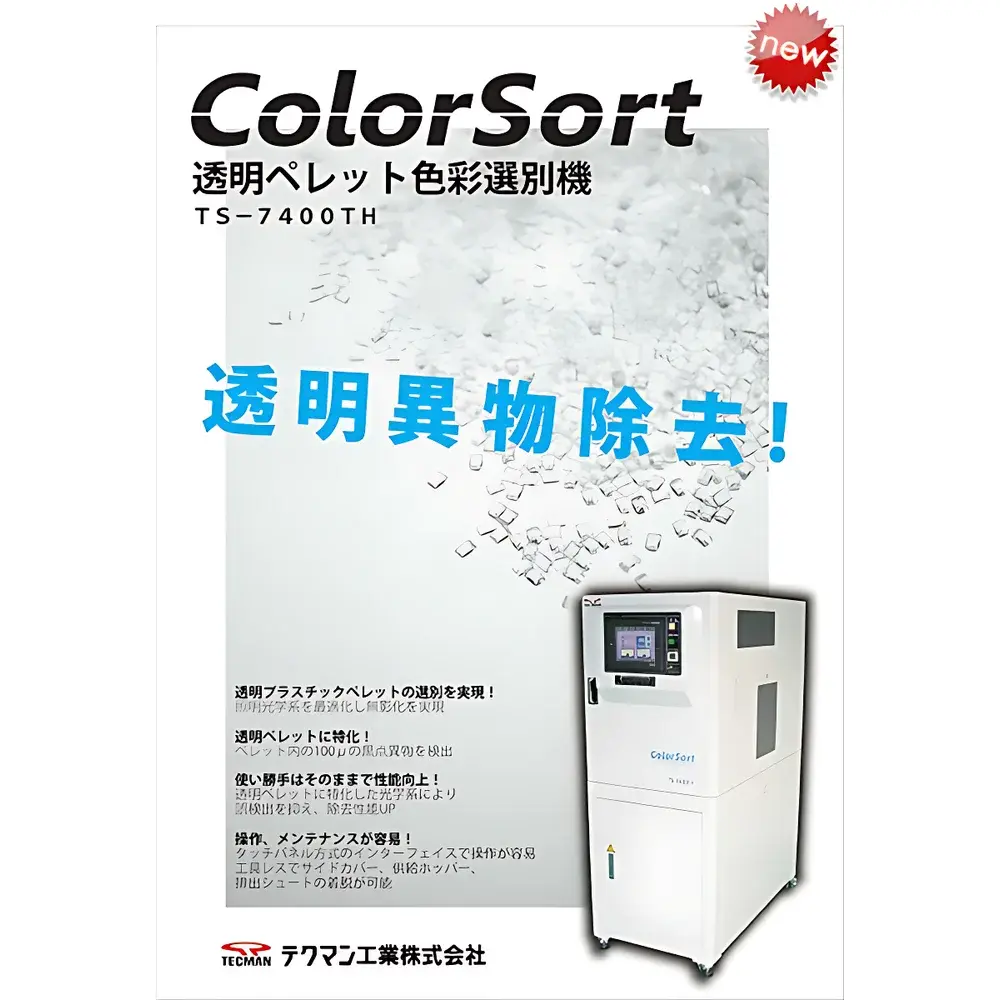
TECMAN TS-7400TH Transparent Resin Pellet Color Sorting Machine
| Origin | Japan |
|---|---|
| Manufacturer Type | Authorized Distributor |
| Origin Category | Imported |
| Model | TS-7400TH |
| Price Range | USD 42,000 – 70,000 |
| Power Supply | Single-phase AC 200 V |
| Dimensions (W×D×H) | 600 mm × 1120 mm × 1560 mm |
| Weight | 270 kg |
| Throughput | Up to 1000 kg/hr |
| Detection Capability | Sub-100 µm black specks in transparent pellets |
| Illumination | Spherical LED lighting system |
| Camera Type | Linear CCD monochrome camera |
| Pixel Count | 7400 pixels |
| Minimum Resolvable Feature Size | 40 µm |
| Feed System | Vibratory feeder |
| Transport System | Drum-type conveyor |
| Separation Mechanism | Velocity-differential ejection via feed drum coordination |
| Ejection | 16-channel solenoid valves |
| Human-Machine Interface | 8.4-inch color touch panel |
| Optional | PC-based monitoring and data logging system |
Overview
The TECMAN TS-7400TH Transparent Resin Pellet Color Sorting Machine is an industrial-grade optical sorting system engineered specifically for high-precision defect detection and color classification of optically transparent thermoplastic pellets—including polycarbonate (PC), polymethyl methacrylate (PMMA), cyclic olefin copolymer (COC), and other amorphous transparent resins. Unlike conventional color sorters optimized for opaque or semi-crystalline materials, the TS-7400TH employs a proprietary illumination architecture based on spherical LED arrays that eliminate shadowing and specular glare—critical for achieving uniform light penetration through low-scattering, high-transmittance substrates. Its core measurement principle relies on high-resolution linear CCD imaging combined with multi-spectral reflectance and transmission analysis under controlled, collimated illumination. This enables reliable discrimination of sub-100 µm black specks, gel particles, carbonized residues, and subtle chromatic deviations—even within fully transparent matrixes where conventional RGB thresholding fails. Designed for integration into continuous polymer compounding, pelletizing, and packaging lines, the TS-7400TH operates under ISO 9001–certified manufacturing protocols and complies with IEC 61000-6-2/6-4 electromagnetic compatibility standards.
Key Features
- Patented spherical LED illumination system eliminating parallax-induced shadows and enabling uniform trans-illumination of transparent pellets
- 7400-pixel linear monochrome CCD sensor with 40 µm effective spatial resolution—optimized for high-speed, high-fidelity grayscale contrast analysis
- Velocity-differential separation mechanism using synchronized vibratory feed and rotating drum transport—ensuring stable pellet orientation and consistent dwell time in the inspection zone
- 16-channel high-speed solenoid valve ejection array with <5 ms response time and programmable pulse width modulation for precise particle rejection
- 8.4-inch industrial-grade color touch HMI supporting multi-language interface (English, Japanese, Chinese), real-time throughput monitoring, and alarm logging
- Rugged mechanical construction: stainless-steel frame, IP54-rated enclosure, and vibration-damped base—designed for 24/7 operation in ambient temperatures from 5°C to 40°C
Sample Compatibility & Compliance
The TS-7400TH is validated for use with standard pellet geometries (3–5 mm cylindrical or spherical) across major transparent engineering resins. It supports ASTM D1603 (carbon black content), ISO 18064 (plastic pellet quality assessment), and internal QC specifications aligned with automotive-grade resin standards (e.g., ISO/TS 16949). The system’s optical calibration protocol conforms to NIST-traceable photometric reference standards. All firmware and operational logs comply with GLP audit requirements—including timestamped event records, user access control, and non-erasable history storage. Optional PC-based monitoring supports FDA 21 CFR Part 11-compliant electronic signatures and audit trails when deployed in regulated pharmaceutical excipient or medical-grade polymer production environments.
Software & Data Management
The embedded control software provides real-time image acquisition, adaptive threshold segmentation, and multi-parameter defect classification (size, contrast ratio, shape factor, edge gradient). Users define pass/fail criteria via intuitive drag-and-drop ROI tools and store up to 200 recipe profiles with version timestamps. All sorting decisions are logged with metadata: timestamp, pellet count, reject count, cumulative yield, and raw image thumbnails (stored locally on SD card or optionally streamed to network-attached storage). The optional PC monitoring package adds remote diagnostics, OEE analytics, CSV/Excel export, and integration with MES platforms via Modbus TCP or OPC UA. Firmware updates are delivered via secure HTTPS with SHA-256 signature verification.
Applications
- Final quality assurance of transparent PC and PMMA pellets prior to injection molding—detecting black specks, gels, and oxidation-induced yellowing
- Recycled transparent resin streams where contamination from mixed-color regrind must be removed without compromising clarity
- Medical-grade polymer batches requiring compliance with USP extractables testing prerequisites—sorting out particulate defects before extrusion
- Optical lens preform production lines where sub-50 µm inclusion limits are mandated by ISO 10110-7
- Automotive lighting module suppliers verifying absence of micro-defects in headlamp lens resin pellets per OEM PPAP submission requirements
FAQ
What types of transparent resins are compatible with the TS-7400TH?
The system is validated for polycarbonate (PC), polymethyl methacrylate (PMMA), cyclic olefin copolymer (COC), polyethylene terephthalate glycol (PETG), and transparent polypropylene (TPP) pellets with refractive indices between 1.49 and 1.59.
Can the TS-7400TH detect color variations—not just black specks?
Yes—while optimized for high-contrast black-in-clear detection, the monochrome CCD system supports grayscale intensity mapping calibrated against master reference pellets; optional spectral enhancement modules enable limited hue differentiation via multi-angle illumination analysis.
Is the system compliant with FDA or EU MDR requirements for medical polymer processing?
The base unit meets CE Machinery Directive 2006/42/EC and EMC Directive 2014/30/EU; full 21 CFR Part 11 and MDR Annex I compliance requires optional PC monitoring license and documented IQ/OQ/PQ validation support—available upon request.
What maintenance intervals are recommended for long-term stability?
Daily visual inspection of feed chute and ejection nozzles; quarterly recalibration of illumination intensity and camera gain using certified neutral density targets; annual full optical alignment verification by TECMAN-certified field service engineers.
How does throughput vary with pellet size and moisture content?
Rated 1000 kg/hr assumes dry, 4 mm cylindrical pellets at ≤0.02% surface moisture; throughput decreases by ~12% per 0.1 mm reduction in average diameter and ~8% per 0.05% increase in moisture above specification.




