
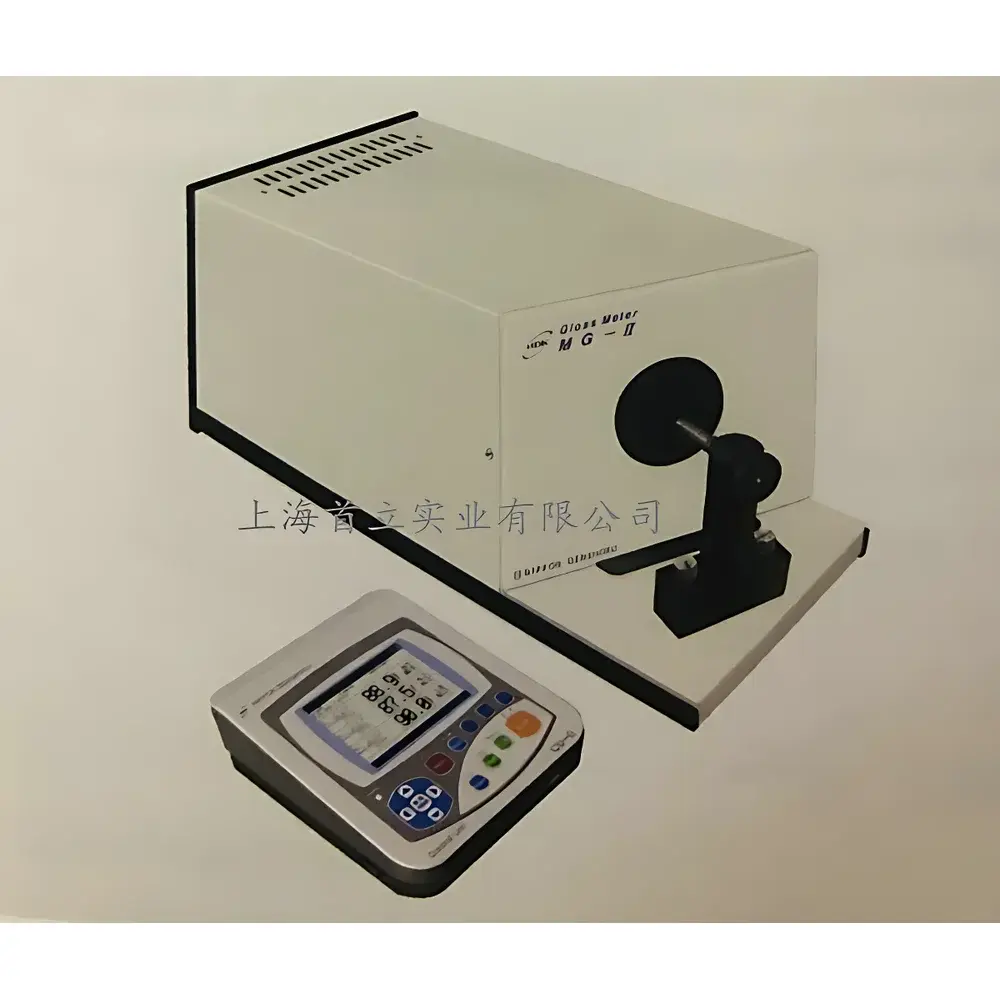
NIPPON DENSHOKU MG-II 7000 Indirect Specular Reflectometer
| Brand | NIPPON DENSHOKU |
|---|---|
| Origin | Japan |
| Model | MG-II 7000 |
| Illumination Angle | 25° |
| Receiving Method | Integrating Sphere |
| Reflectance Range | 0.0–100.0% |
| Light Source | Halogen Lamp (5 V, 9 W) or Optional White LED |
| Measurement Time | Approx. 1 s |
| Aperture Diameter | Φ40 mm |
| Reflectance Repeatability | Standard Deviation ≤ 0.1% (10 measurements within 10 s) |
| Displayed Parameters | Reflectance (%), ΔReflectance |
| Compliance | ISO 5740 |
| Power Supply | 100 V AC, 50/60 Hz |
| Power Consumption | 40 VA (Optical Unit), 26 VA (Measurement Unit) |
| Dimensions & Weight | Optical Unit — 463 × 325 × 500 mm, 12 kg |
| Optional | Data Transfer Software |
Overview
The NIPPON DENSHOKU MG-II 7000 Indirect Specular Reflectometer is a precision optical instrument engineered for the quantitative assessment of specular reflectance in mirror-finished and highly reflective surfaces. Unlike direct-angle reflectometers, the MG-II 7000 implements an indirect measurement methodology defined in ISO 5740—specifically developed for automotive rearview mirrors—where reflectance is determined via calibrated luminance comparison between the test sample and a reference standard under controlled geometric illumination (25° incident angle) and diffuse-integrated detection. This approach eliminates dependency on absolute photometric calibration while ensuring high reproducibility across production-grade mirror substrates including electroplated metals, polished stainless steel, aluminized glass, convex safety mirrors, and coated optical polymers. The system’s dual-unit architecture—comprising a dedicated optical unit housing the stabilized halogen light source and integrating sphere detector, and a separate measurement unit with intuitive front-panel interface—ensures thermal and mechanical isolation critical for long-term photometric stability.
Key Features
- ISO 5740-compliant indirect specular reflectance measurement protocol optimized for automotive mirror certification and QC workflows
- Dual-unit modular design enhances operational flexibility and minimizes thermal crosstalk between illumination and signal processing subsystems
- Standard 5 V, 9 W halogen lamp provides stable spectral output in the visible range (380–780 nm); optional white LED source available for extended lifetime and reduced heat load
- Φ40 mm measurement aperture accommodates standard mirror specimens and curved surface geometries without edge diffraction artifacts
- Single-button operation enables rapid pass/fail verification: sample placement → press START → reflectance value displayed in ≤1 second
- High repeatability performance: standard deviation ≤0.1% across ten consecutive readings (within 10 s), verified per ISO 5740 Annex B
- Integrated ΔReflectance calculation supports comparative analysis between batch samples or pre/post-treatment evaluations
Sample Compatibility & Compliance
The MG-II 7000 is validated for use with planar and moderately curved mirror surfaces exhibiting specular-dominant reflection characteristics. Compatible sample types include chromium- or silver-plated glass, vacuum-metallized acrylic mirrors, electropolished aluminum panels, and thermally tempered convex rearview assemblies. All measurements adhere strictly to the geometric and photometric requirements of ISO 5740:2002 “Road vehicles — Rear-view mirrors — Photometric performance and test methods”, particularly Clause 5.2 (indirect method using integrating sphere detection). While not intended for diffuse or semi-specular materials (e.g., painted surfaces, matte finishes), the instrument may be employed in R&D environments for correlating specular reflectance with coating thickness or surface roughness (Ra < 0.05 µm) when referenced against traceable NIST-traceable standards. No regulatory certification (e.g., FDA, CE) applies to this class of industrial metrology equipment; however, its documented repeatability and ISO-aligned methodology support GLP-compliant quality records in Tier-1 automotive supply chains.
Software & Data Management
An optional PC-based data transfer software package enables bidirectional communication with the MG-II 7000 via RS-232 interface. The software logs timestamped reflectance values, calculates statistical summaries (mean, SD, min/max), exports CSV-formatted reports compatible with LIMS and SPC platforms, and supports user-defined pass/fail thresholds with visual alert indicators. Audit trail functionality includes operator ID tagging, firmware version stamping, and configuration change logging—features aligned with internal quality system requirements for ISO 9001:2015 clause 7.1.5.2 (Measurement traceability) and IATF 16949:2016 clause 8.5.1.5 (Control of monitoring and measuring resources). Raw data files retain full metadata including ambient temperature, measurement duration, and source mode (halogen/LED), facilitating retrospective root-cause analysis during process validation or nonconformance investigations.
Applications
- Final inspection of OEM and aftermarket automotive rearview mirrors prior to shipment
- In-process verification of electroplating bath consistency in mirror substrate manufacturing
- Quality assurance of polished metal components used in architectural glazing and medical device housings
- Reflectance trending studies during accelerated aging tests (e.g., UV exposure, humidity cycling)
- Calibration verification of reference mirrors used in optical alignment laboratories
- Supplier qualification audits requiring objective, standardized reflectance metrics per ISO 5740
FAQ
What standards does the MG-II 7000 comply with?
The instrument implements the indirect specular reflectance methodology specified in ISO 5740:2002 and is routinely used to verify conformance to that standard’s acceptance criteria.
Can the MG-II 7000 measure non-planar mirrors?
Yes—it accommodates convex and concave rearview mirrors within typical automotive curvature ranges, provided the measurement aperture fully covers a locally flat region ≥Φ40 mm.
Is the halogen lamp replaceable by the user?
Yes; lamp replacement is a field-serviceable procedure requiring only standard screwdriver tools and adherence to the maintenance schedule outlined in the operator manual.
Does the system support GMP or 21 CFR Part 11 compliance?
The base hardware does not include electronic signature or audit trail capabilities; however, the optional software package provides configurable audit logging suitable for regulated environments when deployed with appropriate procedural controls.
What is the recommended calibration frequency?
NIPPON DENSHOKU recommends annual calibration using certified reference mirrors traceable to national metrology institutes; interim verification using a stable in-house reference sample is advised before each shift.



