Keebio Blot1000 Universal Fast Protein Transfer System
| Brand | Keebio |
|---|---|
| Origin | Shanghai, China |
| Manufacturer Type | Authorized Distributor |
| Country of Origin | China |
| Model | Keebio-Blot1000 |
| Instrument Type | Semi-Dry Electrophoretic Transfer Apparatus |
| Electrophoresis Chamber | Integrated Dual-Compartment Transfer Cassette |
| Gel Format Compatibility | 1–4 × 70 × 85 mm gels or 1–2 × 135 × 85 mm gels |
| Voltage Range | 0–25 V (1 V increments) |
| Current Range | 0–2.5 A (0.1 A increments) |
| Dimensions (W×D×H) | 290 × 250 × 235 mm |
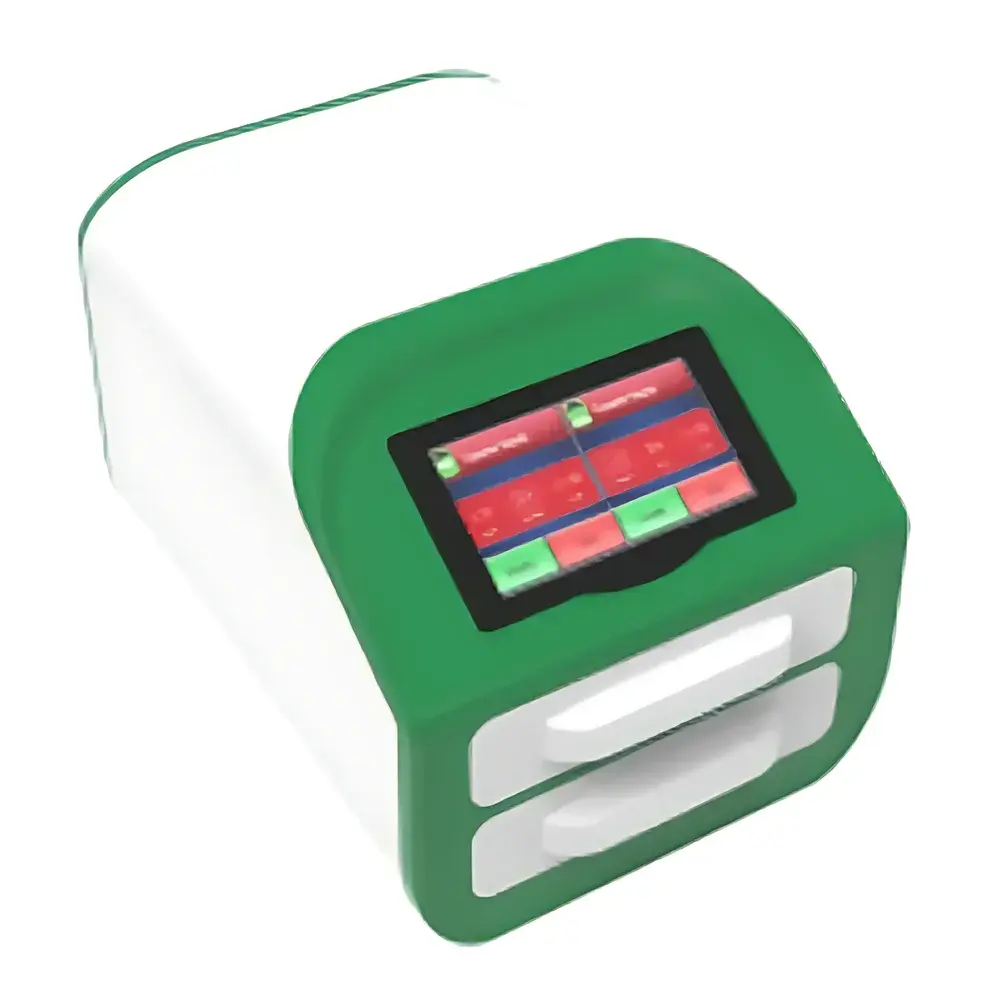
| Display | 5-inch capacitive touchscreen |
| Dual Independent Transfer Chambers | Yes |
| Predefined Protocols | 9 factory presets + 9 user-defined protocols (auto-saved) |
| Cooling | Active forced-air thermal management system |
| Weight | 3.6 kg |
Overview
The Keebio Blot1000 Universal Fast Protein Transfer System is an engineered semi-dry electrophoretic transfer apparatus designed for rapid, reproducible, and scalable protein transfer from polyacrylamide gels to solid supports—including nitrocellulose and PVDF membranes—during Western blot workflows. It operates on the principle of controlled electric field-driven migration of denatured proteins across a sandwich assembly (gel–membrane–filter paper stack), leveraging optimized ion conductivity and uniform electrode contact to minimize Joule heating while maximizing transfer efficiency. Unlike conventional wet or traditional semi-dry systems, the Blot1000 integrates dual independent transfer chambers, precision programmable power delivery, and active thermal regulation to enable consistent sub-10-minute transfers without compromising epitope integrity or band resolution—critical for downstream immunodetection sensitivity and quantitative densitometry.
Key Features
- Dual independent transfer compartments: Each chamber accommodates either one 135 × 85 mm gel or up to two 70 × 85 mm gels, enabling parallel processing of heterogeneous samples or condition-matched replicates under identical electrical parameters.
- Programmable power supply with fine-grained control: Adjustable voltage (0–25 V, 1 V steps) and current (0–2.5 A, 0.1 A steps) allow precise optimization for varying gel thicknesses, acrylamide concentrations (8–20%), and membrane types—supporting both rapid low-voltage protocols and extended high-efficiency transfers.
- Active thermal management: A dedicated axial fan and internal airflow channel dissipate resistive heat generated during high-current operation, maintaining interfacial temperatures below 30 °C throughout 10-minute transfers—reducing protein denaturation, membrane brittleness, and buffer evaporation artifacts.
- Intuitive 5-inch capacitive touchscreen interface: Supports touch-responsive navigation, real-time parameter monitoring, and on-device protocol editing. All executed runs are automatically timestamped and archived; users may store nine custom methods alongside nine preloaded templates (e.g., “High MW Transfer”, “Low MW Rapid”, “PVDF Optimized”).
- Modular electrode architecture: Spring-loaded planar electrodes with integrated latching mechanisms ensure uniform pressure distribution (≥1.2 kg/cm² contact force) and consistent field homogeneity across the entire transfer surface—minimizing edge effects and band distortion.
- Open-system compatibility: Accepts standard semi-dry consumables (Whatman filter paper, Bio-Rad or Thermo Fisher membranes, Tris-Glycine or CAPS-based buffers) and supports both rapid (3–10 min) and conventional (30–60 min) transfer modes without hardware modification.
Sample Compatibility & Compliance
The Blot1000 accommodates standard slab gels cast in-house or purchased commercially, including SDS-PAGE, native PAGE, and gradient gels (8–20% T). It is validated for use with common transfer membranes (0.2 µm and 0.45 µm PVDF; 0.45 µm nitrocellulose), supporting molecular weight ranges from 5 kDa to >250 kDa. The system complies with general laboratory safety standards (IEC 61010-1:2012), features double-insulated power circuitry, and includes over-current and over-temperature shutdown logic. While not certified for GLP/GMP environments out-of-the-box, its audit-ready protocol logging, user-accessible method storage, and deterministic parameter recall support alignment with ISO/IEC 17025 documentation requirements for method validation and instrument qualification.
Software & Data Management
No external software installation is required—the embedded firmware handles all operational logic and data persistence. Each run logs date/time stamp, applied voltage/current profile, duration, chamber ID, and selected protocol name. Historical records (last 9 runs) and user-defined protocols (up to 9 slots) are retained in non-volatile memory. Export functionality is not included; however, experimental metadata can be manually transcribed for LIMS integration or SOP documentation. The interface adheres to WCAG 2.1 AA contrast and touch-target sizing guidelines for accessibility in shared core facilities.
Applications
- Routine Western blotting in academic and industrial research labs requiring high-throughput validation of antibody specificity and target expression levels.
- Comparative proteomics workflows where reproducible transfer efficiency across multiple gels is essential for semi-quantitative analysis.
- Teaching laboratories seeking a robust, low-maintenance platform that reduces hands-on time while reinforcing fundamental electrophoretic principles.
- QC/QA settings performing lot-release testing of recombinant proteins, where transfer consistency directly impacts detection limit reliability per USP and ICH Q5E guidance.
- Method development for novel membrane chemistries or alternative transfer buffers (e.g., ethanol-free, low-methanol formulations).
FAQ
Can the Blot1000 perform wet transfer?
No—it is exclusively configured for semi-dry electrophoretic transfer and lacks reservoirs, cooling coils, or pump infrastructure required for submerged wet-tank operation.
Is it compatible with pre-cast gels from major vendors?
Yes—gels from Bio-Rad, Thermo Fisher, Lonza, and Cytiva (formerly GE Healthcare) in standard dimensions (70 × 85 mm and 135 × 85 mm) fit precisely within the transfer cassette recesses.
Does it support constant current, constant voltage, or constant power modes?
It operates in constant voltage mode with current limiting; output current adjusts dynamically based on system resistance, ensuring stable field strength without manual recalibration.
How is calibration performed?
The unit ships with factory-calibrated voltage and current sensing circuits traceable to NIST-certified references; no user calibration is required or supported.
What maintenance is recommended?
Wipe electrode surfaces and chamber gaskets with 70% ethanol after each use; inspect spring tension and latch integrity quarterly; replace filter paper and membrane consumables per run—no scheduled servicing intervals are specified.