
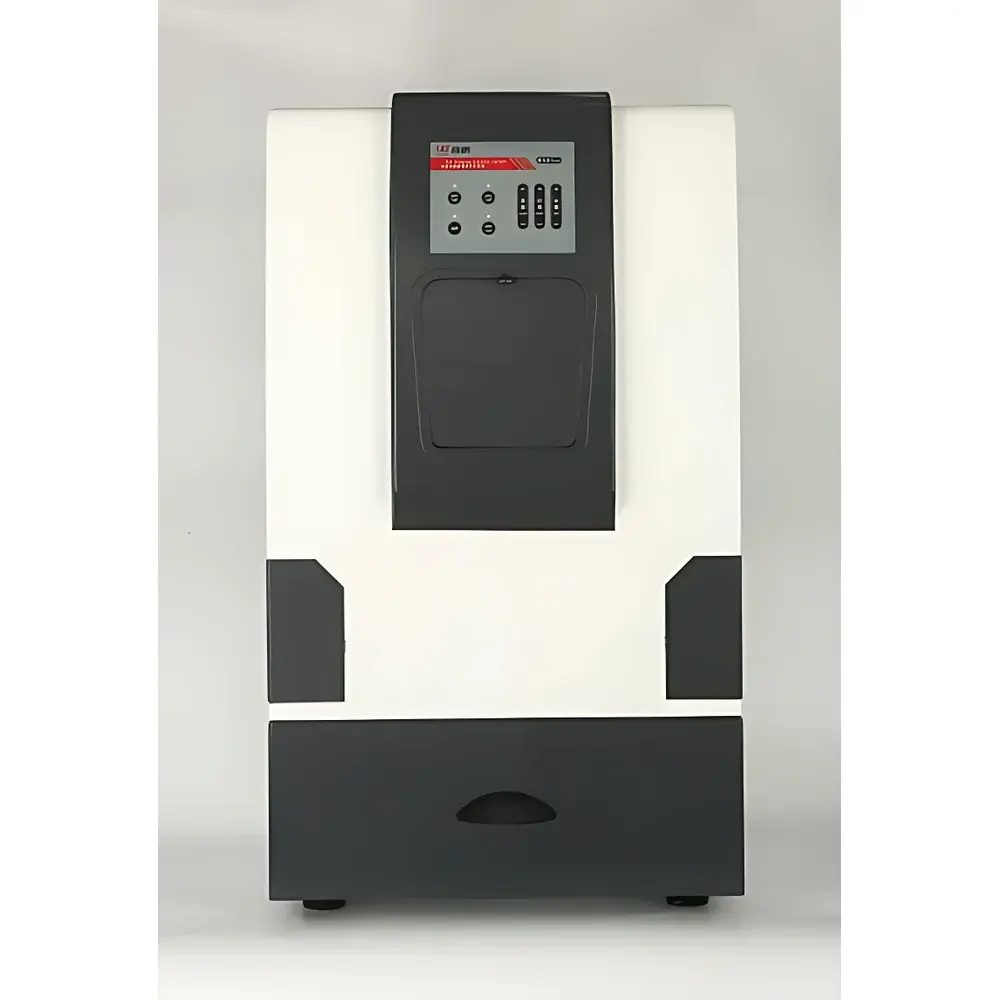
Jiapeng ZF-288 Fully Automated Gel Documentation and Analysis System
| Brand | Jiapeng |
|---|---|
| Origin | Shanghai, China |
| Model | ZF-288 |
| Instrument Type | Standard Gel Imaging System |
| CCD Resolution | 5 MP (3096 × 2080 pixels) |
| Bit Depth | 16-bit |
| Dynamic Range | 4.5 OD |
| CCD Sensor Size | 1/2.5" |
| Minimum Detectable DNA | 0.01 ng (EB-stained dsDNA) |
| Signal-to-Noise Ratio | ≥56 dB |
| Lens | Motorized High-Transmission Zoom Lens (Computar, f/1.2, 8–48 mm) |
| Transmission UV Source | 300 nm (210 × 260 mm area) |
| Reflected UV Sources | 254 nm & 365 nm |
| Blue/White Light Transilluminator | 210 × 300 mm |
| Standard Emission Filter | 590 nm |
| Software | JP-GEL 1D Image Analysis Suite |
| Power Supply | AC 220 V, 50/60 Hz |
| Dimensions (W×D×H) | 435 × 390 × 760 mm |
| Weight | 19.68 kg |
Overview
The Jiapeng ZF-288 Fully Automated Gel Documentation and Analysis System is a dedicated benchtop imaging platform engineered for precise, reproducible documentation and quantitative analysis of nucleic acid and protein gels, blots, and fluorescent or chemiluminescent membranes. It operates on the principle of controlled UV transillumination and reflected excitation, coupled with high-sensitivity CCD-based digital capture and calibrated optical path management. Designed for routine molecular biology laboratories, the system supports ethidium bromide (EB), SYBR Safe, GoldView, and other common nucleic acid stains—enabling reliable detection of DNA fragments down to 0.01 ng under standardized conditions. Its fully motorized optics, integrated illumination control, and programmable exposure sequencing eliminate manual variability, ensuring compliance with laboratory documentation standards such as GLP and internal SOPs for electrophoresis data integrity.
Key Features
- Fully automated motorized lens assembly (Computar 8–48 mm, f/1.2) enabling precise zoom, focus, and iris control via software interface or front-panel touch keys
- Scientific-grade 16-bit CCD sensor (1/2.5″, 3096 × 2080 pixels) delivering 4.5 optical density (OD) dynamic range and ≥56 dB signal-to-noise ratio for high-fidelity low-abundance band detection
- Dual-mode illumination: adjustable 300 nm UV transilluminator (210 × 260 mm) for gel visualization and dual-wavelength reflected UV (254 nm / 365 nm) for membrane imaging
- Integrated blue/white light transilluminator (210 × 300 mm) for Coomassie- and silver-stained protein gels without UV exposure
- Real-time sample monitoring through UV-blocking observation window and live preview mode in JP-GEL 1D software
- Auto-shutdown protocol: all light sources deactivate after 15 minutes of inactivity; full illumination shutdown triggered upon software exit to extend lamp lifetime and reduce thermal drift
- Export flexibility: captured images saved in lossless TIFF (for archival quantification) and standard JPEG (for reporting and presentation)
Sample Compatibility & Compliance
The ZF-288 accommodates standard vertical and horizontal electrophoresis gels (up to 20 × 20 cm), Western/Northern/Southern blots, colony lifts, and autoradiography films. Its 590 nm emission filter is optimized for EB, SYBR-family dyes, and GoldView, with optional filter sets available for alternative fluorophores (e.g., Cy3, FITC). The system meets essential safety and performance benchmarks for academic and industrial molecular labs: UV shielding complies with IEC 61010-1 for laboratory equipment; electrical design conforms to CE marking requirements; and image acquisition workflows support traceable, timestamped metadata generation—facilitating alignment with ISO/IEC 17025 documentation practices and internal audit readiness.
Software & Data Management
JP-GEL 1D is a validated, Windows-based analysis suite supporting one-dimensional electrophoretic image processing. Core functions include background subtraction, lane and band detection, molecular weight calibration (via reference ladder fitting), relative optical density (ROD) quantification, and comparative intensity profiling across multiple gels. All processing steps are logged with operator ID, timestamp, and parameter settings—enabling basic audit trail functionality compatible with GLP-aligned environments. Export options include CSV for statistical analysis in R or Python, PDF reports with embedded annotations, and TIFF stacks for third-party reanalysis. No cloud dependency: all data remains local unless explicitly exported by the user.
Applications
- Quantitative assessment of PCR product yield, restriction digest efficiency, and RNA integrity (e.g., 28S/18S rRNA ratios)
- DNA fragment sizing and purity evaluation in cloning and NGS library QC
- Semi-quantitative Western blot densitometry using chemiluminescent or fluorescent substrates
- Colony screening and plasmid verification in transformation assays
- Teaching lab implementation: intuitive interface and preset protocols lower learning curve for undergraduate instruction
- Regulatory support: consistent image capture parameters enable repeatable documentation for method validation reports
FAQ
Does the ZF-288 support chemiluminescence imaging?
Yes—when used with high-sensitivity CCD settings (long exposure, pixel binning), it captures low-light signals from HRP- and AP-based substrates; however, dedicated chemiluminescence systems offer superior sensitivity for faint bands.
Can I calibrate molecular weight standards across multiple gels?
Yes—JP-GEL 1D allows inter-gel normalization using internal or external ladder references, with exportable calibration curves for cross-experiment comparison.
Is the UV transilluminator intensity adjustable?
No—the 300 nm source operates at fixed optimal irradiance for EB excitation; exposure time and lens aperture are the primary variables for signal optimization.
What file formats does the software generate for raw image data?
TIFF (16-bit, uncompressed) is the native acquisition format; JPEG, PNG, and BMP are available for derivative outputs.
Does the system meet FDA 21 CFR Part 11 requirements?
Out-of-the-box, it provides audit-ready metadata logging but lacks electronic signature enforcement and role-based access control; these features require integration with validated LIMS or ELN platforms.
Related Products



