
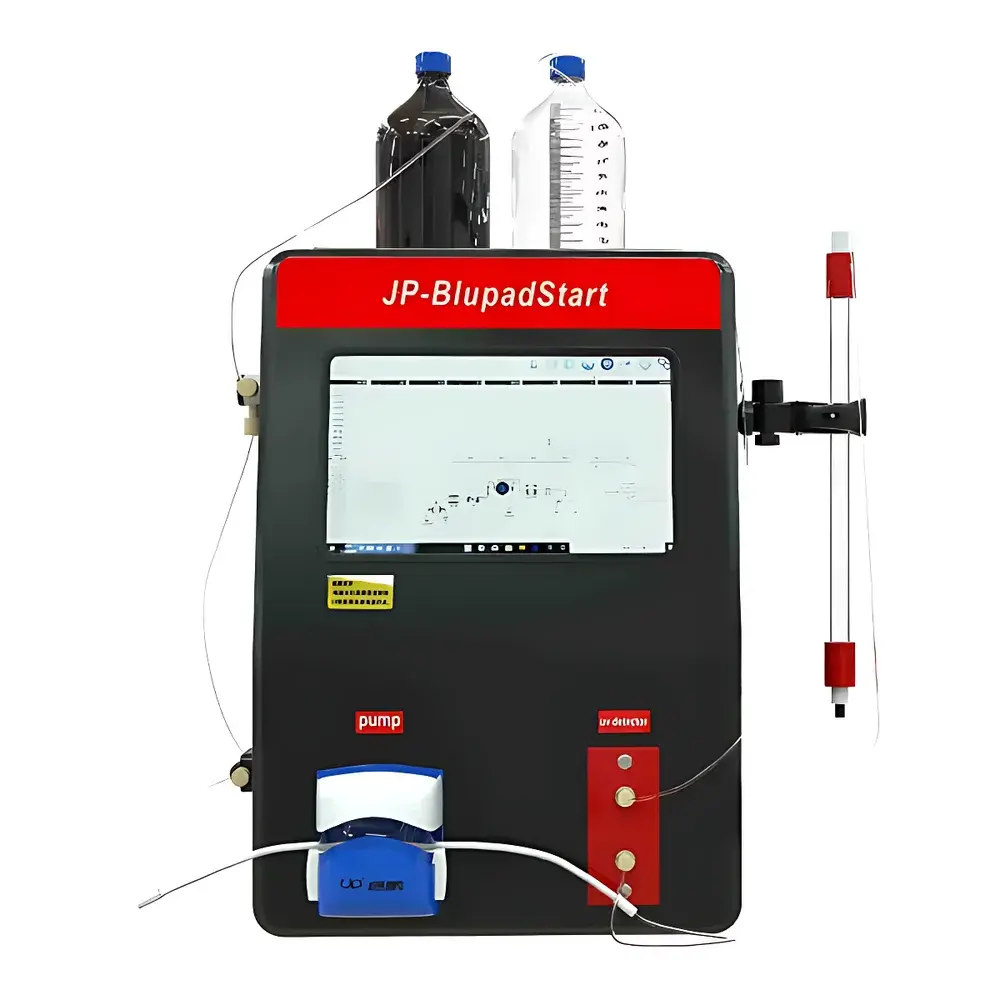
Jiapeng JP-3007 Protein Purification System
| Brand | Jiapeng |
|---|---|
| Origin | Shanghai, China |
| Model | JP-3007 |
| Purification Principle | Ion Exchange Chromatography (IEX) |
| Gradient Type | Linear Gradient |
| Detector Type | UV Absorbance Detector |
| Flow Rate Range | 0.1–10 mL/min |
| Flow Rate Accuracy | ±1.2% |
| Detection Range | –6 AU to +6 AU |
| Maximum Pressure | 3 MPa |
| Wavelength Options | 260 nm, 280 nm, 295 nm, 310 nm |
| Wavelength Accuracy | ±1 nm |
| Linearity | ±1.5% (0–2 AU) |
| Sample Cell Volume | 10 µL |
| Operating Temperature | 4–40 °C |
| Dimensions (W×D×H) | 360 × 360 × 470 mm |
| Weight | 10.6 kg |
Overview
The Jiapeng JP-3007 Protein Purification System is an integrated, benchtop liquid chromatography platform engineered for reproducible and scalable protein isolation in academic, biotech, and quality control laboratories. Built upon classical low-pressure liquid chromatography (LPLC) architecture, the system employs a dual-piston constant-flow pump and fixed-wavelength UV absorbance detection to support core purification modalities—including ion exchange chromatography (IEX), affinity chromatography, gel filtration (size exclusion chromatography, SEC), desalting, and buffer exchange. Its design prioritizes operational robustness, regulatory traceability, and method transfer fidelity across early-stage research and process development workflows. Unlike high-performance liquid chromatography (HPLC) systems, the JP-3007 operates at pressures up to 3 MPa (30 bar), making it compatible with standard polypropylene or glass columns packed with soft- or medium-resolution resins (e.g., Sepharose CL-4B, DEAE-Sepharose FF, Ni-NTA Agarose). The system does not require column oven temperature control or gradient delay volume compensation—simplifying method development while maintaining sufficient resolution for analytical-to-preparative scale applications.
Key Features
- Integrated 12-inch high-resolution capacitive touchscreen interface with real-time dual-channel display (UV absorbance and fraction collection status)
- LED-based UV detector with four user-selectable wavelengths (260 nm, 280 nm, 295 nm, 310 nm) optimized for nucleic acid and protein quantification; cold-light source ensures thermal stability and extended lamp lifetime
- Microprocessor-controlled dual-piston peristaltic pump delivering flow rates from 0.1 to 10 mL/min with ≤±1.2% accuracy across full range—validated per ISO 5725-2 precision criteria
- No warm-up required: baseline stabilization achieved within 60 seconds of power-on, minimizing idle time between runs
- Bilingual software interface (English/Chinese) supporting intuitive method programming, parameter locking, and password-protected user roles
- Automatic data logging with timestamped CSV and Excel-compatible export; all acquisition parameters—including flow rate, UV signal, conductivity (if optional module installed), and fraction trigger logic—are embedded in metadata
- Modular expansion capability: supports optional conductivity detector, manual loop injector, and JP-blupadFC fraction collector with programmable tube rack compatibility (1.5 mL, 2 mL, 5 mL, 15 mL, 50 mL formats)
Sample Compatibility & Compliance
The JP-3007 accommodates a broad range of biological sample matrices, including clarified cell lysates, serum supernatants, hybridoma culture media, and recombinant expression harvests. It is validated for use with common chromatographic media such as agarose-, dextran-, and silica-based resins, provided column dimensions remain within 10–26 mm internal diameter and bed heights do not exceed 30 cm. All wetted components—including fluidic path tubing, pump heads, and UV flow cell—are chemically resistant to standard aqueous buffers (e.g., Tris-HCl, phosphate, sodium acetate) and mild organic modifiers (≤20% ethanol, ≤10% isopropanol). The system adheres to IEC 61010-1 safety standards for laboratory equipment and supports GLP-compliant operation through audit-trail-enabled software logging (user login history, method modification timestamps, and raw data immutability). While not certified for GMP manufacturing environments, its data integrity framework aligns with FDA 21 CFR Part 11 principles when deployed with appropriate IT controls (e.g., network authentication, encrypted storage, electronic signatures).
Software & Data Management
The embedded chromatography workstation provides synchronized visualization of UV absorbance, fraction collection events, and optional conductivity signals on a single screen. Method templates can be saved, duplicated, and version-controlled; each run generates a unique .raw file containing analog-to-digital converted detector output sampled at 10 Hz, along with header metadata (date/time, operator ID, method name, instrument serial number). Export functions include direct Excel (.xlsx) generation with column-aligned retention time, peak area, and baseline-corrected absorbance values. Raw files are structured using open binary format specifications—enabling third-party analysis via Python (NumPy/Pandas), MATLAB, or commercial tools like OriginLab. Audit trails record all user-initiated actions, including method edits, calibration updates, and data deletion attempts, with immutable timestamps stored locally on the onboard SSD.
Applications
- Purification of His-tagged recombinant proteins via immobilized metal affinity chromatography (IMAC)
- Removal of endotoxins and host-cell proteins from monoclonal antibody harvests using anion-exchange polishing steps
- Desalting and buffer exchange of enzymatically digested peptides prior to LC-MS/MS analysis
- Gel filtration-based molecular weight estimation and aggregate screening of therapeutic proteins
- Isolation of native enzymes from tissue homogenates under non-denaturing conditions
- Process development studies requiring consistent fraction collection triggered by UV threshold, time window, or conductivity shift
FAQ
What column formats are compatible with the JP-3007?
Standard gravity-fed or low-pressure chromatography columns with 10–26 mm internal diameter and maximum bed height of 30 cm. Prepacked disposable columns (e.g., HiTrap, PD-10) are supported via appropriate adapters.
Can the system perform multi-step gradient elution?
Yes—the built-in gradient programmer supports up to 8 linear gradient segments per method, with independent control of mobile phase A/B composition, flow rate, and UV wavelength switching.
Is remote monitoring or network integration possible?
The system features Ethernet and USB ports; remote desktop access is enabled via standard VNC protocols when connected to a local LAN. No cloud-based telemetry or proprietary remote service is included.
Does the UV detector support variable wavelength scanning?
No—it is a fixed-wavelength LED detector with four preset options. Full spectral scanning requires external diode-array or photodiode-based detectors not integrated into this platform.
What maintenance intervals are recommended for the pump and detector?
Pump tubing should be replaced every 6 months under continuous use; UV flow cell cleaning with 70% isopropanol is advised after each week of operation involving viscous or particulate-laden samples.
Related Products



