
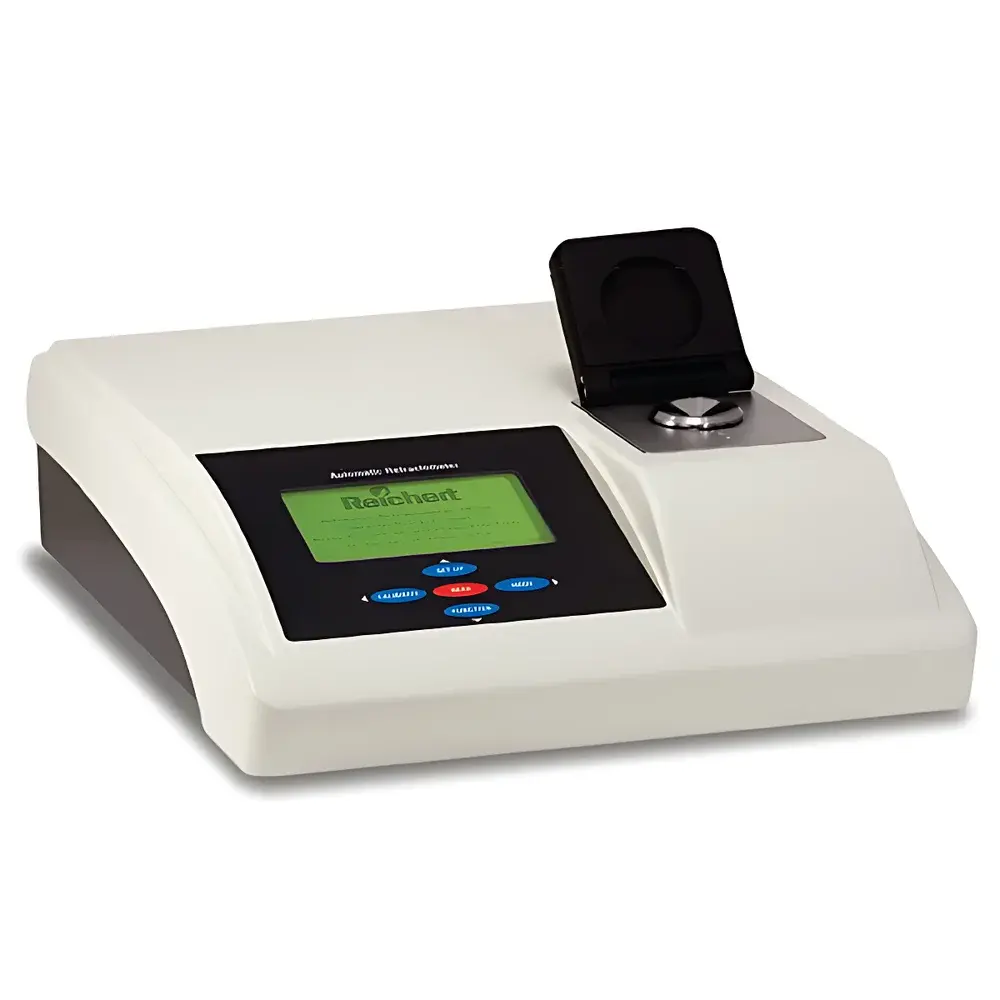
Reichert AR70 Automatic Digital Refractometer
| Brand | Reichert |
|---|---|
| Origin | USA |
| Model | AR70 |
| Instrument Type | Benchtop Refractometer |
| Temperature Control | Peltier-based, 10–100 °C |
| Display | LCD (11 × 6 cm) |
| Refractive Index Range | 1.3329–1.6000 |
| Brix Range | 0–95.0% |
| RI Resolution | 0.0001 |
| Brix Resolution | 0.1% |
| Light Source | High-intensity LED at 589 nm |
| Prism Material | Sapphire |
| Sample Chamber | Sealed Teflon-lined 416 stainless steel |
| Calibration | NIST-traceable standard oils |
| Data Logging | Up to 14 user programs, password-protected settings, automatic equilibrium detection, factory reset capability |
| Compliance | Designed for GLP/GMP environments with audit-trail-capable calibration history |
Overview
The Reichert AR70 Automatic Digital Refractometer is a high-precision benchtop instrument engineered for reliable, repeatable refractive index (RI) and Brix measurements across diverse industrial, pharmaceutical, food & beverage, and clinical laboratories. It operates on the principle of total internal reflection at the prism–sample interface, where the critical angle of incident light is precisely determined using a monochromatic 589 nm sodium-D line-equivalent LED source. This optical configuration—combined with a sapphire prism and thermally stabilized measurement cell—ensures long-term stability and resistance to chemical corrosion or mechanical wear. Unlike traditional water-bath refractometers, the AR70 integrates a solid-state Peltier temperature control system, eliminating external cooling units and enabling rapid, accurate thermal equilibration across its full 10–100 °C operating range. Its ability to measure transparent, translucent, and opaque liquid samples—without dilution or filtration—makes it suitable for viscous, particulate-laden, or highly colored matrices commonly encountered in real-world QC workflows.
Key Features
- Sapphire prism assembly with Teflon-sealed 416 stainless steel sample chamber for exceptional durability and chemical compatibility
- Peltier-driven temperature regulation with ±0.01 °C stability and auto-equilibrium detection, supporting method-defined thermal protocols
- High-intensity 589 nm LED light source with >50,000-hour lifetime and minimal spectral drift
- Refractive index resolution of 0.0001 and Brix resolution of 0.1%, traceable to NIST-certified reference oils
- Onboard LCD display (11 × 6 cm) with intuitive menu navigation and real-time measurement feedback
- Up to 14 programmable measurement methods, each configurable for RI, Brix, or custom concentration units
- Password-protected instrument settings and encrypted calibration history storage for regulatory compliance
- Automatic sample detection and equilibrium confirmation prior to result capture, reducing operator dependency
Sample Compatibility & Compliance
The AR70 accepts a broad spectrum of liquid samples—including aggressive solvents, polymer melts, emulsions, suspensions, and high-viscosity fluids—without requiring pre-treatment. Its sealed sample chamber accommodates volumes as low as 0.5 mL while maintaining consistent thermal contact. The instrument is routinely deployed in environments governed by ISO/IEC 17025, USP , ASTM D1218 and D322, and FDA 21 CFR Part 11 requirements. Calibration records—including date, operator ID, standard used, deviation values, and pass/fail status—are retained internally and exportable via optional RS-232 or USB interfaces. All firmware and calibration procedures support full audit-trail documentation necessary for GLP and GMP validation.
Software & Data Management
While the AR70 operates autonomously via its embedded microcontroller, its firmware architecture supports structured data governance. Each calibration event is timestamped and logged with metadata including ambient conditions, user credentials, and deviation from certified reference values. The 14-program memory allows labs to store validated SOPs—including temperature ramp profiles, averaging intervals, and unit conversions—for immediate recall. Factory defaults are preserved independently and can be restored without erasing historical logs. Optional PC connectivity enables integration into LIMS or ELN platforms through ASCII-based serial communication protocols, ensuring seamless alignment with enterprise quality management systems.
Applications
In chemical manufacturing, the AR70 verifies solvent purity, monitors polymerization endpoints, quantifies solids content in coatings, and assesses freeze-point depression in deicing fluids. Within food science, it delivers rapid Brix assessment for fruit juice maturity grading, dairy solids estimation, fermentation progress tracking in brewing, and sugar concentration control in confectionery production. In pharmaceutical settings, it supports osmolality estimation of parenteral solutions, excipient concentration verification, and raw material identity testing per ICH Q5A guidelines. Clinical labs utilize it for serum protein estimation and urine specific gravity screening—applications validated against CLSI EP10-A3 protocols. Its robustness and reproducibility make it equally suited for R&D method development and routine QC release testing.
FAQ
Does the AR70 require external water circulation for temperature control?
No—the instrument uses an integrated Peltier thermoelectric module with closed-loop feedback, eliminating dependence on external chillers or water baths.
Can the AR70 measure opaque or turbid samples?
Yes—it is specifically designed to handle translucent and opaque liquids, including slurries and emulsions, due to its optimized optical path and high-sensitivity photodetector array.
Is calibration traceable to national standards?
Yes—calibration is performed using NIST-traceable refractive index standard oils, and all calibration events are digitally recorded with full metrological metadata.
What temperature accuracy is maintained during extended measurements?
The system maintains ±0.01 °C stability over time, verified by internal thermistor monitoring and compensated in real time during RI calculation.
How is data integrity ensured under regulated conditions?
Through password-restricted access, immutable calibration logs, electronic signatures (via optional software), and compatibility with 21 CFR Part 11-compliant audit trail generation.




