
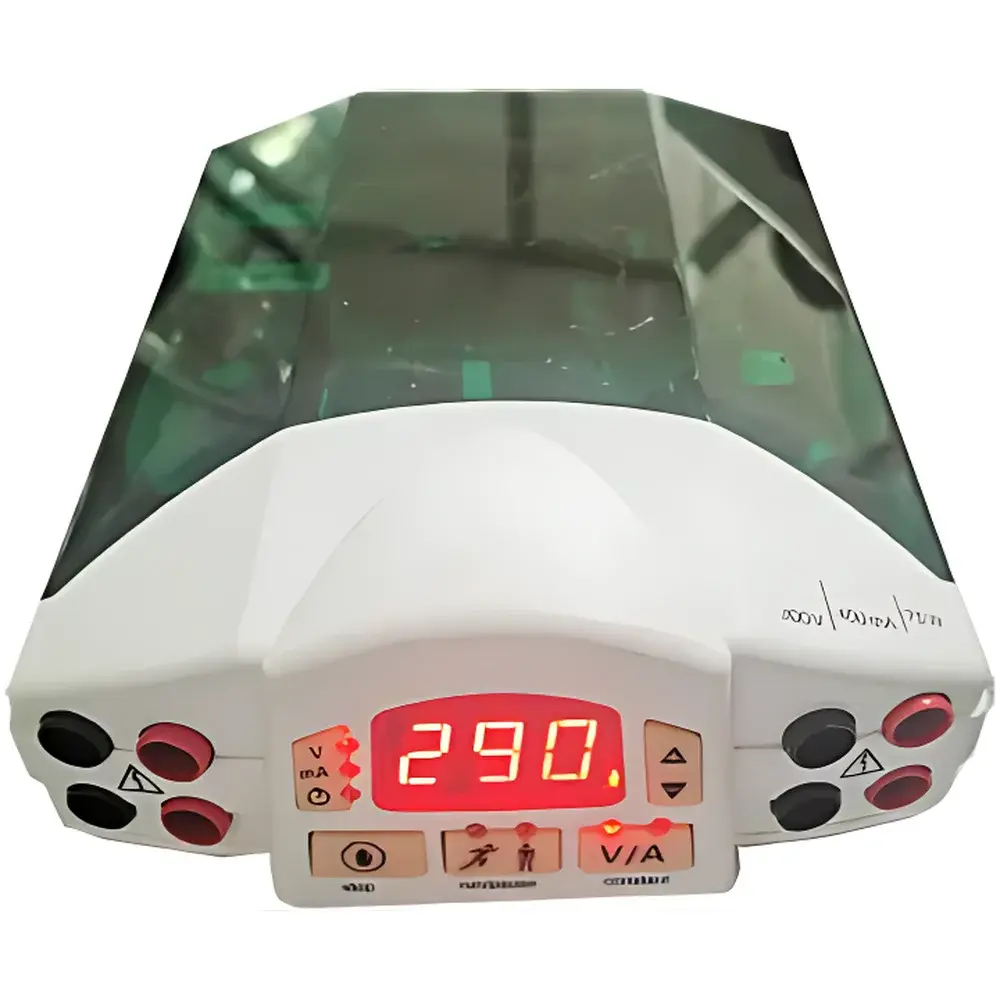
Keebio BP300 Basic Electrophoresis Power Supply
| Brand | Keebio |
|---|---|
| Origin | Shanghai, China |
| Model | BP300 |
| Instrument Type | Electrophoresis Power Supply |
| Output Modes | Constant Voltage / Constant Current / Constant Power |
| Voltage Range | 10–300 V (±1 V accuracy) |
| Current Range | 4–400 mA (±1 mA accuracy) |
| Max Power | 100 W |
| Timer Range | 1–999 min (adjustable) |
| Output Ports | 4 independent DC output channels |
| Display | 3-digit LED |
| Operating Environment | 0–40 °C, 0–95% RH (non-condensing) |
| Dimensions (W×D×H) | 240 × 190 × 50 mm |
| Weight | 1.1 kg |
| Safety Certifications | Overload, short-circuit, no-load, surge, and power-fail protection |
| Input Power | AC 220 V, 50/60 Hz |
Overview
The Keebio BP300 Basic Electrophoresis Power Supply is a compact, microprocessor-controlled DC power source engineered for routine nucleic acid and protein electrophoresis applications in academic, clinical, and industrial life science laboratories. It operates on the fundamental principle of applying a controlled electric field across a gel matrix—typically agarose or polyacrylamide—to drive charged biomolecules toward oppositely charged electrodes at rates proportional to their size-to-charge ratio. Designed for reliability under continuous operation, the BP300 delivers stable, low-noise DC output with real-time regulation across three independent operating modes: constant voltage (CV), constant current (CC), and constant power (CP). Its architecture supports standard slab-gel electrophoresis systems—including mini vertical units, horizontal submarine gels, and semi-dry transfer apparatus—without requiring external cooling or auxiliary modules.
Key Features
- Triple-mode output control (CV, CC, CP) with automatic mode switching based on load impedance and user-defined setpoints
- Precision-regulated outputs: ±1 V voltage stability and ±1 mA current resolution over full range
- Four isolated DC output channels—enabling simultaneous operation of up to four electrophoresis tanks without cross-talk or voltage drop
- Programmable timer (1–999 minutes) with audible end-of-run alert and auto-shutdown functionality
- Intuitive front-panel interface with 3-digit LED display showing real-time voltage, current, elapsed time, and active mode
- Robust safety architecture including short-circuit protection, open-circuit detection, thermal foldback, and input line surge suppression
- Stackable chassis design (240 × 190 × 50 mm) optimized for benchtop space efficiency in high-density lab environments
- Non-volatile memory retains last-used parameters across power cycles—eliminating repetitive setup for standardized protocols
- Pause/resume function allows temporary interruption of runs without resetting timer or output values
Sample Compatibility & Compliance
The BP300 is compatible with all common electrophoretic formats utilizing standard buffer systems (e.g., TAE, TBE, SDS-PAGE running buffer). It supports standard mini-gel cassettes (e.g., 8 × 10 cm), midi-gels, and blotting modules used in Western, Southern, and Northern transfer workflows. While not intended for high-voltage applications such as capillary or pulsed-field electrophoresis, its 300 V ceiling accommodates standard vertical SDS-PAGE, native PAGE, and DNA fragment analysis. The unit complies with IEC 61010-1:2010 for laboratory electrical equipment safety and meets electromagnetic compatibility requirements per EN 61326-1:2013. Its operational specifications align with common GLP documentation practices for instrument qualification (IQ/OQ/PQ), and its deterministic timer and parameter retention support audit-ready recordkeeping per FDA 21 CFR Part 11 when integrated into validated workflows.
Software & Data Management
The BP300 operates as a standalone instrument with no proprietary software dependency. All configuration and monitoring occur via the built-in LED interface; no drivers, USB connections, or cloud services are required. This design minimizes IT infrastructure dependencies and eliminates cybersecurity risks associated with networked lab devices. For labs implementing electronic lab notebooks (ELNs) or LIMS integration, manual entry of run parameters (voltage, current, duration, gel type) is supported through standardized templates aligned with MIAME and MIAPE reporting guidelines. The device’s repeatable output behavior and parameter memory facilitate consistent protocol execution across shifts and operators—critical for QC/QA reproducibility in regulated environments.
Applications
- Routine DNA fragment separation in agarose gels (0.5–2% w/v) at 50–120 V
- SDS-PAGE and native PAGE of proteins (10–200 kDa) using vertical mini-gel systems
- Electroblotting (wet and semi-dry transfer) of proteins from gels to PVDF or nitrocellulose membranes
- Isotachophoresis and basic zone electrophoresis setups requiring stable low-current delivery
- Teaching laboratories where robustness, ease of use, and cost-effective maintenance are prioritized
- Preparative electrophoresis workflows requiring parallel processing of multiple samples
FAQ
What electrophoresis tank models are compatible with the BP300?
The BP300 supports any standard electrophoresis chamber rated for ≤300 V and ≤400 mA, including common mini-vertical (e.g., Bio-Rad Mini-PROTEAN®, Thermo Fisher Owl E1 series) and horizontal submarine tanks (e.g., Hoefer HE12, Cleaver Scientific HE series).
Does the BP300 support gradient or pulse programming?
No—it provides only steady-state DC output in CV, CC, or CP mode. It does not support time-varying waveforms, ramping, or programmable pulse sequences.
Can output channels be used independently for different protocols simultaneously?
Yes. Each of the four DC outputs operates independently with separate voltage/current setpoints and timers, enabling concurrent runs with distinct conditions.
Is calibration traceable to national standards?
The BP300 includes factory calibration with documented uncertainty; users may perform periodic verification using NIST-traceable multimeters per ISO/IEC 17025-compliant procedures.
What maintenance is required?
No scheduled maintenance is required. Routine cleaning of ventilation grilles and visual inspection of output terminals every 6 months is recommended. No consumables or firmware updates are necessary.




