
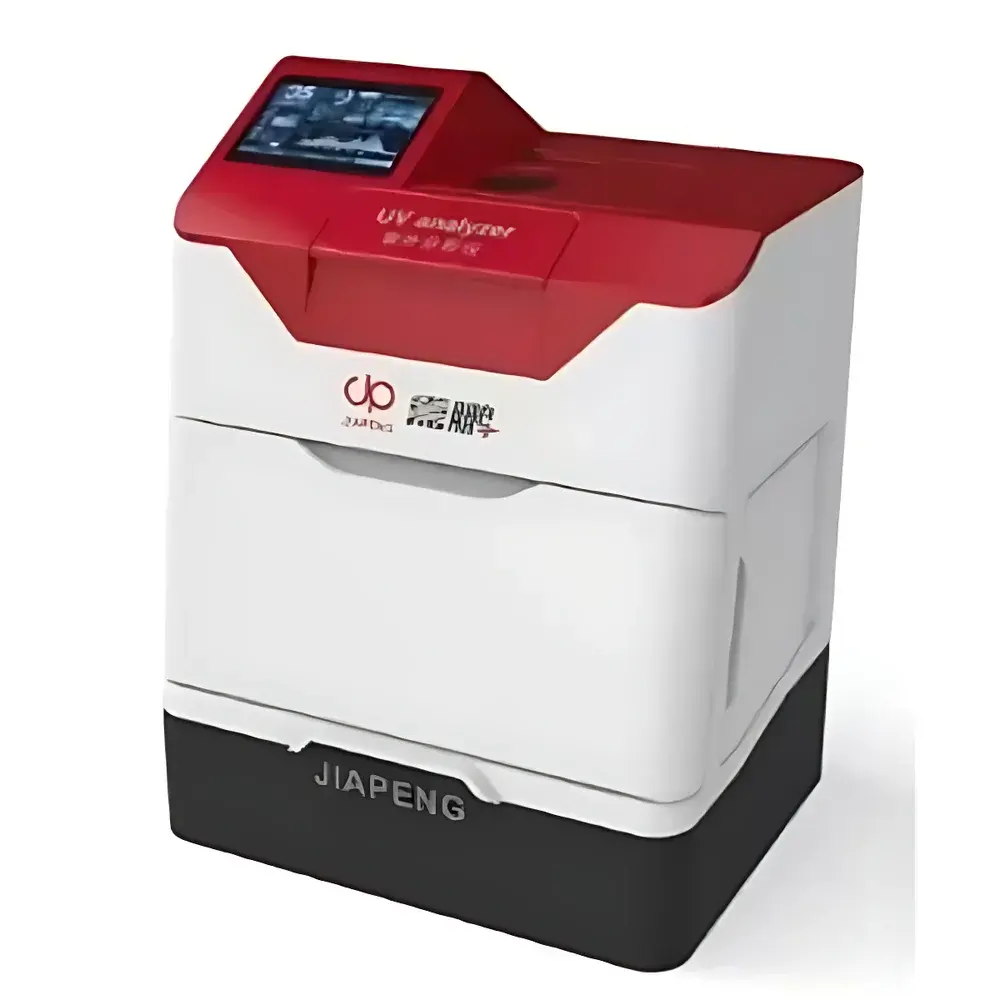
JP-UV1 Multi-Wavelength UV Transilluminator and Reflector
| Brand | Jiapeng |
|---|---|
| Origin | Shanghai, China |
| Manufacturer Type | Authorized Distributor |
| Country of Origin | China |
| Model | JP-UV1 |
| Instrument Type | Preparative Thin-Layer Chromatography (TLC) UV Visualization System |
| Operation Mode | Manual |
| Measurement Modes | Reflectance Absorption, Transmittance Absorption |
| Wavelengths | 254 nm, 365 nm (reflectance) |
| UV Light Source | Low-pressure mercury vapor lamps (8 W × 10) + white LED array |
| Imaging Wavelengths | 254 nm, 365 nm, visible white light |
| Viewing Area | 260 × 210 mm |
| UV Intensity at 20 cm | ≥20 µW/cm² (per JJF 1936–2021) |
| Optional UV Radiometer | 0–1000 µW/cm² range |
| Safety Features | >99% UV-blocking viewing window, dual side access ports |
| Dimensions (L×W×H) | 440 × 338 × 270 mm |
| Weight | 5.3 kg |
| Compliance | JJF 1936–2021 (National Verification Regulation for UV Analyzers), registered utility models ZL2012205175136 & ZL201920792756.2 |
Overview
The JP-UV1 Multi-Wavelength UV Transilluminator and Reflector is an engineered solution for visualizing, documenting, and excising nucleic acid and protein bands in gel electrophoresis and thin-layer chromatography (TLC). Designed in strict accordance with JJF 1936–2021—the national metrological verification regulation for UV analyzers in China—the instrument integrates three discrete illumination modalities: transmittance UV (302 nm), reflectance UV (254 nm and 365 nm), and high-CRI white light (5500 K) for post-staining visualization. Its optical architecture employs low-pressure mercury vapor lamps (8 W × 10) with precision interference filters to isolate target wavelengths, minimizing spectral bleed and ensuring reproducible excitation of ethidium bromide, SYBR® dyes, and other common fluorophores. The 260 × 210 mm uniform illumination field supports standard mini-gels (e.g., 10 × 10 cm), analytical TLC plates (20 × 20 cm), and preparative silica layers—enabling both qualitative band detection and semi-quantitative analysis prior to downstream extraction or sequencing.
Key Features
- Triple-wavelength illumination system: 302 nm transmittance (optimized for ethidium bromide-stained DNA), 254 nm reflectance (high sensitivity for nucleotide detection), 365 nm reflectance (reduced photodamage for UV-labile samples), and 5500 K white LED for Coomassie- or silver-stained protein gels
- Integrated 4.3-inch resistive touch interface with bilingual (English/Chinese) firmware; real-time display of lamp status, operational mode, and optional radiometric intensity readout (0–1000 µW/cm²)
- Dual-side ergonomic access ports and a certified UV-blocking observation window (>99% attenuation at 254/302/365 nm) enabling safe real-time monitoring during band excision
- Standardized camera mounting interface compatible with Canon EOS, Nikon DSLR, and mirrorless systems (via C-mount adapter); supports time-lapse documentation and fluorescence image capture under controlled ambient conditions
- Compliance-certified UV output: ≥20 µW/cm² at 20 cm distance per JJF 1936–2021, verified using traceable NIM-calibrated radiometers
- Modular design with removable cut-out tray, stainless steel blade holder, and four interchangeable tungsten-carbide cutting tips for precise gel/TLC band isolation
Sample Compatibility & Compliance
The JP-UV1 accommodates standard electrophoretic formats including agarose (0.5–3.0%), polyacrylamide (8–20%), and SDS-PAGE gels, as well as silica- or alumina-based TLC plates (standard, fluorescent, or reversed-phase). It meets the essential performance criteria outlined in ISO 15190:2020 (clinical laboratory safety) for UV exposure control and aligns with GLP-relevant documentation practices when paired with external audit-ready imaging software. While not FDA 21 CFR Part 11–certified out-of-the-box, its manual operation mode and deterministic lamp control logic support integration into validated workflows requiring traceable excitation parameters—particularly in academic core facilities and QC labs performing routine nucleic acid purity checks per USP Analytical Instrument Qualification guidelines.
Software & Data Management
The JP-UV1 operates as a standalone hardware platform without embedded data storage or network connectivity. Image acquisition is performed externally via DSLR/mirrorless cameras using manufacturer-provided exposure protocols (e.g., 1/30 s shutter speed, f/5.6 aperture, ISO 400). Raw TIFF/JPEG files are managed through institutional LIMS or ELN systems. For regulatory environments, users may integrate third-party image analysis tools—including ImageJ/Fiji (NIH), AlphaView SA (ProteinSimple), or GelAnalyzer 2010—that support metadata tagging, histogram calibration, and audit trail generation compliant with ISO/IEC 17025:2017 clause 7.7. All firmware updates and calibration logs are distributed via secure FTP upon request to authorized distributors.
Applications
- Nucleic acid analysis: Detection and quantification of DNA/RNA fragments in agarose and PAGE gels; verification of PCR product size and specificity; assessment of restriction digest completeness
- TLC-based separation validation: Rf value determination for organic compounds, pharmaceutical intermediates, and natural product extracts under 254 nm (aromatic ring absorption) and 365 nm (fluorescent tag excitation)
- Protein visualization: Post-electrophoretic detection of Coomassie- and silver-stained bands using white-light reflectance; confirmation of western blot transfer efficiency
- Molecular forensics: DNA fingerprinting via restriction fragment length polymorphism (RFLP) and amplified fragment length polymorphism (AFLP) workflows
- Educational laboratories: Hands-on instruction in nucleic acid biochemistry, chromatographic theory, and UV safety protocols aligned with ANSI Z136.1–2022 standards
FAQ
What safety certifications does the JP-UV1 hold?
The instrument complies with JJF 1936–2021 and incorporates engineering controls meeting IEC 61010-1:2010 requirements for laboratory electrical equipment. Its viewing window is certified to attenuate ≥99% of incident UV radiation at 254 nm, 302 nm, and 365 nm.
Can the JP-UV1 be used for quantitative densitometry?
No—this is a visualization and excision tool, not a calibrated densitometer. Semi-quantitative comparisons require external imaging systems with flat-field correction and standardized exposure matrices.
Is the 302 nm transmittance mode suitable for SYBR® Safe staining?
Yes. SYBR® Safe exhibits peak excitation at ~300 nm; the 302 nm band provides optimal signal-to-noise ratio while reducing direct DNA photochemical damage compared to 254 nm.
Does the unit include a radiometer?
No—the UV intensity sensor is optional and must be ordered separately (Part No. JP-RAD-2023). Calibration certificates are issued per NIM traceability standards.
What maintenance is required for long-term wavelength stability?
Lamp arrays should be replaced every 1,500 operating hours. Filter sets require annual inspection for micro-scratches or yellowing; replacement filters are available with documented OD ≥4.0 at non-target wavelengths.



