
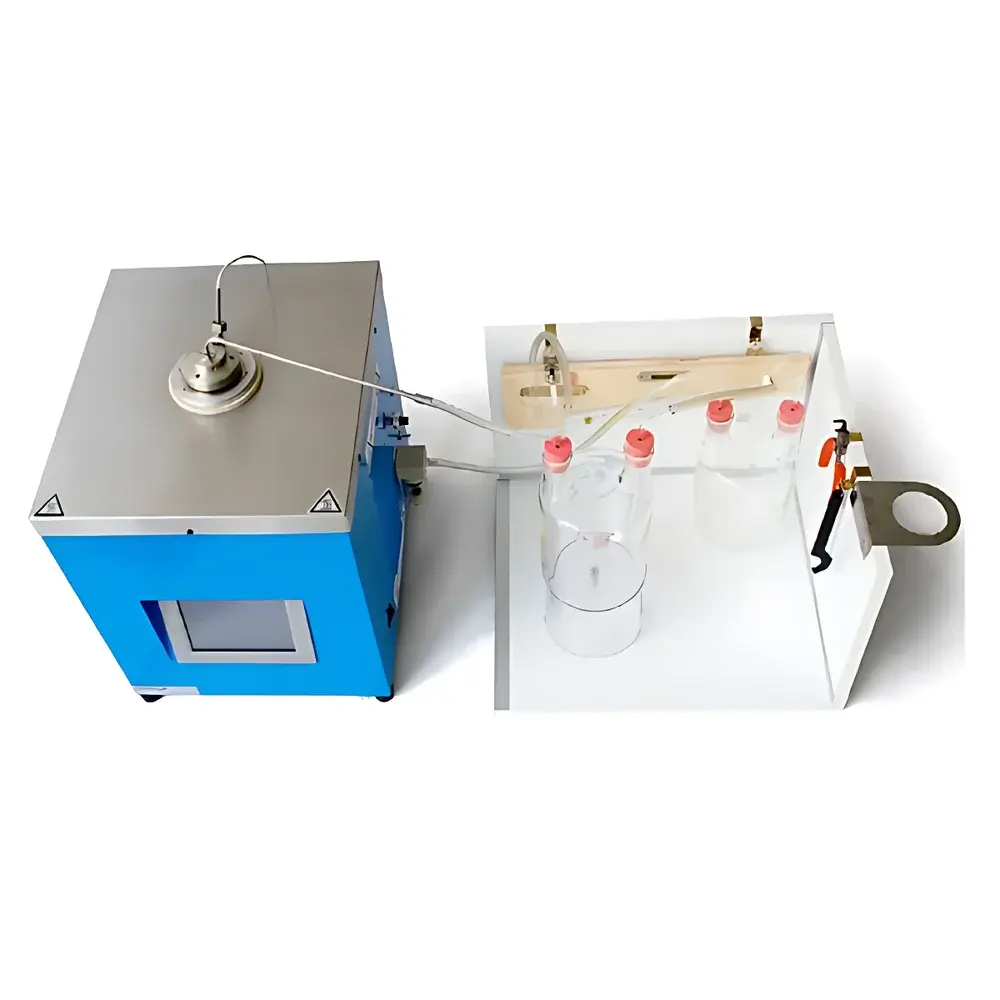
Linetechnic 580 Noack Volatility Tester
| Brand | Linetechnic |
|---|---|
| Origin | Switzerland |
| Model | 580 |
| Standards Compliance | ASTM D5800, DIN 51581, CEC L-40-A-93 |
| Temperature Range | 0–320 °C |
| Temperature Accuracy | ±0.5 °C |
| Temperature Resolution | 0.1 °C |
| Air Flow Control | Adjustable differential pressure (20 mm H₂O / 1.96 mbar), valve- and flowmeter-regulated |
| Evaporation Duration | 60 min at set temperature |
| Safety Features | Overtemperature protection, integrated oil-filtered vacuum pump |
| Interface | RS-232 serial port for real-time temperature and pressure data logging |
| Display | LCD showing actual temperature, differential pressure, elapsed time |
| Automation | Auto-start test sequence, acoustic timer alert, fault indication via audible tone and visual LED status |
Overview
The Linetechnic 580 Noack Volatility Tester is a precision-engineered instrument designed to quantify the evaporative loss of lubricating oils under controlled high-temperature, forced-air conditions—directly aligned with the fundamental physical behavior of hydrocarbon-based fluids in engine and industrial applications. Based on the standardized Noack volatility principle, the instrument subjects a precisely weighed oil sample to sustained thermal stress within a calibrated evaporation crucible, while a regulated stream of ambient air sweeps volatile fractions into a cooled condensation trap. The mass difference before and after the 60-minute exposure yields the gravimetric volatility loss as a percentage—providing a critical indicator of base oil stability, additive volatility, and long-term formulation integrity. Operating up to 320 °C with tight thermal uniformity (±0.5 °C) and sub-degree resolution (0.1 °C), the 580 delivers metrologically traceable results essential for R&D validation, batch release testing, and regulatory submission under globally harmonized frameworks.
Key Features
- High-stability PID-controlled heating system with adaptive parameter tuning—ensures consistent thermal profiles across extended test durations and variable ambient loads
- PT100 platinum resistance thermometer with NIST-traceable calibration; integrated overtemperature cutoff circuitry prevents thermal runaway
- Differential pressure regulation system compliant with CEC L-40-A-93 specifications (20 mm H₂O ≡ 1.96 mbar), implemented via dual-mode control: manual needle valve + digital flowmeter feedback
- Integrated oil-mist filtered vacuum pump for reliable vapor extraction without cross-contamination or pump degradation
- RS-232 serial interface enabling continuous streaming of real-time temperature, differential pressure, and elapsed time to external data acquisition systems or LIMS
- Backlit LCD operator interface displaying live process variables, countdown timer, and diagnostic status codes—supports unattended operation
- Acoustic timer alert eliminates dependency on external timing devices; synchronized start/stop logic ensures precise 60-minute dwell time per ASTM D5800 Section 8.2
- Self-diagnostic firmware with audible fault signaling and multi-color LED status indicators—detects sensor drift, airflow deviation, and thermal overshoot before measurement error occurs
- Auto-zeroing sensor compensation algorithm mitigates long-term thermistor drift—maintains accuracy over 12+ months without recalibration
Sample Compatibility & Compliance
The 580 accommodates standard ASTM/CEC/DIN crucibles (e.g., 30 mL porcelain or stainless-steel variants) and supports viscosity ranges from SAE 0W-20 to ISO VG 680 gear oils. Its thermal architecture enables stable operation at 250 °C ± 0.5 °C—the nominal test condition for automotive engine oils per ASTM D5800—and extends reliably to 320 °C for specialty high-temperature formulations (e.g., turbine, compressor, or synthetic ester-based lubricants). All operational parameters—including airflow linearity, temperature ramp rate, soak stability, and mass repeatability—are validated against the metrological requirements of ASTM D5800 Annex A1, DIN 51581 Clause 6.3, and CEC L-40-A-93 Section 4. The system’s design inherently supports GLP-compliant workflows: audit trails for method parameters, electronic signature-capable software integration (via optional Linetechnic LabLink Suite), and full traceability of calibration certificates per ISO/IEC 17025.
Software & Data Management
While the 580 operates as a standalone benchtop instrument, its RS-232 port enables seamless integration into automated QC laboratories. When paired with Linetechnic’s optional LabLink Suite (v3.2+), users gain access to FDA 21 CFR Part 11–compliant electronic records—including user authentication, immutable audit logs, version-controlled test methods, and digital signatures for result approval. Raw sensor data (temperature, pressure, time) is timestamped at 1 Hz resolution and exported in CSV or ASTM E1382-compliant XML format. The software also supports statistical process control (SPC) charting per ISO 7870-2, trend analysis of volatility drift across production lots, and automatic flagging of out-of-specification results based on configurable acceptance criteria.
Applications
- Quality assurance of finished engine oils (API SP, ACEA C5, JASO DL-1) and industrial lubricants (ISO VG 32–680)
- Formulation development of low-SAPS (Sulfated Ash, Phosphorus, Sulfur) and high-thermal-stability synthetic blends
- Stability screening of bio-based lubricants and renewable ester derivatives
- Regulatory compliance testing for OEM specifications (e.g., GM dexos2®, Ford WSS-M2C946-A, VW 502 00)
- Root-cause analysis of excessive oil consumption in field-failure investigations
- Accelerated aging studies correlating Noack loss with oxidation induction time (OIT) and RPVOT performance
FAQ
What standards does the Linetechnic 580 explicitly support?
ASTM D5800, DIN 51581, and CEC L-40-A-93—each verified via third-party performance qualification reports available upon request.
Can the instrument operate continuously across multiple test cycles without manual intervention?
Yes—its auto-start function, acoustic timer, and fault-detection logic enable unattended overnight operation when loaded with pre-weighed crucibles and configured with fixed test parameters.
Is calibration traceable to national metrology institutes?
All factory calibrations are performed using Fluke 729 and AMETEK TEGAM reference standards, with certificates traceable to NIST and METAS (Swiss Federal Institute of Metrology).
How is airflow accuracy maintained during extended testing?
The dual-stage regulation—mechanical fine-tuning via needle valve plus real-time feedback from a calibrated thermal mass flow sensor—ensures airflow stability within ±1.5% of setpoint over 60 minutes.
Does the system meet requirements for 21 CFR Part 11 compliance?
The hardware itself is Part 11–ready; full compliance requires deployment with Linetechnic LabLink Suite v3.2+, including role-based access control, electronic signatures, and audit trail generation.
Related Products






