
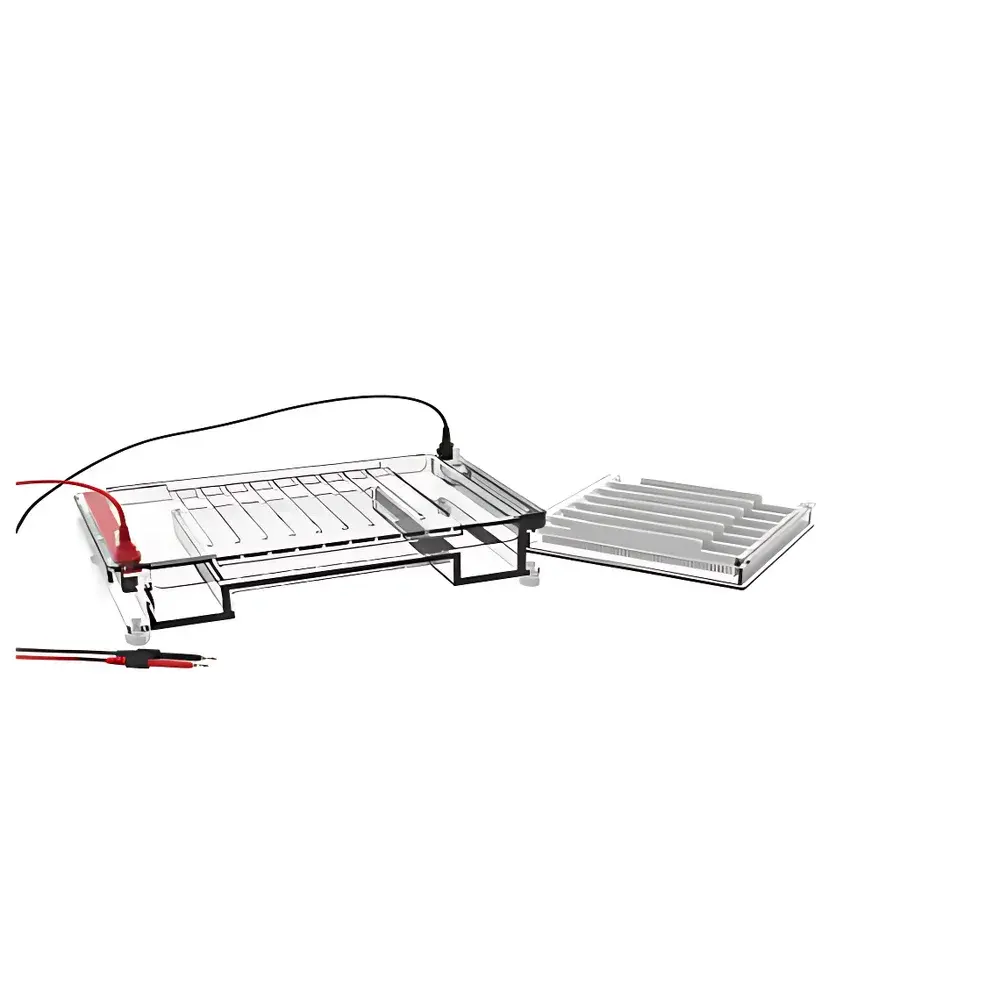
Keebio HE260 Horizontal DNA Electrophoresis Tank
| Brand | Keebio |
|---|---|
| Origin | Shanghai, China |
| Model | HE260 |
| Electrophoresis Tank Type | Horizontal |
| Max Gel Dimensions (mm) | 245 × 250 / 245 × 125 |
| Max Sample Capacity | 350 samples per run |
| Max Voltage | 500 V |
| Buffer Volume Capacity | 1660 mL |
| Gel Casting Volume | 350–400 mL (245×250 mm) or 175–200 mL (245×125 mm) |
| Dimensions (L×W×H, mm) | 440 × 280 × 130 |
| Weight | 3 kg |
| Electrode Material | 99.99% Pure Platinum |
| Adjustable Leveling Feet | Yes |
| Replaceable Electrode Assembly | Yes |
| Comb Options | 1.0 mm & 1.5 mm thickness |
Overview
The Keebio HE260 Horizontal DNA Electrophoresis Tank is a precision-engineered platform for high-throughput nucleic acid separation under standard agarose or polyacrylamide gel electrophoresis (AGE/PAGE) conditions. Designed in accordance with fundamental electrokinetic principles—where charged biomolecules migrate through a porous matrix under a controlled direct current electric field—the HE260 supports reproducible resolution of DNA fragments ranging from 50 bp to >20 kb. Its horizontal configuration enables uniform field distribution across large-format gels, minimizing edge effects and thermal gradient distortion. The system operates within a safe, open-top design compliant with standard laboratory biosafety protocols for UV visualization and ethidium bromide or SYBR-based staining workflows.
Key Features
- Large-format gel compatibility: Accommodates two interchangeable gel trays—245 × 250 mm (standard high-capacity) and 245 × 125 mm (dual-gel or reduced-volume mode)—enabling flexible experimental scaling without hardware modification.
- High-throughput sample loading: Supports up to 350 discrete samples per run using a modular comb system, including seven 52-tooth combs (1.0 mm thick, 35 µL max loading volume per well) and four 26-tooth combs (1.0 mm thick, 70 µL max), all compatible with multichannel pipettes for rapid, consistent loading.
- Tool-free gel casting: Integrated multi-purpose gel former eliminates the need for sealing tape or parafilm; alignment notches and self-leveling tray geometry ensure leak-free polymerization and uniform gel thickness.
- Precision leveling mechanism: Dual bottom-mounted adjustment screws allow fine-tuning of tank horizontality—critical for maintaining even buffer depth and preventing differential migration rates across the gel surface.
- Durable electrode architecture: Platinum-coated electrodes (99.99% purity) provide stable conductivity over extended voltage application (up to 500 V DC), resist oxidation and chloride-induced corrosion, and are fully replaceable to extend service life.
- Optimized thermal management: Large buffer reservoir (1660 mL total capacity) combined with low-resistance electrode geometry minimizes Joule heating during prolonged runs, preserving gel integrity and band sharpness.
Sample Compatibility & Compliance
The HE260 is validated for use with standard electrophoretic buffers—including TAE (Tris-Acetate-EDTA), TBE (Tris-Borate-EDTA), and MOPS—across agarose concentrations from 0.7% to 3.0% and native or denaturing polyacrylamide gels (up to 20%). It meets mechanical and electrical safety requirements aligned with IEC 61010-1 for laboratory equipment. While not certified as a medical device, its construction materials (ABS housing, platinum electrodes, stainless steel hardware) conform to ISO 10993-5 biocompatibility guidelines for indirect contact with biological samples. The open-tank design facilitates integration into GLP-compliant workflows where visual documentation, manual gel excision, and downstream extraction (e.g., PCR cleanup, cloning) are routinely performed.
Software & Data Management
The HE260 is a standalone electrophoresis tank and does not include embedded electronics, microcontrollers, or proprietary software. As such, it requires no firmware updates, driver installation, or cloud connectivity. All operational parameters—including voltage, current, run time, and buffer composition—are set externally via compatible power supplies (e.g., EPS series, Bio-Rad PowerPac). This analog architecture ensures full audit trail transparency: users record settings manually or via external logging systems compliant with FDA 21 CFR Part 11 when paired with validated electronic lab notebooks (ELNs). No data encryption, remote access, or automated reporting features are present—consistent with ISO/IEC 17025 requirements for equipment used in testing laboratories where measurement traceability depends on user-controlled procedural documentation.
Applications
- Routine DNA fragment analysis in molecular biology labs, including PCR product verification, restriction digest profiling, and plasmid quality control.
- High-density genotyping workflows requiring parallel processing of hundreds of samples—e.g., SNP screening, RFLP mapping, and colony PCR validation in academic and contract research settings.
- Teaching laboratories: Robust mechanical design and intuitive operation support student-led experiments on charge-to-mass ratio, sieving effects, and electrophoretic mobility under varying voltage and matrix conditions.
- Quality assurance in diagnostic reagent manufacturing, where consistent gel performance across batches supports SOP-driven release testing per ISO 13485 Annex A.3.
- Preparative electrophoresis for excising bands prior to enzymatic digestion, ligation, or sequencing library preparation—enabled by precise comb spacing and uniform gel thickness.
FAQ
What buffer volumes are required for each gel tray configuration?
For the 245 × 250 mm tray, 350–400 mL of molten agarose is recommended, with total buffer volume maintained at ~1660 mL for optimal ion conduction. For the 245 × 125 mm tray, 175–200 mL agarose is sufficient, and buffer volume may be reduced proportionally while retaining ≥1 cm depth above the gel surface.
Can the HE260 be used with SDS-PAGE or native PAGE gels?
Yes—though optimized for nucleic acids, the tank accommodates standard vertical or horizontal polyacrylamide gel formats when used with appropriate spacers, combs, and running buffers (e.g., Tris-Glycine or Bis-Tris). Note that acrylamide polymerization must occur in sealed casting frames prior to insertion.
Is the platinum electrode assembly field-replaceable without tools?
Yes—the electrode module mounts via captive thumbscrews and slides into precision-machined slots; replacement can be completed in under 90 seconds without disassembly of the main tank body.
Are calibration certificates or factory test reports available?
As a passive electrophoresis platform, the HE260 does not require metrological calibration. However, dimensional verification reports (per ISO 17025-accredited third-party measurement) and material certification for platinum electrodes (ASTM F1137) are available upon request.
Does the system support UV transillumination compatibility?
The transparent acrylic lid (optional accessory) and low-profile gel tray design permit unobstructed placement on standard UV light boxes (254 nm / 302 nm) and digital gel documentation systems without repositioning or adapter hardware.
Related Products



