
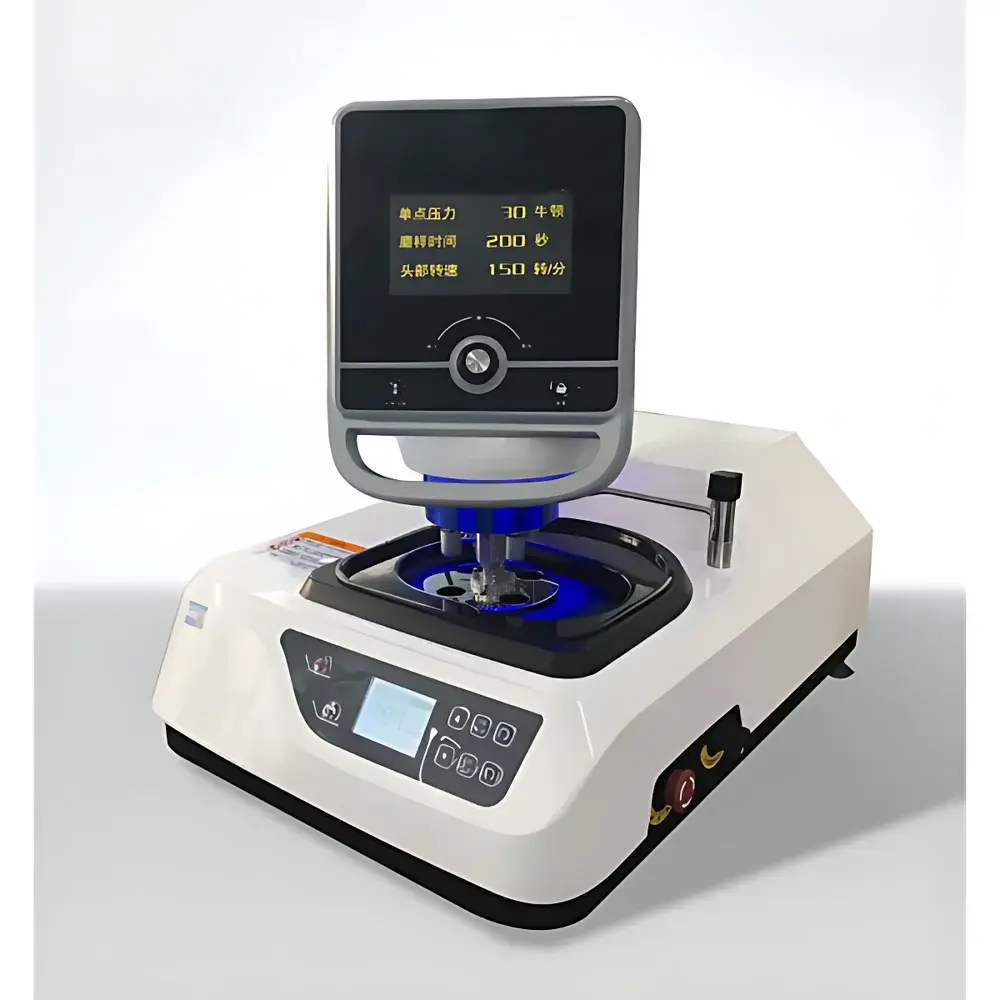
JYMoPao Benchtop Precision Polishing and Grinding Machine for Fused Bead Samples
| Brand | Guangzhou Jingying |
|---|---|
| Origin | Guangdong, China |
| Manufacturer Type | Direct Manufacturer |
| Model | JYMoPao |
| Speed Range | 50–1000 rpm (polishing plate), 50–150 rpm (sample holder) |
| Polishing Plate Diameter | Ø250 mm (customizable: Ø203 mm or Ø300 mm) |
| Sample Capacity | Up to 4 fused bead specimens per cycle |
| Sample Diameter | Ø30 mm (customizable) |
| Cycle Time Range | 0–995 s |
| Dimensions (L×W×D) | 594 × 795 × 687 mm |
Overview
The JYMoPao Benchtop Precision Polishing and Grinding Machine is an engineered solution designed specifically for the final-stage surface preparation of fused bead samples—commonly used in X-ray fluorescence (XRF) spectroscopy, inductively coupled plasma (ICP) analysis, and geochemical reference material certification. Unlike general-purpose grinding systems, the JYMoPao integrates dual-axis independent speed control (polishing plate and sample holder), programmable dwell time, and reproducible load application to ensure planar, scratch-free, and contamination-minimized surfaces essential for quantitative elemental analysis. Its operation adheres to core principles of controlled mechanical abrasion: material removal rate is modulated via rotational velocity, applied pressure, and abrasive medium selection—enabling consistent surface finish across heterogeneous silicate, borate, and phosphate-based beads.
Key Features
- Dual independent motor control: polishing plate (50–1000 rpm) and sample holder (50–150 rpm) operate at user-defined speeds to optimize shear distribution and minimize edge rounding.
- Microprocessor-based digital interface with intuitive parameter entry: preset time (0–995 s), rotational speed, and manual/automatic mode selection—all accessible via tactile keypad and LED display.
- Standard Ø250 mm polishing plate compatible with industry-standard consumables—including silicon carbide papers (P120–P2000), diamond suspension pads (1–6 µm), and synthetic polishing cloths (e.g., napped polyester or woven nylon).
- Four-position sample holder accommodates Ø30 mm fused beads mounted in standard metal or phenolic resin mounts; optional adapters support Ø25 mm and Ø32 mm configurations.
- Rigid cast-iron base and precision-machined column ensure vibration damping and long-term alignment stability—critical for maintaining flatness tolerance < ±0.5 µm across the entire specimen surface.
- Integrated safety interlock prevents operation when the safety guard is open; emergency stop button complies with IEC 60204-1 requirements.
Sample Compatibility & Compliance
The JYMoPao is validated for use with fused beads prepared from geological, metallurgical, cement, and environmental matrices—including but not limited to lithium tetraborate (Li₂B₄O₇), sodium tetraborate (Na₂B₄O₇), and mixed-flux compositions. It supports sample preparation workflows aligned with ASTM E135, ISO 29581-1, and GB/T 176-2017 standards for cement and clinker analysis. While not certified under FDA 21 CFR Part 11, its parameter logging capability (via optional RS232/USB output) enables traceable recordkeeping suitable for GLP-compliant laboratories conducting method validation or proficiency testing.
Software & Data Management
The embedded firmware stores up to 20 user-defined protocols—including speed profiles, dwell times, and sequence steps (e.g., coarse grind → fine polish → final chemo-mechanical polish). Protocol recall is achieved via numeric ID selection. Optional PC connectivity allows export of cycle logs (timestamp, speed setpoint, actual RPM, duration) in CSV format for audit trail generation. No proprietary software installation is required—data transfer uses standard serial communication protocols compatible with LabVIEW, MATLAB, or custom LIMS integrations.
Applications
- Preparation of fused beads for high-precision XRF quantification in mining exploration and ore grade verification.
- Surface finishing of glassy disks prior to wavelength-dispersive (WDXRF) or energy-dispersive (EDXRF) analysis.
- Reproducible polishing of certified reference materials (CRMs) used in inter-laboratory comparison studies.
- Method development for low-Z element analysis (e.g., Na, Mg, Al), where surface topography directly impacts spectral peak shape and background intensity.
- Quality control of fusion furnace outputs—ensuring homogeneity and absence of micro-cracks or flux segregation before instrumental analysis.
FAQ
What types of consumables are compatible with the JYMoPao?
Standard abrasive papers (ISO 6344), diamond-impregnated polishing pads (1–6 µm), and non-woven synthetic cloths are fully supported. Mounting fixtures accept standard 30 mm metal or phenolic mounts.
Can the machine be integrated into automated lab workflows?
Yes—via RS232 or USB serial interface, the JYMoPao accepts external TTL-triggered start commands and reports completion status, enabling synchronization with robotic sample handlers or LIMS-driven scheduling.
Is calibration documentation provided?
A factory calibration certificate is included, verifying rotational speed accuracy (±1.5% full scale) and timer fidelity (±0.5 s over 995 s). Periodic verification can be performed using a handheld tachometer and stopwatch.
Does the system support variable downforce control?
No—the JYMoPao applies fixed mechanical loading via calibrated spring mechanisms. For applications requiring dynamic force modulation, a separate electro-mechanical press module may be interfaced externally.
What maintenance intervals are recommended?
Lubrication of spindle bearings every 500 operating hours; inspection of belt tension and polishing plate flatness every 1,000 hours; replacement of drive belts every 3,000 hours or as wear indicators appear.



