
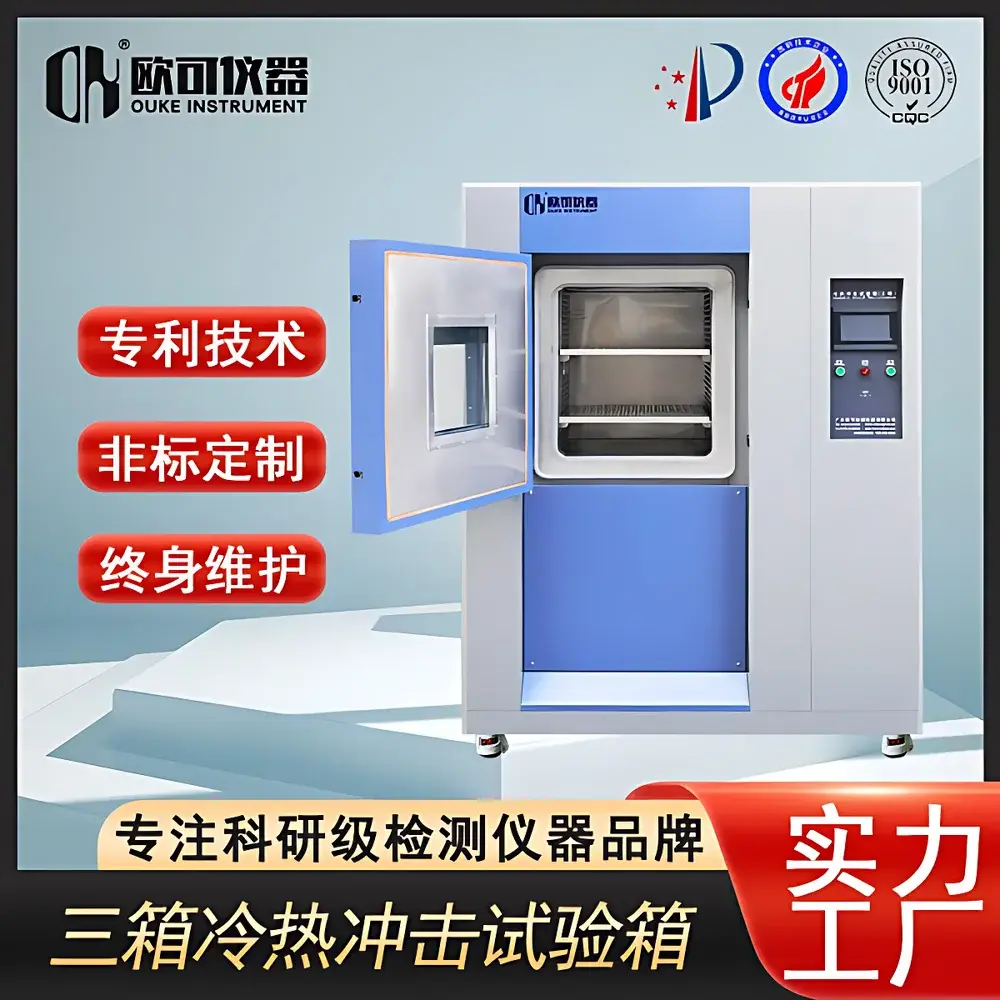
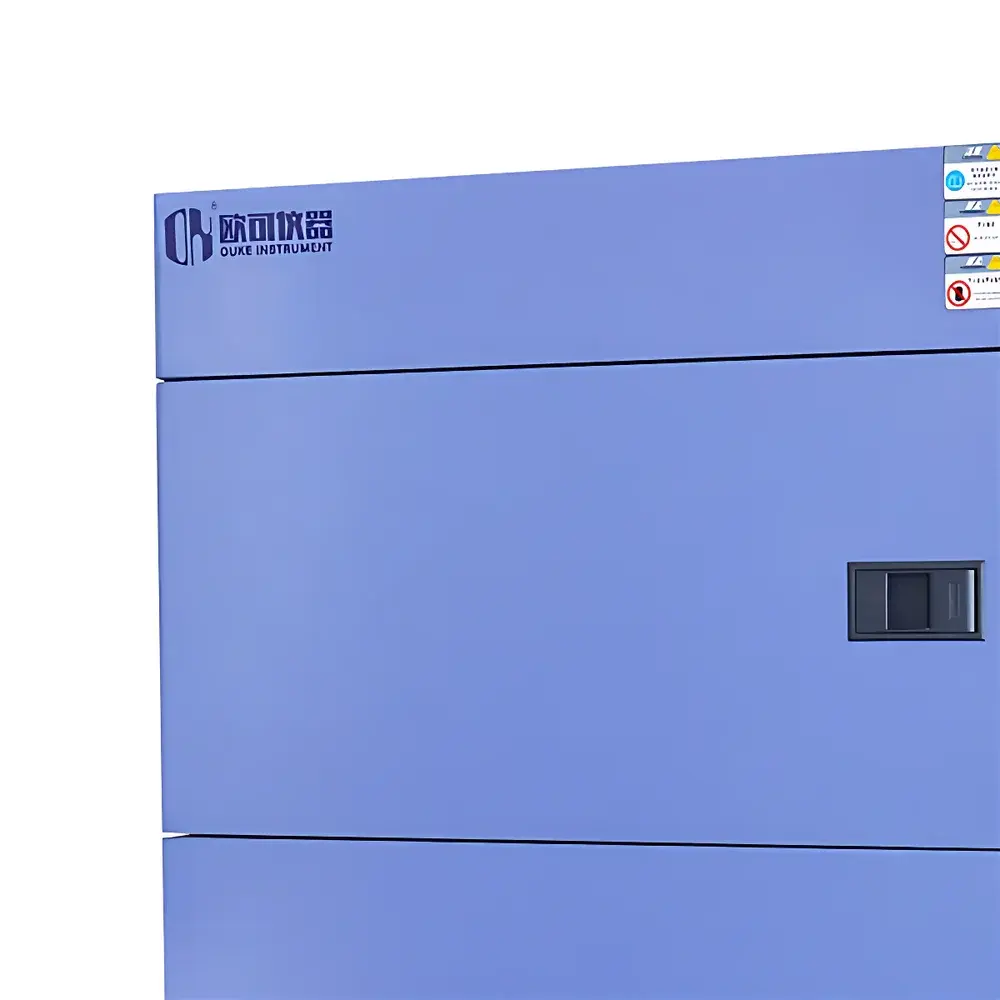
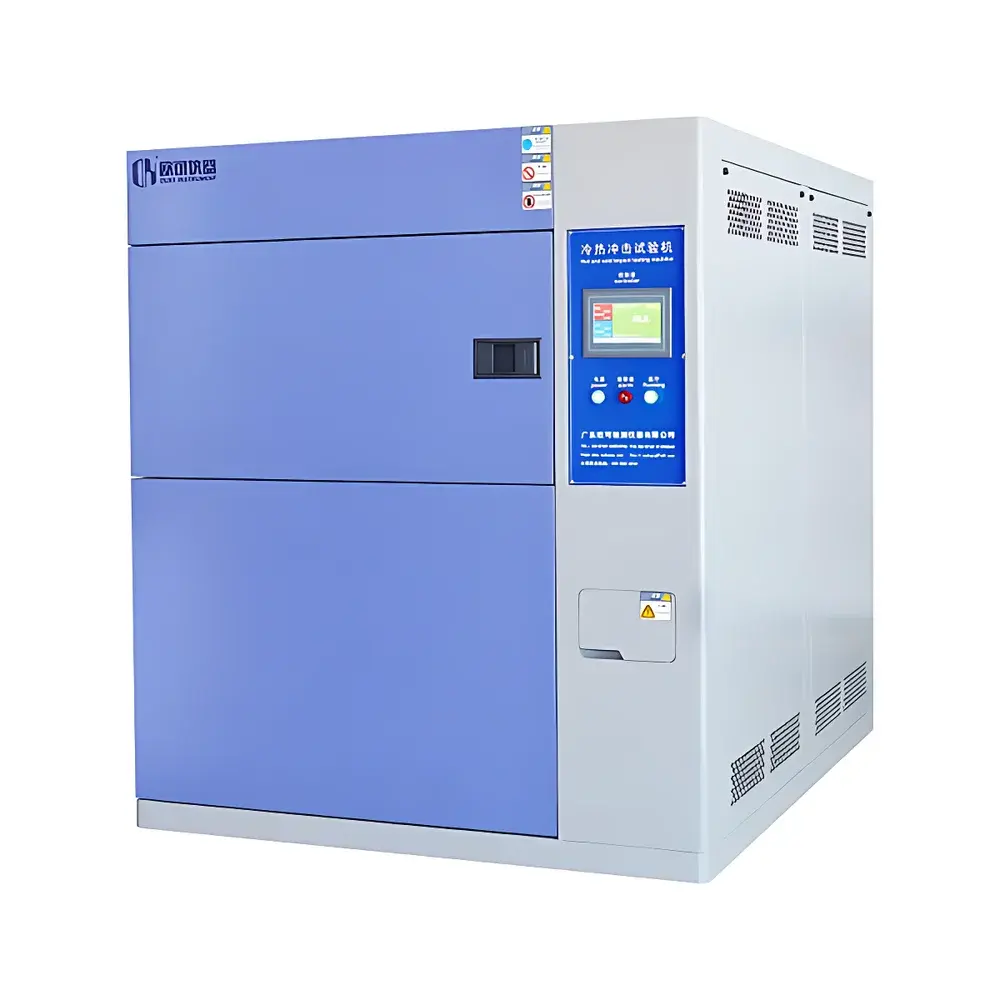
OK-TS-50 Thermal Shock Test Chamber
| Brand | OK Instruments |
|---|---|
| Origin | Guangdong, China |
| Manufacturer Type | OEM/ODM Manufacturer |
| Product Category | Domestic |
| Model | OK-TS-50 |
| High-Temperature Range | +150 °C |
| Low-Temperature Range | −50 °C |
| Thermal Shock Range | −50 °C to +150 °C |
| Temperature Stability | ±2 °C |
| Heating Rate | 10 °C/min (typical) |
| Cooling Rate | 10 °C/min (typical) |
Overview
The OK-TS-50 Thermal Shock Test Chamber is an engineered environmental test system designed for rapid, high-fidelity thermal cycling evaluation of materials and components under extreme temperature transitions. It operates on the principle of accelerated thermal stress induction—subjecting test specimens to abrupt, repeated shifts between predefined high- and low-temperature zones to simulate real-world operational extremes encountered in aerospace, automotive, electronics, and defense applications. Unlike standard temperature-humidity chambers, the OK-TS-50 employs a dual- or triple-zone architecture (configurable per user specification) to achieve true thermal shock conditions defined by IEC 60068-2-14 (Test N: Change of Temperature) and MIL-STD-810G Method 503.5. Its core function is to quantify resistance to thermally induced mechanical fatigue, interfacial delamination, solder joint failure, seal integrity loss, and coefficient-of-thermal-expansion (CTE)-mismatch damage—phenomena that cannot be reliably detected via gradual ramp testing.
Key Features
- Configurable chamber architecture: Available in two-zone (hot/cold lift-basket) or three-zone (hot soak / cold soak / test chamber) configurations to meet specific test protocol requirements per ASTM D6988, GJB 150.5A, or ISO 16750-4.
- Dual-stage cascade refrigeration system utilizing imported semi-hermetic German compressors with water-cooled condensers—enabling stable operation at −50 °C and rapid transition performance.
- Precision temperature control with ±2 °C uniformity across working volume and programmable ramp rates up to 10 °C/min (verified per IEC 60068-3-5).
- Energy-regulated refrigerant flow control to optimize compressor load distribution, reduce thermal lag, and extend system service life without compromising test repeatability.
- Stainless steel 304 interior chamber with reinforced insulation, non-corrosive chamber seals, and integrated over-temperature/over-pressure safety interlocks compliant with EN 61000-6-2 EMC and UL 61010-1 electrical safety standards.
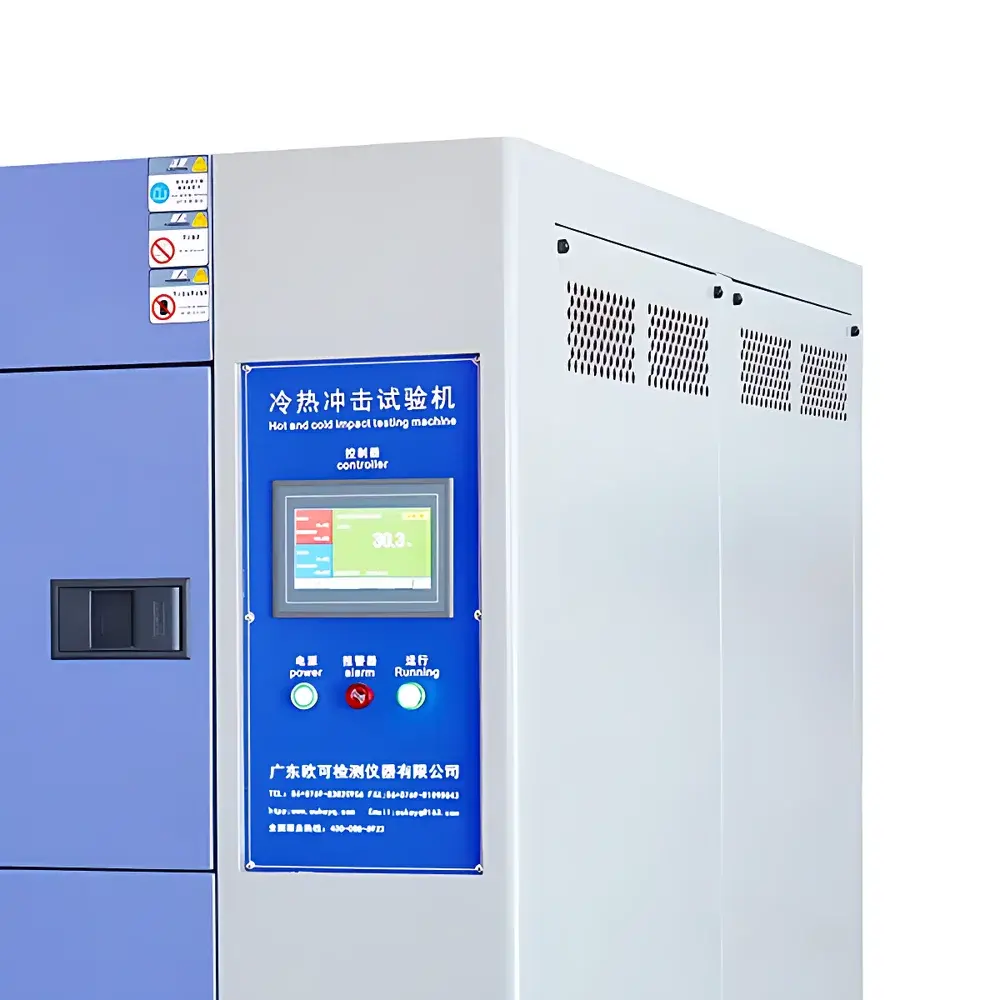
- Touchscreen HMI with multi-language interface (English, Chinese, Spanish), real-time curve logging, and configurable alarm thresholds for deviation monitoring.
Sample Compatibility & Compliance
The OK-TS-50 accommodates specimens up to 50 L internal volume (standard configuration), supporting rigid and semi-flexible samples including PCB assemblies, molded plastic housings, metal alloy coupons, elastomeric gaskets, and hermetically sealed optoelectronic modules. All operational parameters are traceable to national metrological standards via factory calibration certificates (NIST-traceable reference sensors). The chamber meets full compliance with:
- IEC 60068-2-14: Environmental testing – Part 2-14: Tests – Test N: Change of temperature
- GJB 150.5A-2009: Military standard environmental test methods – Temperature shock test
- GB/T 2423.22–2012: Environmental testing for electric and electronic products – Temperature change tests
- ISO 16750-4: Road vehicles – Environmental conditions and testing for electrical and electronic equipment – Climate loads
- EIA-364-32: Thermal shock test procedure for electrical connectors and sockets
- QC/T 17–1992: General rules for weathering tests of automotive components
Validation documentation supports GLP/GMP audit readiness, including IQ/OQ protocols and raw data export in CSV and PDF formats with time-stamped metadata.
Software & Data Management
The embedded control software provides full test sequence programming—including dwell time, transition count, soak duration, and stepwise profile definition—with automatic pass/fail evaluation against user-defined acceptance criteria. Data acquisition records temperature at ≥1 Hz sampling rate from multiple internal PT100 sensors (calibrated annually per ISO/IEC 17025). Exported datasets include timestamped chamber setpoints, actual readings, alarm logs, and compressor runtime metrics. For regulated environments, optional 21 CFR Part 11-compliant software add-on enables electronic signatures, audit trail generation, role-based access control, and secure data archiving—all validated per Annex 11 guidelines.
Applications
- Qualification testing of avionics modules per DO-160 Section 4.5 (Temperature Shock)
- Reliability screening of automotive ECUs prior to AEC-Q200 certification
- Failure mode analysis of solder joints in high-density BGA packages
- Validation of adhesive bond strength in multi-material composites subjected to CTE mismatch
- Accelerated life testing of MEMS sensors and piezoelectric actuators
- Pre-shipment stress screening for industrial IoT gateways operating in outdoor enclosures
FAQ
What is the difference between two-zone and three-zone thermal shock configurations?
Two-zone systems use a mechanical lift basket to shuttle samples between hot and cold chambers, minimizing thermal mass exposure but requiring precise motion synchronization. Three-zone designs isolate test specimens in a neutral chamber while independently conditioning hot/cold reservoirs—reducing cross-contamination risk and enabling faster recovery times between cycles.
Does the OK-TS-50 support automated test reporting?
Yes—built-in reporting engine generates customizable PDF/CSV reports with test summary, deviation alerts, and sensor traceability; optional 21 CFR Part 11 module adds electronic signature capability and immutable audit trails.
Is external cooling water required?
Yes—operation requires a dedicated closed-loop water cooling system delivering 10 m³/h at ≤32 °C inlet temperature, typically supplied via an external cooling tower or chiller plant.
Can the chamber be integrated into a larger test automation framework?
Yes—RS-485 Modbus RTU and Ethernet TCP/IP interfaces support integration with SCADA systems, MES platforms, and LabVIEW-based test orchestration environments.
What calibration standards apply to temperature sensors?
All PT100 sensors are calibrated against NIST-traceable references per ISO/IEC 17025; calibration certificates include uncertainty budgets and as-found/as-left data.



