
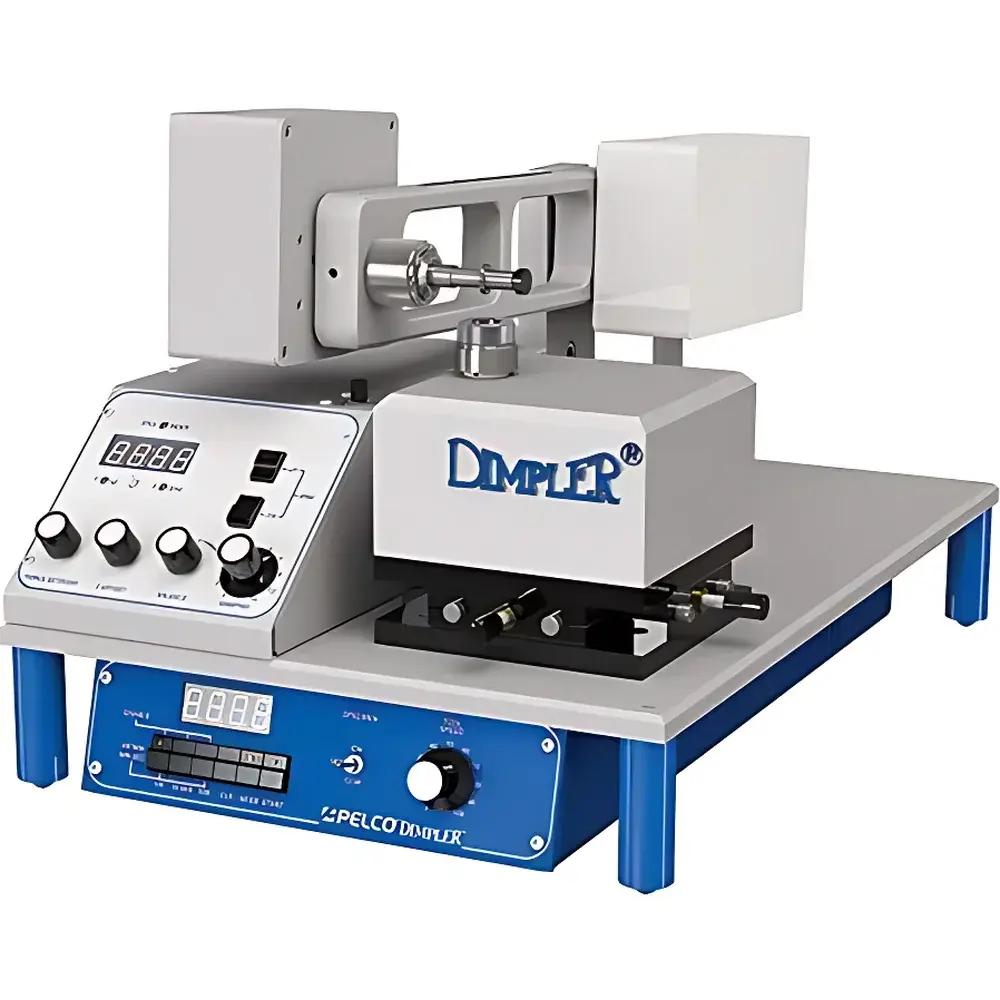
Ted Pella PELCO Dimpler TEM Precision Dimpling Instrument
| Brand | Ted Pella |
|---|---|
| Origin | USA |
| Model | Dimpler |
| Z-Axis Accuracy | ±1 µm |
| Z-Range | 2000 µm |
| Z-Termination Accuracy (Tool 1i/3i) | <±1 µm |
| Z-Termination Accuracy (Tool 2i/4i) | <±2 µm |
| Tool Load Range | 1–200 g (1 g increments) |
| Balance Sensitivity | 1 g (Range: 50 g) |
| Tool Rotation Speed | 100–600 RPM |
| Platen Rotation Speed | 10 RPM |
| Spindle Runout (TIR) | 0.5 µm |
| Tool TIR (1i/3i) | <±1 µm |
| Tool TIR (2i/4i) | <±2 µm |
| Platen Surface TIR | <0.5 µm |
| Dimensions (L×W×H) | 68.6 × 35.6 × 33 cm |
| Weight | 32 kg |
| Power Input | 85–264 VAC, 47–63 Hz |
| Product Codes | 84000 (Dimpler), 83050 (Video Alignment Tool), 83031 (Standard 3 mm TEM Tool Set), 83032 (Adjustable Clamp Assembly), 83001 (Sapphire Sample Holder) |
Overview
The Ted Pella PELCO® Dimpler is a precision electromechanical dimpling instrument engineered for reproducible, controlled thinning of electron-transparent specimens prior to final ion milling or electropolishing in transmission electron microscopy (TEM) sample preparation workflows. Unlike manual or semi-automated grinding systems, the Dimpler employs closed-loop Z-axis position monitoring and real-time load feedback to dynamically regulate tool engagement depth and applied force—enabling automated termination at user-defined thickness thresholds. Its core mechanism operates on a dual-rotation principle: the specimen-mounted platen rotates slowly at 10 RPM while the counter-rotating grinding tool spins at 100–600 RPM, minimizing localized heating and mechanical damage. The system achieves dimensional repeatability within ±1 µm across successive runs, making it suitable for high-throughput TEM labs requiring strict process control and auditability under GLP or GMP-aligned protocols.
Key Features
- High-precision Z-axis control with <±1 µm termination accuracy for Tools 1i and 3i, and <±2 µm for Tools 2i and 4i—ensuring consistent final thickness across diverse material classes.
- Motorized tool feed with 0.5 µm per step resolution and total 2000 µm travel range, enabling fine-grained adjustment of dimple depth profiles.
- Load-controlled operation with programmable force application from 1 g to 200 g in 1 g increments; integrated balance sensitivity of 1 g over a 50 g dynamic range ensures stable, vibration-resistant contact pressure.
- Ultra-low runout design: spindle TIR ≤0.5 µm, tool TIR <±1 µm (1i/3i) or <±2 µm (2i/4i), and platen surface TIR <0.5 µm—critical for uniform material removal and avoidance of edge artifacts.
- Dual-speed independent drive system: constant 10 RPM platen rotation coupled with variable 100–600 RPM tool speed allows optimization for brittle vs. ductile materials.
- Modular accessory architecture supporting standardized 3 mm TEM discs (via part #83031), adjustable clamping assemblies (#83032), sapphire sample holders (#83001), and optional video alignment tools (#83050) for real-time positional verification.
Sample Compatibility & Compliance
The PELCO Dimpler accommodates a broad spectrum of inorganic and composite materials commonly encountered in semiconductor failure analysis, metallurgical research, and advanced ceramics development—including silicon, GaAs, Ge, sapphire, SiO₂, SiC, TiB₂, MoSi₂, borosilicate glass, multiphase alloys (e.g., Al-based systems), structural ceramics, carbon fibers, and carbon-carbon composites. Its low-force, low-heat dimpling strategy minimizes subsurface deformation and phase transformation—particularly advantageous for III–V compound semiconductors and radiation-sensitive oxides. The instrument complies with general electrical safety standards for laboratory equipment (IEC 61010-1) and supports traceable process documentation when integrated into validated TEM preparation SOPs aligned with ISO/IEC 17025 or ASTM E1558 guidelines for electron microscopy specimen preparation.
Software & Data Management
While the Dimpler operates via front-panel controls without embedded firmware or proprietary software, its mechanical repeatability and parameter stability enable full integration into laboratory information management systems (LIMS) and electronic lab notebooks (ELN). Users may log critical parameters—including tool ID, load setpoint, rotation speeds, dimple depth target, and termination timestamp—manually or via external data capture tools. Optional video alignment accessories facilitate image-based validation of tool centering and specimen positioning, supporting 21 CFR Part 11-compliant audit trails when paired with secure digital imaging platforms. All mechanical adjustments are physically indexed and mechanically locked, ensuring configuration integrity between sessions without reliance on volatile memory or calibration drift correction algorithms.
Applications
- Routine preparation of site-specific TEM lamellae from bulk wafers and cross-sectioned devices in semiconductor process development and failure analysis.
- Controlled thinning of brittle ceramic and intermetallic samples where conventional grinding induces microcracking or delamination.
- Pre-thinning of large-area specimens (>3 mm diameter) prior to focused ion beam (FIB) lift-out or plasma FIB processing.
- Standardized dimpling for inter-laboratory comparison studies requiring metrologically traceable thickness endpoints.
- Training platform for TEM sample prep technicians due to intuitive mechanical interface and visual feedback during tool engagement.
FAQ
What materials are compatible with the PELCO Dimpler?
The instrument is validated for use with silicon, III–V semiconductors (e.g., GaAs, InP), group IV elements (Ge), sapphire, oxides (Al₂O₃, SiO₂), carbides (SiC, WC), borides (TiB₂), silicides (MoSi₂), glasses, aluminum alloys, structural ceramics, carbon-based materials, and multiphase composites.
Does the Dimpler require routine recalibration?
No. Its mechanical Z-axis encoder, hardened spindle assembly, and fixed-platen geometry eliminate drift-related recalibration needs; periodic verification using certified gauge blocks or interferometric thickness standards is recommended annually per ISO/IEC 17025.
Can the Dimpler be used for cryo-TEM sample preparation?
Not directly—the system lacks cryogenic cooling capability. However, pre-dimpled specimens can be transferred to cryo-compatible holders post-processing for subsequent plunge-freezing or cryo-FIB workflows.
Is the video alignment tool necessary for routine operation?
It is optional but strongly recommended for first-time users and applications requiring precise tool-to-specimen centering, such as asymmetric dimpling or multi-step thinning sequences.
What power supply specifications does the Dimpler support?
The unit accepts universal AC input (85–264 VAC, 47–63 Hz), making it compatible with standard laboratory outlets worldwide without external transformers or voltage converters.




