
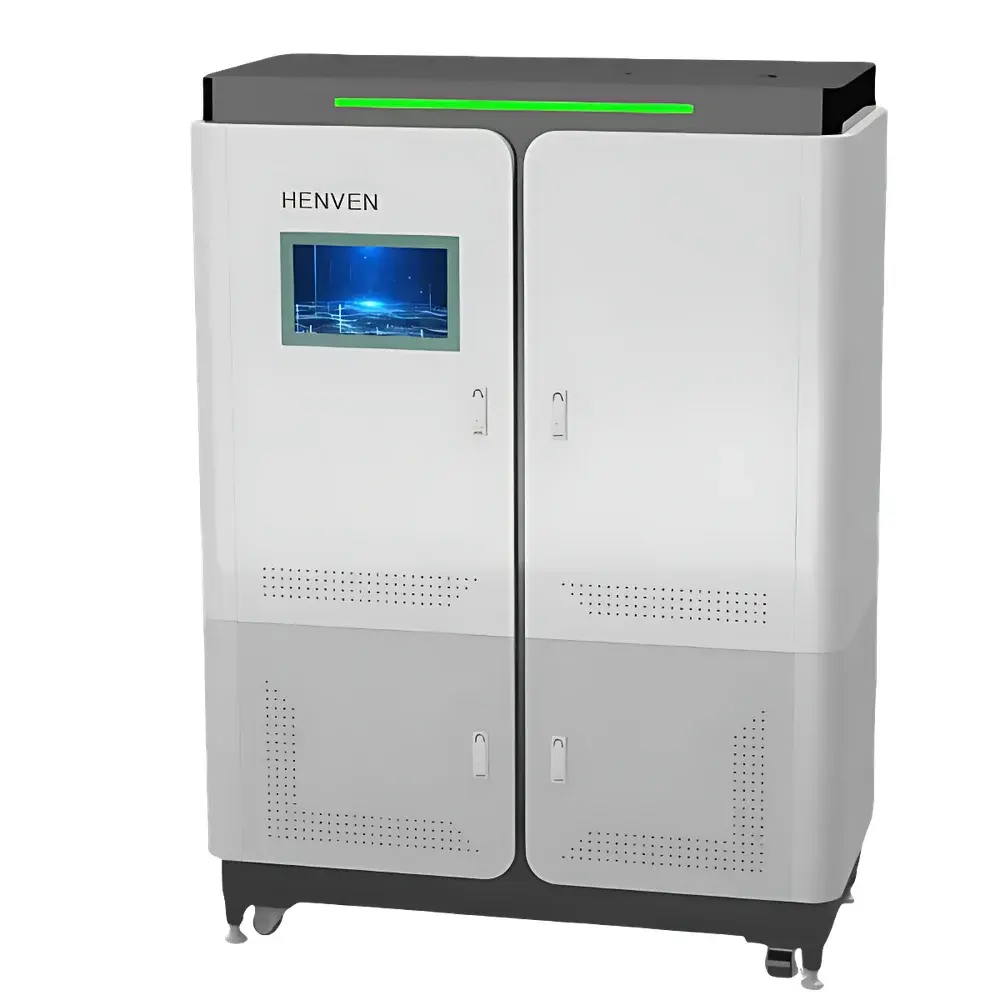
Henven HWD-50g/500g High-Capacity Thermogravimetric Analyzer
| Brand | Henven |
|---|---|
| Origin | Beijing, China |
| Manufacturer Type | Direct Manufacturer |
| Origin Category | Domestic (China) |
| Model | HWD-50g/500g |
| Operating Environment | Ambient Pressure |
| Sample Capacity | Single Sample |
| Instrument Type | Dedicated TGA System |
| Temperature Range | RT to 1100 °C |
| Temperature Accuracy | ±0.1 °C |
| Temperature Uniformity | ±0.1 K |
| Dynamic Weighing Range | 10–50 g |
| Balance Sensitivity | 1000 µg |
| Mass Accuracy | 0.01% (100 ppm) |
| Heating/Cooling Rate | 0.1–40 K/min |
| Maximum Sample Mass | 500 g |
| Baseline Drift | ≤0.01% over 60 min |
| Weight Resolution | 1 mg |
| Weight Noise | <1 mg |
| Gas Control | Triple Mass Flow Controllers (MFCs) |
| Crucible Dimensions | Ceramic, Ø80 mm × H70 mm |
| Water Vapor Generator Output | 0.01–1000 mL/min (±0.01 mL/min resolution) |
Overview
The Henven HWD-50g/500g High-Capacity Thermogravimetric Analyzer is an engineered solution for quantitative thermal stability and compositional analysis of bulk materials under controlled atmospheric conditions. Operating on the principle of thermogravimetry—continuous high-precision mass measurement as a function of temperature or time under defined gas environments—the HWD series enables rigorous characterization of decomposition kinetics, phase transitions, hydration/dehydration behavior, oxidative stability, and volatile evolution profiles. Unlike conventional micro-TGAs limited to sub-gram samples, the HWD platform accommodates sample masses up to 500 g, supporting statistically representative analysis of heterogeneous industrial feedstocks, catalysts, polymers, pharmaceutical excipients, coal, biomass, and refractory ceramics. Its dual-thermocouple architecture—one monitoring furnace setpoint temperature independently of operational state, the other measuring actual sample-zone temperature during heating—ensures traceable thermal calibration per ISO 11358-1 and ASTM E1131. The integrated water vapor generator (0.01–1000 mL/min, ±0.01 mL/min resolution) allows reproducible humidified atmosphere testing aligned with ASTM D7569 and ICH Q5C hydrolytic stability protocols.
Key Features
- Fully motorized vertical furnace lift mechanism—enables automated sample loading/unloading and eliminates manual handling-induced thermal disturbance.
- Dual independent thermocouple system: one fixed in furnace wall for setpoint validation; one positioned adjacent to crucible for real-time sample-zone temperature feedback—critical for kinetic modeling accuracy.
- Modular crucible design: interchangeable ceramic crucibles (Ø80 mm × H70 mm) support both micro-scale validation runs (10–50 g) and macro-scale process-relevant testing (up to 500 g), with optional custom geometry available.
- Triple-channel mass flow controller (MFC) gas delivery system—provides precise, independent control of purge, reactant, and carrier gases with full digital logging and pressure compensation.
- Integrated saturated water vapor generator—capable of delivering stable, calibrated humid atmospheres for accelerated aging, hydrolysis, and corrosion studies compliant with USP <1208> and ISO 15148.
- Self-contained temperature calibration routine—users perform in-situ verification using certified reference materials (e.g., Ni, Cu, Al₂O₃) to validate both temperature accuracy (±0.1 °C) and mass linearity across the full dynamic range.
- Real-time LCD interface with dual-axis plotting—simultaneously displays TG, DTG, and DDTG curves with selectable abscissa (temperature or time) and ordinate (absolute mass or % mass loss).
Sample Compatibility & Compliance
The HWD analyzer accepts solid, granular, powdered, and pelletized samples without pre-grinding—eliminating preparation bias common in micro-TGA workflows. Its large-volume crucible design minimizes edge effects and ensures uniform heat/mass transfer for materials with low thermal conductivity (e.g., insulating polymers, clays, biochar). The instrument complies with core regulatory frameworks for thermal analysis: data acquisition meets FDA 21 CFR Part 11 requirements for electronic records and signatures when operated with validated software; thermal calibration procedures align with ISO/IEC 17025:2017 clause 6.4.10; and baseline drift performance (<0.01% over 60 min) satisfies GLP-compliant method validation criteria per OECD TG 113. All gas lines, MFCs, and vapor generators are constructed from electropolished 316 stainless steel and VCR-fitted to prevent adsorption artifacts.
Software & Data Management
Embedded firmware and PC-based analysis suite support full lifecycle data integrity—from raw mass/temperature acquisition through kinetic modeling (Friedman, Ozawa-Flynn-Wall, Kissinger-Akahira-Sunose) to comparative overlay and statistical deviation mapping. Software features include audit trail logging (user ID, timestamp, parameter changes), automatic report generation (PDF/Excel), and export-ready datasets compatible with ASTM E1641-compliant third-party analysis tools. Raw data files are stored in open-format ASCII (.txt) with metadata headers, enabling long-term archival and reprocessing without proprietary dependency. Optional integration with GC/MS via heated transfer line (maintained at user-defined constant temperature) supports evolved gas analysis (EGA) workflows under ISO 11358-2.
Applications
- Thermal degradation profiling of polymer composites and flame-retardant formulations at industrially relevant mass scales.
- Coal rank determination and ash fusion behavior assessment per ASTM D3172 and D5373.
- Moisture sorption/desorption isotherms and bound-water quantification in pharmaceutical powders and food matrices.
- Catalyst deactivation kinetics under simulated reactor conditions (oxidizing/reducing/humid atmospheres).
- Calcination yield optimization for metal oxide precursors (e.g., LiCoO₂, NiFe₂O₄) in battery material synthesis.
- Waste-to-energy feedstock characterization—including municipal solid waste (MSW), sewage sludge, and agricultural residues.
FAQ
What is the maximum allowable sample mass for kinetic modeling applications?
The HWD-500g configuration supports up to 500 g for compositional screening; however, for reliable kinetic parameter extraction (Eₐ, A), we recommend 50–200 g to maintain thermal homogeneity and minimize intra-sample temperature gradients.
Can the instrument operate under vacuum or inert gas with continuous mass flow monitoring?
Yes—gas routing supports vacuum evacuation (down to 10⁻² mbar) followed by purging with N₂, Ar, He, or synthetic air, with all three MFCs actively logged and adjustable during runtime.
Is baseline correction performed automatically or manually?
Both options are available: real-time auto-zeroing prior to each run and post-acquisition polynomial or spline-based baseline subtraction with user-defined anchor points.
Does the water vapor generator introduce condensation risk in downstream gas lines?
No—the entire vapor delivery path, including mixing chamber and transfer tubing, is actively heated and insulated to ≥120 °C, preventing condensation and ensuring gaseous-phase delivery to the sample zone.
How is temperature calibration verified across the full 1100 °C range?
Using certified reference materials with known phase transitions (e.g., Ni Curie point at 354 °C, Cu melting at 1084.62 °C), users execute multi-point calibration routines traceable to NIST SRMs, with results stored in instrument history logs.



