
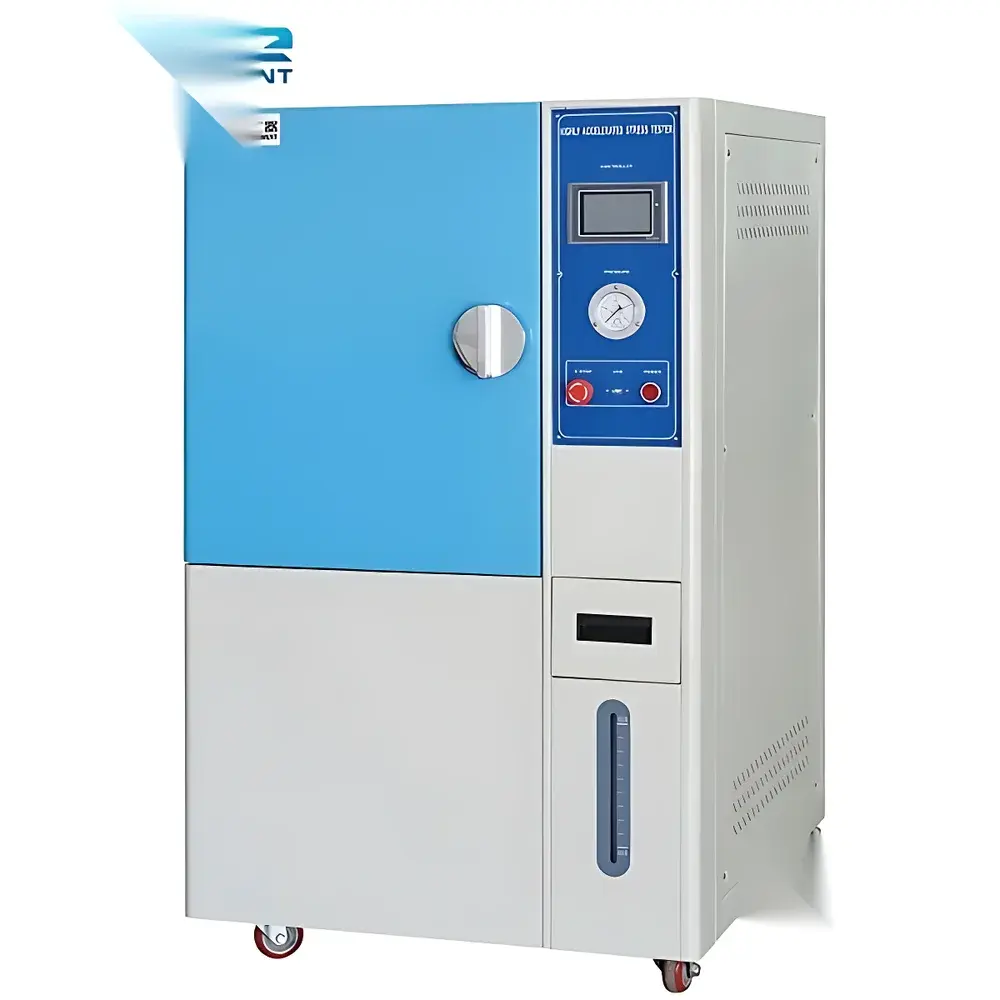
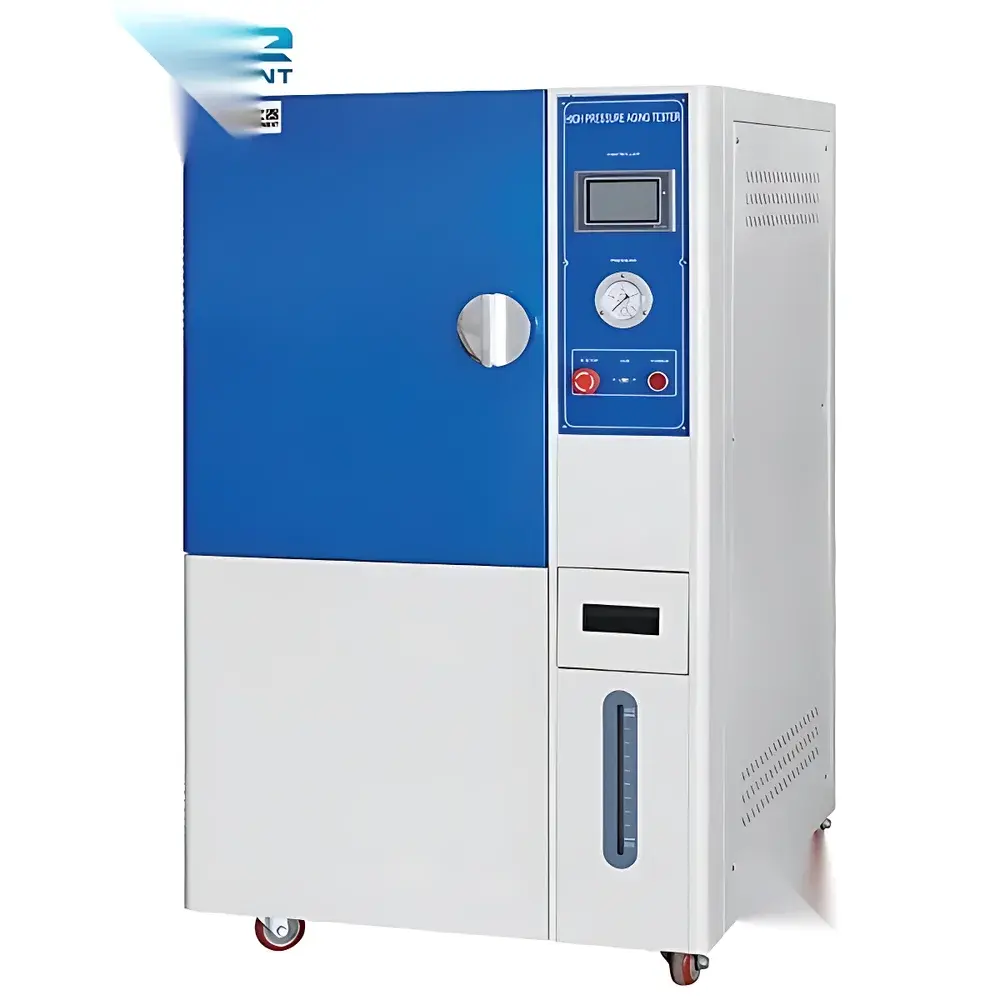
High-Pressure Steam Aging Chamber
| Brand | Other Brands |
|---|---|
| Origin | Imported |
| Manufacturer Type | Authorized Distributor |
| Price | USD 4,100 (FOB) |
| Temperature Control Accuracy | ±0.5 °C |
| Temperature Resolution | 0.1 °C |
| Pressure Control Accuracy | ±0.15 kgf/cm² |
| Vacuum Preconditioning | Integrated with <1 µm particulate filtration |
| Continuous Operation | Up to 999 h with auto-refill |
| Safety Interlock | Dual-mode (pressure-activated door lock + thermal limit cutoff) |
| Compliance | ASTM D2000, ISO 188, JIS K6257, CNS 12917, MIL-STD-810H, IEC 60068-2-66 |
Overview
The High-Pressure Steam Aging Chamber is an engineered environmental test system designed for accelerated life testing and hermeticity evaluation of components subjected to high-humidity, high-pressure saturated steam conditions. Operating on the principle of accelerated hydrothermal aging—where elevated temperature and pressure synergistically increase water vapor partial pressure and diffusion kinetics—the chamber replicates decades of moisture-induced degradation in hours or days. It is widely deployed in reliability engineering workflows during design validation, qualification testing, and failure analysis for mission-critical components across aerospace, automotive electronics, medical device packaging, and semiconductor assembly. Unlike conventional humidity chambers, this unit maintains true saturated steam equilibrium (100% RH at elevated pressure), enabling rigorous assessment of seal integrity, polymer hydrolysis resistance, corrosion initiation, and interfacial delamination under thermodynamically intensified stress.
Key Features
- Cylindrical stainless-steel inner chamber conforming to ASME BPVC Section VIII Division 1 structural safety standards—eliminates condensate pooling and ensures uniform thermal distribution.
- Self-sealing silicone elastomer gasket system: utilizes differential pressure assist—increasing sealing force proportionally with internal pressure—extending gasket service life by up to 3× versus static compression designs.
- Integrated vacuum preconditioning cycle: evacuates ambient air prior to steam introduction and filters incoming air through a ≤1 µm particulate filter, maintaining internal cleanliness per ISO Class 8 (Class 100,000) requirements.
- Dual-mode water replenishment: manual fill supports up to 1 h continuous operation; fully automated refill system enables unattended 999-hour test cycles without interruption.
- Fail-safe mechanical and electronic interlocks: door remains physically locked when internal pressure exceeds 0.1 kgf/cm²; real-time pressure–temperature correlation monitoring prevents unsafe opening.
- LIMIT-based critical protection architecture: monitors 12+ fault vectors—including overpressure, overheating, sensor drift, and power anomaly—with LED fault-code display and automatic shutdown.
- Post-test depressurization protocol: executes controlled pressure release upon cycle completion, followed by timed hot-air drying to prevent residual condensation on test specimens.
Sample Compatibility & Compliance
The chamber accommodates samples up to Ø600 mm × 800 mm (customizable), including PCB assemblies, hermetically sealed sensors, MEMS packages, automotive connectors, pharmaceutical blister packs, and multilayer ceramic capacitors. Its operational envelope meets the technical requirements of multiple international reliability standards: ASTM D2000 (elastomer classification), ISO 188 (heat aging of vulcanized rubber), JIS K6257 (accelerated aging of rubber), CNS 12917 (electronic component steam aging), MIL-STD-810H Method 507.6 (high-humidity storage), and IEC 60068-2-66 (damp heat, cyclic, high pressure). All control algorithms and data logging functions are structured to support GLP/GMP audit readiness, with optional 21 CFR Part 11-compliant software add-ons available for regulated industries.
Software & Data Management
Equipped with a microprocessor-based controller featuring LED-display interface, the system provides real-time visualization of saturated steam temperature (range: 100–135 °C), chamber pressure (0–3.0 kgf/cm²), elapsed time, and vacuum status. PID + SSR control ensures stable saturation point maintenance within ±0.5 °C and ±0.15 kgf/cm² tolerances. Optional Ethernet/RS-485 connectivity enables integration with LabView, MATLAB, or enterprise MES platforms. Data export supports CSV and PDF formats, with timestamped event logs capturing all setpoint changes, alarms, and safety interventions—fully traceable for internal QA review or regulatory submission.
Applications
- Accelerated moisture ingress testing of plastic encapsulated microcircuits (PEMs) per JEDEC JESD22-A110.
- Hermetic seal validation for implantable medical devices and sterile barrier systems.
- Corrosion susceptibility screening of aluminum housings, solder joints, and copper traces under high-partial-pressure steam.
- Hydrolytic stability assessment of polyamide (PA6/PA66), polybutylene terephthalate (PBT), and epoxy molding compounds (EMCs).
- Qualification of conformal coatings and underfill materials used in automotive ADAS modules.
- Process validation for steam sterilization compatibility of non-metallic components in Class II/III medical devices.
FAQ
What standards does this chamber specifically support for automotive electronics qualification?
It complies with AEC-Q200 stress test requirements for humidity resistance, as well as ISO 16750-4 (road vehicles—environmental conditions) and GMW3172 (material and component testing).
Can the chamber operate without external compressed air or nitrogen supply?
Yes—vacuum generation and steam pressurization are fully self-contained using integrated electric vacuum pump and resistive steam generator; no auxiliary gas sources required.
Is the controller capable of executing multi-step profile testing?
Standard configuration supports single-setpoint soak tests; programmable multi-segment profiles (e.g., ramp-soak-depressurize-dry) are enabled via optional firmware upgrade and PC-based configuration software.
How is calibration traceability maintained?
Each unit ships with NIST-traceable calibration certificates for both PT100 temperature sensors and piezoresistive pressure transducers, valid for 12 months; annual recalibration kits and certified service are available globally.



