
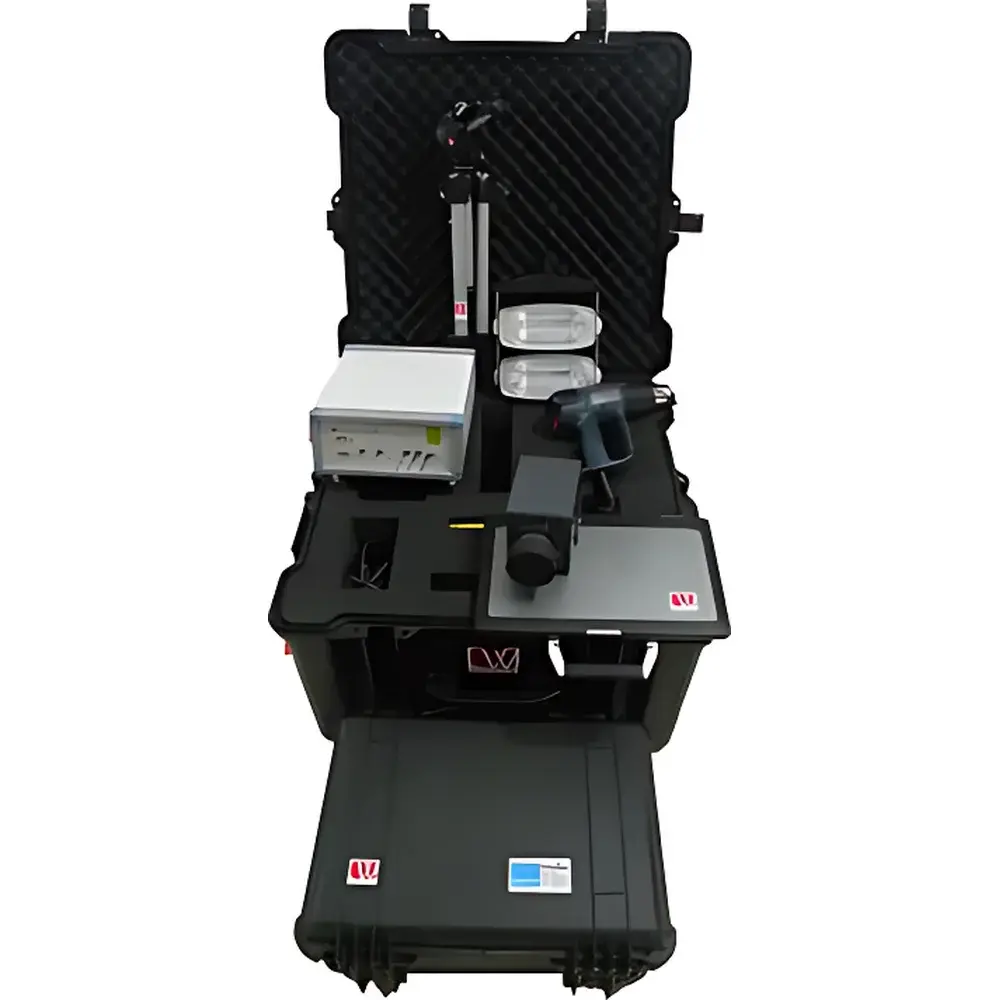
WTKX-IRNDT-1001 Portable Active Thermographic NDT System
| Origin | Beijing, China |
|---|---|
| Manufacturer Type | Authorized Distributor |
| Origin Category | Domestic (PRC) |
| Model | WTKX-IRNDT-1001 |
| Pricing | Available Upon Request |
Overview
The WTKX-IRNDT-1001 Portable Active Thermographic NDT System is an engineered solution for non-contact, single-sided subsurface defect characterization using pulsed or modulated thermal excitation combined with high-speed infrared imaging. Based on the physical principle of transient heat diffusion—governed by Fourier’s law and the thermal diffusivity (α = k/ρcp) of materials—the system detects anomalies such as disbonds, delaminations, impact damage, porosity, and inclusions by analyzing spatiotemporal surface temperature evolution. Unlike passive thermography, this active configuration applies controlled external thermal energy (via flash lamps, halogen arrays, or modulated LED sources) to induce measurable thermal contrast across subsurface discontinuities. Its design prioritizes field-deployable operation without compromising measurement repeatability or spatial resolution, making it suitable for both laboratory-based material qualification and real-time in-service inspection under ambient or constrained environmental conditions.
Key Features
- Single-sided, non-contact inspection: Eliminates need for access to both sides of the test object; no couplant, coating removal, or surface preparation required.
- Broad material compatibility: Validated for metals (Al, Ti, stainless steel), composites (CFRP, GFRP), ceramics, polymers, honeycomb cores, and historic substrates including stone, wood, and plaster.
- High-speed acquisition: Captures full-frame thermal sequences at up to 60 Hz (configurable), enabling dynamic thermal response analysis over time domains from milliseconds to seconds.
- Automated mosaic stitching: Software-driven image registration and blending for seamless large-area coverage—critical for aircraft skins, wind turbine blades, and pressure vessel weld zones.
- Multi-modal excitation support: Compatible with pulse, lock-in (sinusoidal modulation), and step-heating stimulation protocols—each optimized for depth sensitivity, signal-to-noise ratio, or defect type discrimination.
- Quantitative depth estimation: Implements established inverse heat conduction algorithms (e.g., thermal quadrupole method, 1D/2D thermal modeling) to estimate defect depth with uncertainty bounds traceable to calibration standards.
- Ruggedized portable architecture: Integrated battery power, shock-absorbing housing, and IP54-rated enclosure for operation in hangars, shipyards, power plants, and outdoor cultural heritage sites.
Sample Compatibility & Compliance
The WTKX-IRNDT-1001 supports inspection of flat, curved, and moderately complex geometries with surface emissivity ≥0.6 (adjustable via software-based emissivity mapping). It complies with core requirements of ASTM E1934–19 (Standard Guide for Examining Electrical Heaters and Thermal Insulation Using Infrared Thermography), ISO 18251–1:2021 (Non-destructive testing — Thermographic testing — Part 1: General principles), and EN 13187:2014 (Thermal performance of buildings — Qualitative detection of thermal irregularities in building envelopes — Infrared method). For regulated industries—including aerospace (AS9100-aligned workflows), nuclear (ANSI N45.2.23), and pharmaceutical manufacturing—the system supports audit-ready data export with embedded metadata (time stamp, excitation parameters, camera settings, operator ID) and optional integration with GLP/GMP-compliant electronic lab notebooks.
Software & Data Management
The system runs on a Windows 7–10 (64-bit) platform with proprietary thermographic analysis software featuring intuitive GUI navigation, context-sensitive tooltips, and workflow-guided operation. All functions—thermal excitation control, IR image capture, sequence processing, defect annotation, and report generation—are integrated into a single interface. Advanced processing includes PCA (Principal Component Analysis), PPT (Pulse Phase Thermography), and TSR (Thermal Signal Reconstruction) algorithms to enhance contrast between defective and sound regions. Data files are stored in vendor-neutral HDF5 format with embedded calibration coefficients and EXIF-like metadata. Export options include CSV (for depth/area metrics), AVI/MPEG-4 (for dynamic thermal videos), and PDF reports compliant with ISO/IEC 17025 documentation requirements. Optional 21 CFR Part 11 add-on provides electronic signature, audit trail, and user role-based access control.
Applications
- Aerospace: Detection of impact damage, water ingress, and adhesive bond failures in composite fuselage panels and wing structures.
- Energy: Inspection of thermal barrier coatings on gas turbine blades; assessment of insulation integrity in steam piping and reactor containment vessels.
- Automotive: Validation of adhesive bonding quality in EV battery enclosures and carbon-fiber body components.
- Cultural Heritage: Subsurface crack mapping in frescoes, delamination detection beneath gilding layers, and moisture distribution analysis in historic masonry.
- Manufacturing QA: In-line verification of honeycomb core integrity in sandwich panels prior to final assembly.
- Research & Development: Quantitative evaluation of thermal contact resistance at interfaces, aging effects in polymer matrix composites, and laser-weld joint quality.
FAQ
What types of defects can the WTKX-IRNDT-1001 reliably detect?
It identifies subsurface discontinuities including delaminations, disbonds, voids, impact damage, and inclusions—provided their thermal contrast and lateral dimensions exceed the system’s spatial and temporal resolution limits.
Is calibration required before each inspection?
A factory-performed radiometric calibration is valid for 12 months; field verification using NIST-traceable blackbody sources is recommended prior to critical inspections.
Can the system operate outdoors under variable ambient temperatures?
Yes—adaptive background subtraction and real-time emissivity correction mitigate solar loading and convective cooling effects, though optimal results are achieved within ±15°C of stabilized ambient conditions.
Does the software support automated defect classification?
The base package includes threshold-based segmentation and manual ROI annotation; AI-assisted classification modules (CNN-based) are available as licensed add-ons for high-throughput production environments.
Is training and technical support provided internationally?
Comprehensive remote and on-site training programs—covering physics fundamentals, operational procedures, and standards alignment—are delivered globally by certified thermography instructors accredited to ISO 18436–7 Level 2.



