
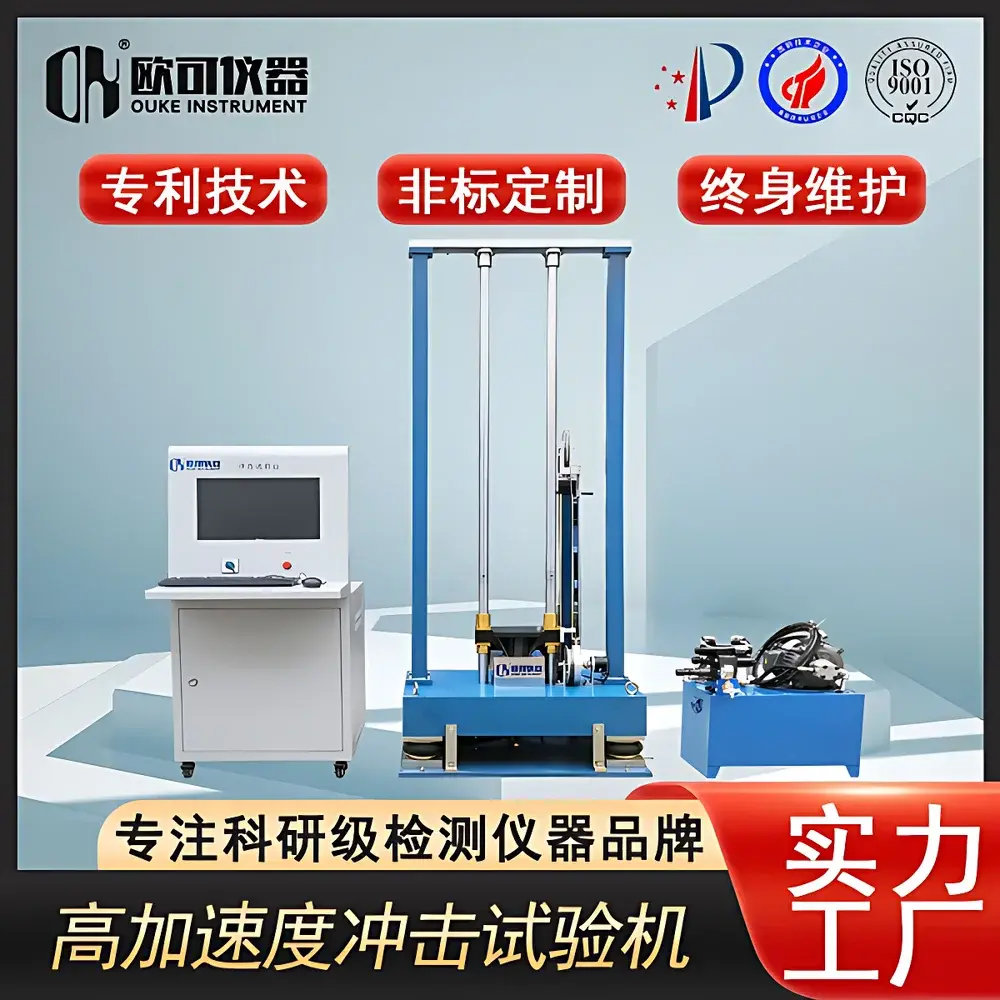
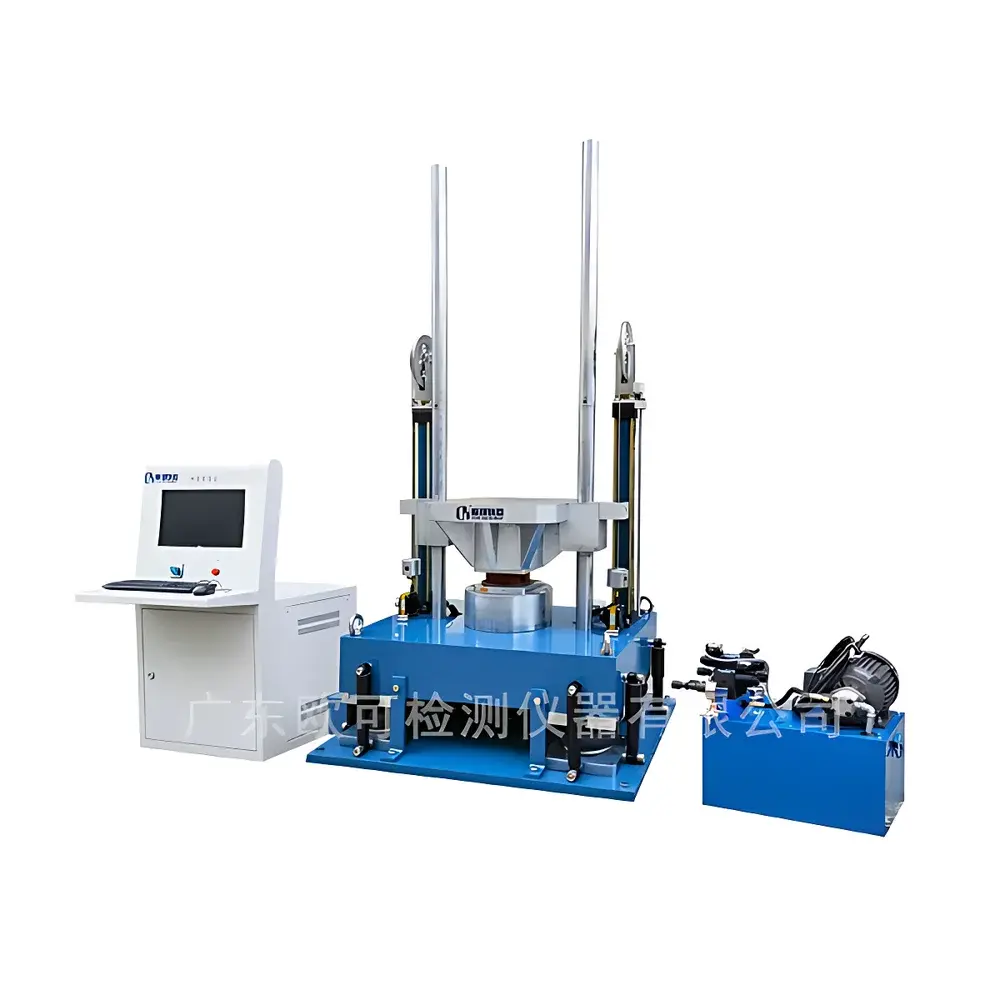
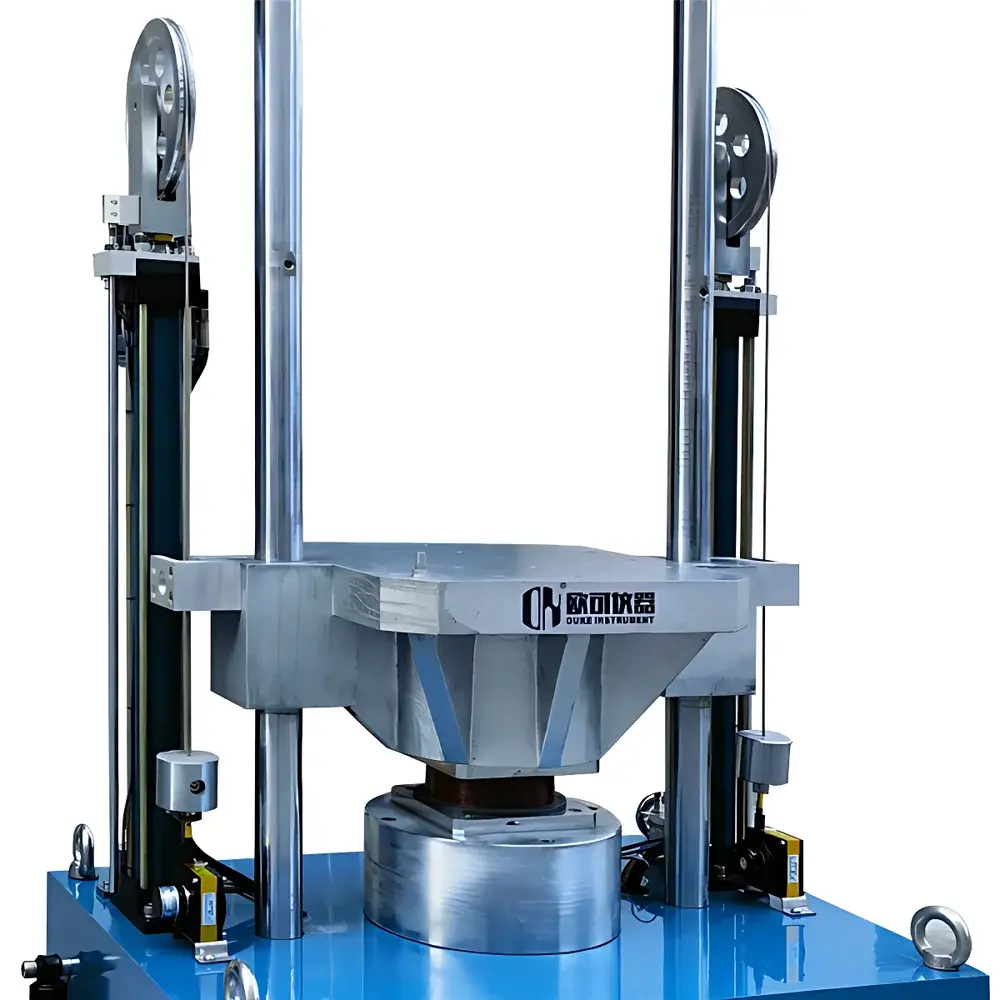
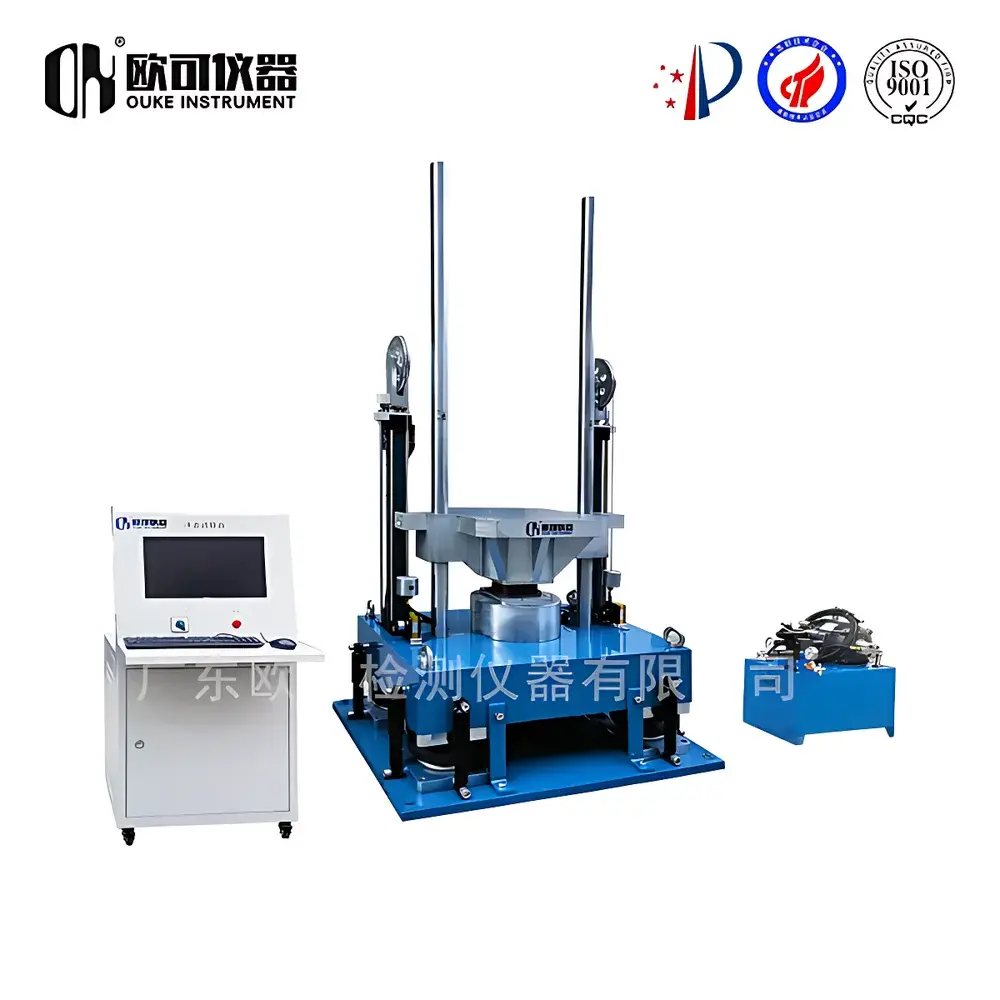
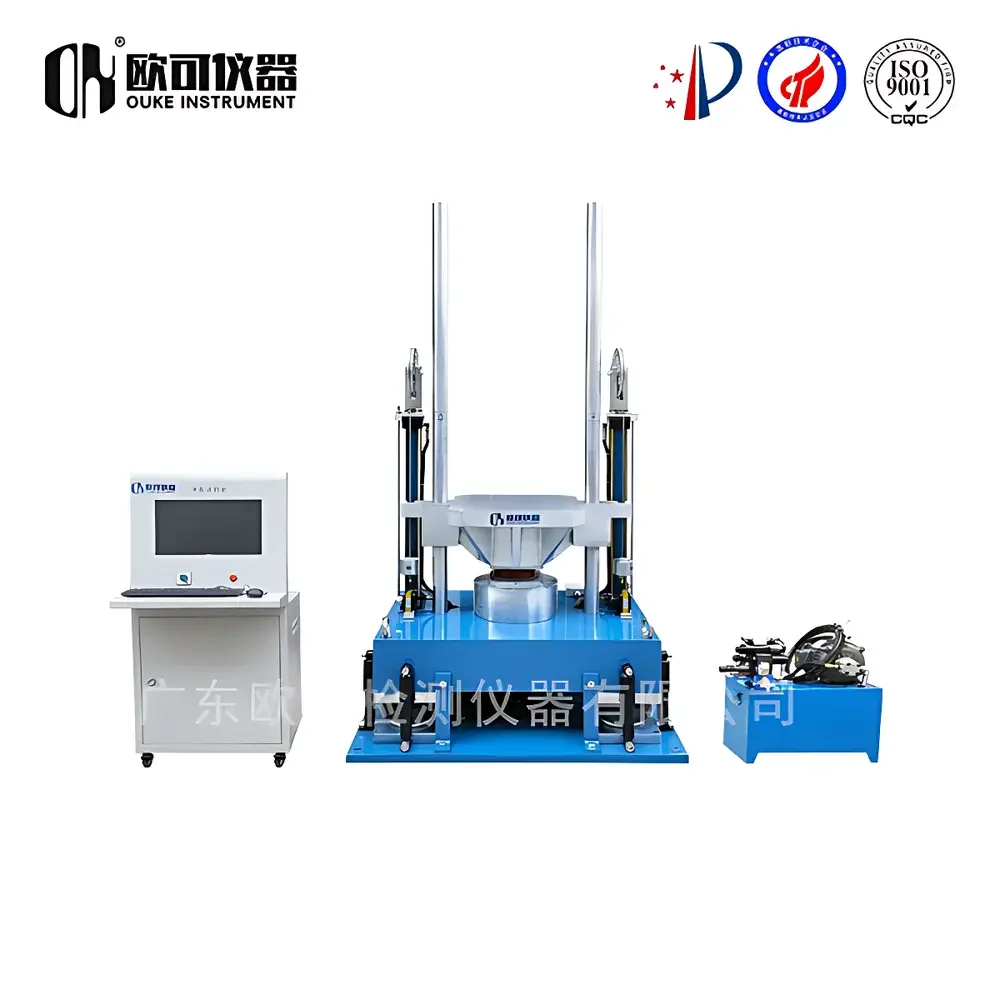
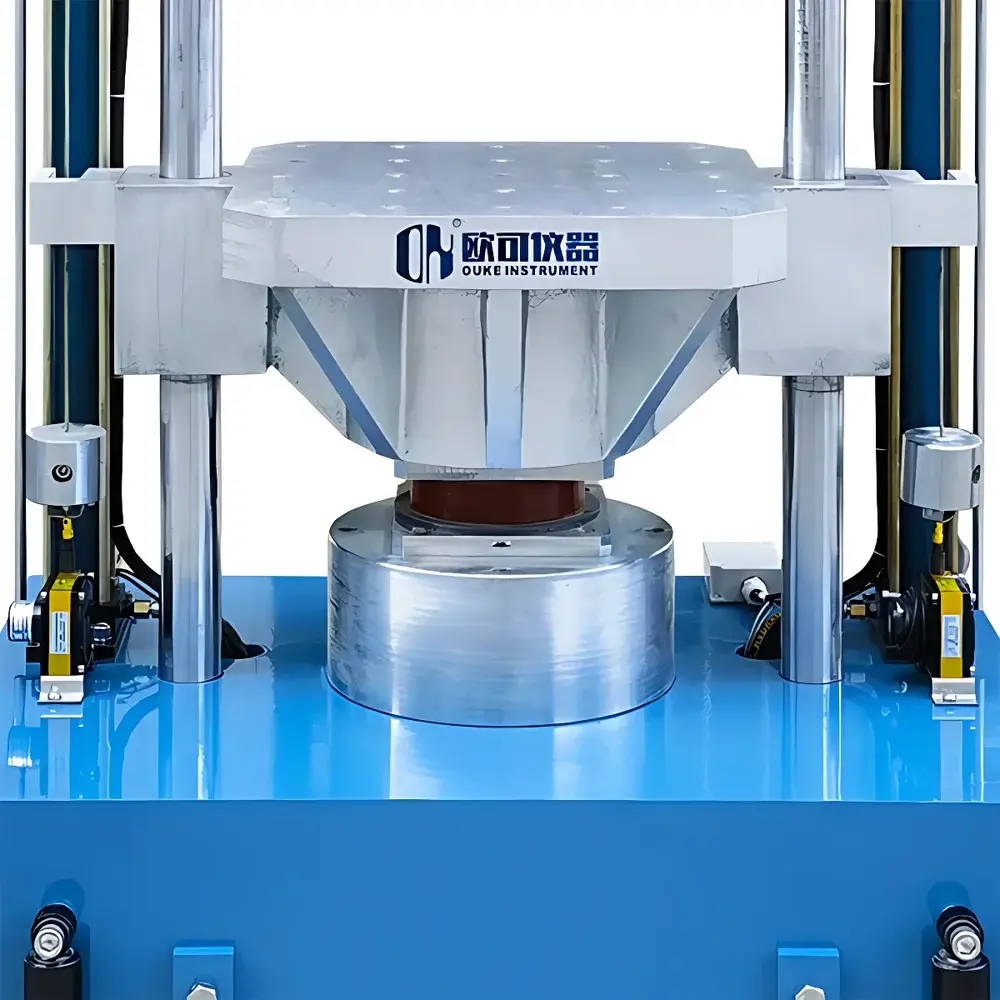
OK-S-50 High-Acceleration Shock Test System
| Brand | OK Instruments |
|---|---|
| Origin | Guangdong, China |
| Manufacturer Type | Direct Manufacturer |
| Product Category | Domestic |
| Model | OK-S-50 |
| Impact Energy | 1000 G |
| Impact Velocity | 4.5 m/s |
| Pendulum Moment (Impact Constant) | 500 N·m |
| Load Cell Range | 15 kN |
| Maximum Lifting Height | 55 mm |
Overview
The OK-S-50 High-Acceleration Shock Test System is an electromechanically engineered test platform designed to generate controlled, transient mechanical shock pulses for reliability validation of components and assemblies under extreme deceleration conditions. It operates on the principle of rapid kinetic energy transfer—either via pneumatic/hydraulic actuation, electromagnetic acceleration, or free-fall impact—followed by abrupt velocity reversal or termination. This process subjects mounted specimens to calibrated acceleration profiles with defined peak magnitude (G), pulse duration (ms), and waveform shape (e.g., half-sine, haversine, trapezoidal, or rear-peak sawtooth). Unlike quasi-static load testing, shock testing evaluates dynamic structural integrity, interconnect robustness, solder joint fatigue resistance, and functional continuity under inertial loading conditions typical of transportation drops, vehicle-mounted equipment exposure, aerospace stage separations, or battlefield handling. The system conforms to fundamental shock physics governed by Newton’s second law (F = ma) and impulse-momentum theory (Δp = F·Δt), enabling repeatable reproduction of real-world transient events in a laboratory environment.
Key Features
- Triple-mode shock generation architecture: supports pneumatic-driven impact, electromagnetic direct-drive, and programmable free-fall configurations for waveform flexibility.
- Calibrated 1000 G peak acceleration capability with ±3% amplitude tolerance across standard pulse durations (1–30 ms), traceable to national metrology standards.
- Programmable impact velocity up to 4.5 m/s, adjustable via precision-controlled release mechanism or servo-regulated actuator stroke.
- Modular waveform shaper interface accommodating interchangeable pulse generators—including elastomeric pads (silicone, nitrile rubber), metallic anvil inserts, and graded-density foam stacks—to synthesize half-sine, trapezoidal, and rear-peak sawtooth waveforms per IEC 60068-2-27 and MIL-STD-883 Method 2002.
- Rigid monolithic base frame with reinforced steel construction and vibration-damped mounting to ensure minimal energy loss and high repeatability (CV ≤ 2.1% over 50 consecutive shocks).
- Integrated digital control unit featuring touchscreen HMI, real-time waveform preview, pre-test simulation, and post-impact residual analysis.
Sample Compatibility & Compliance
The OK-S-50 accommodates specimens weighing up to 5 kg with planar footprints ≤ 300 × 300 mm, secured via threaded inserts or vacuum clamping. It supports both bare-device and fully packaged unit testing—including consumer electronics enclosures, automotive ECUs, avionics modules, and industrial sensor housings. All shock profiles are compliant with internationally recognized qualification standards including IEC 60068-2-27 (Shock), MIL-STD-202G Method 213 (Mechanical Shock), MIL-STD-883K Method 2002 (Shock), JESD22-B104 (Board-Level Shock), and ASTM D999 (Vibration and Shock Testing of Shipping Containers). Optional GLP-compliant audit trail logging and user-access-level authentication align with FDA 21 CFR Part 11 requirements for regulated industries.
Software & Data Management
The embedded OK-TestControl v3.2 software provides full waveform definition, sequence programming (up to 99 steps), and closed-loop feedback adjustment based on real-time accelerometer telemetry. Raw analog signals from the 15 kN piezoelectric load cell and triaxial MEMS accelerometers (mounted on fixture and specimen) are digitized at 1 MS/s and stored in IEEE 1588-synchronized time stamps. Export formats include CSV, MATLAB (.mat), and Universal File Format (UFF 58). Data integrity safeguards include checksum validation, automatic metadata tagging (operator ID, test date, environmental conditions), and encrypted local storage. Remote monitoring via Ethernet/IP and optional OPC UA integration enable centralized test fleet management in multi-lab environments.
Applications
- Electronics: Drop survivability assessment of smartphones, wearables, and PCBAs; evaluation of solder joint fracture thresholds under high-G loading.
- Automotive: Shock qualification of ADAS sensors, battery management systems (BMS), and infotainment units per ISO 16750-3 and LV-124.
- Aerospace & Defense: Structural response analysis of satellite payloads during launch vehicle separation events; ruggedization verification of handheld radios and targeting systems.
- Packaging Engineering: ISTA 3A/3E-compliant transport simulation for e-commerce shipments, including corner-drop and edge-impact scenarios.
- Component Reliability: Mechanical endurance testing of relays, microswitches, optical connectors, and MEMS actuators under repeated shock exposure.
FAQ
What shock waveforms can the OK-S-50 generate?
The system delivers half-sine, trapezoidal, rear-peak sawtooth, and haversine waveforms out-of-the-box. Custom transient profiles may be imported as time-acceleration vectors for electromagnetic mode replay.
Is calibration certification included with delivery?
Yes—each unit ships with NIST-traceable factory calibration certificate covering accelerometer sensitivity, load cell linearity, and timing accuracy across the full operational range.
Can the OK-S-50 be integrated with existing vibration test systems?
It features standardized 19-inch rack-mount dimensions and EtherCAT-compatible I/O ports, enabling synchronized shock-vibration sequencing when paired with OK-VT series electrodynamic shakers.
What safety protections are implemented during operation?
Dual-channel hardware interlocks, light-curtain perimeter sensing, emergency stop circuitry meeting ISO 13857, and automatic brake engagement upon abnormal velocity deviation.
Does the system support automated pass/fail evaluation against specification limits?
Yes—the software includes configurable acceptance criteria engines that compare measured pulse parameters (peak G, duration, symmetry) against user-defined tolerances and generate compliance reports per ISO/IEC 17025 requirements.



