
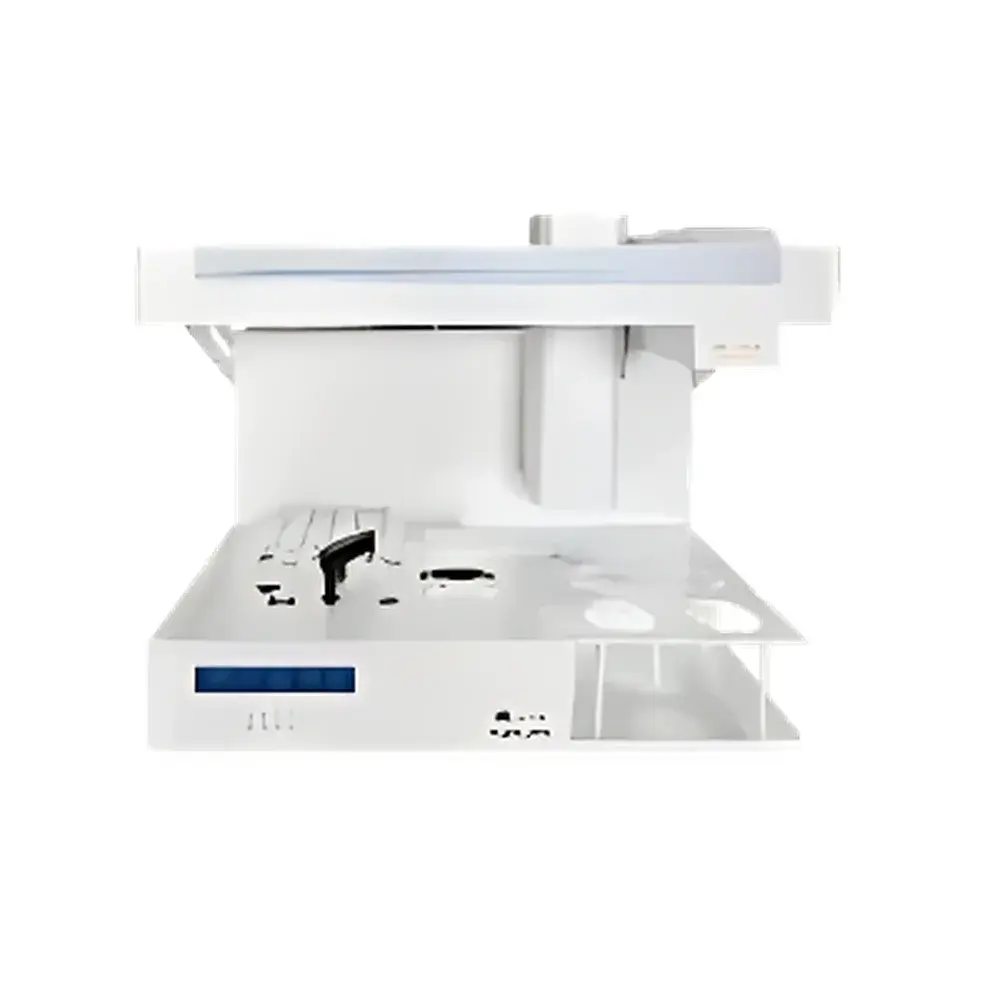
Brookfield LCR-100 Intelligent Hexavalent Chromium Analyzer
| Brand | BEIYU TECHNOLOGIES |
|---|---|
| Origin | Shanghai, China |
| Model | LCR-100 |
| Application | Hexavalent Chromium (Cr(VI)) and Phosphate Determination in Water |
| Measurement Principle | DPC Colorimetric Spectrophotometry (ISO 11045:2023 / GB/T 7467–1987) |
| Sample Capacity | 21-position Cuvette Carousel + Optional 78/118-position Autosampler |
| Detection Range | Cr(VI): 0–2.0 mg/L (adjustable via auto-dilution) |
| Wavelength Accuracy | ±1 nm @ 540 nm |
| Photometric Repeatability | RSD ≤ 1.2% (n=6, 1.0 mg/L Cr(VI)) |
| Auto-dilution Ratio | 2× to 100× |
| Reagent Monitoring | Real-time Level Sensing with Threshold Alerts |
| Data Output | CSV, PDF, XML |
| Compliance | Designed for GLP/GMP environments |
Overview
The BEIYU LCR-100 Intelligent Hexavalent Chromium Analyzer is a fully automated, benchtop spectrophotometric system engineered for precise, regulatory-compliant quantification of hexavalent chromium (Cr(VI)) and phosphate in environmental water matrices. It implements the standardized 1,5-diphenylcarbazide (DPC) colorimetric method—fully aligned with ISO 11045:2023 and China’s national standard GB/T 7467–1987. Unlike manual or semi-automated alternatives, the LCR-100 integrates fluidic control, robotic sample handling, and embedded photometric calibration into a single platform. Its core architecture follows a fixed-wavelength dual-beam optical design centered at 540 nm, optimized for Cr(VI)-DPC complex absorbance with minimal interferences from turbidity or inherent sample color. The instrument operates unattended for up to 72 hours under continuous batch analysis, making it suitable for routine monitoring in municipal wastewater treatment plants, industrial effluent laboratories, and third-party environmental testing facilities requiring high-throughput, trace-level Cr(VI) data with documented chain-of-custody.
Key Features
- Fully integrated robotic sample handler: motorized gripper arm performs vial uncapping, reagent dispensing (including timed addition of DPC and H2SO4), cuvette loading/unloading, and post-analysis cleaning—all without operator intervention.
- Intelligent auto-dilution module: real-time absorbance feedback triggers dynamic dilution (2×–100×) for samples exceeding the linear range (0–2.0 mg/L Cr(VI)), eliminating manual reruns and preserving measurement integrity.
- Self-compensating photometry: simultaneous reference-channel measurement enables automatic correction for both color and turbidity within the same cuvette—eliminating error sources associated with paired-cuvette compensation methods.
- Modular autosampling: base configuration includes a 21-position heated cuvette carousel; optionally expandable to 78- or 118-position tray-based autosamplers compatible with standard 16-mm borosilicate vials.
- Reagent lifecycle management: capacitive level sensors monitor all reagent reservoirs; low-level alerts appear on the HMI and are logged with timestamps, supporting predictive maintenance scheduling.
- Dual-mode cleaning protocol: ultrasonic-assisted rinse followed by pressurized air drying ensures <10 ppb carryover between samples (validated per EPA Method 7196A criteria).
Sample Compatibility & Compliance
The LCR-100 accepts raw, filtered (0.45 µm membrane), or centrifuged aqueous samples—including surface water, domestic sewage, cooling tower discharge, electroplating rinse water, and leachates from solid waste. It accommodates sample volumes from 1.0 mL to 10.0 mL with programmable aspiration precision of ±0.02 mL. All wetted components contact only PTFE, PFA, or quartz—ensuring chemical resistance to strong acids and oxidants used in Cr(VI) preservation (e.g., nitric acid stabilization per ISO 5667-3). The system meets structural and documentation requirements for ISO/IEC 17025:2017 accredited laboratories and provides built-in tools for method validation (linearity, LOD/LOQ, spike recovery, intermediate precision). Software-generated reports include full metadata: analyst ID, instrument serial number, calibration certificate IDs, ambient temperature/humidity logs, and electronic signatures compliant with FDA 21 CFR Part 11 when configured with PKI authentication.
Software & Data Management
The LCR-100 runs on BEIYU’s AnalytiX v3.2 firmware—a deterministic, real-time OS with deterministic task scheduling and non-volatile event logging. Its web-based interface (HTTPS-enabled) supports remote monitoring, method editing, and audit trail review via any modern browser. Data export adheres to ASTM E1384-22 standards for clinical and environmental lab interoperability: structured CSV files contain raw absorbance values, corrected concentrations, dilution factors, and QC flag indicators (e.g., “TURBIDITY_CORR_APPLIED”, “DILUTION_FACTOR=5.0”). Native RESTful API endpoints allow bidirectional integration with LIMS platforms (e.g., Thermo Fisher SampleManager, LabVantage) using OAuth 2.0–secured tokens. All user actions—including method changes, calibration updates, and result overrides—are time-stamped, digitally signed, and immutable in the local database, satisfying GLP audit requirements for traceability.
Applications
- Regulatory compliance monitoring of Cr(VI) in discharge permits (e.g., U.S. EPA NPDES, EU IED Annex I, China’s GB 8978–1996).
- Process control in chrome plating, stainless steel manufacturing, and pigment production facilities.
- Groundwater and surface water quality assessment in mining-impacted watersheds.
- Validation of Cr(VI) reduction efficiency in zero-liquid-discharge (ZLD) systems and ion exchange resin regeneration cycles.
- Phosphate co-monitoring for eutrophication risk modeling in reservoirs and estuaries.
FAQ
What detection method does the LCR-100 use for hexavalent chromium?
It employs the standardized 1,5-diphenylcarbazide (DPC) colorimetric reaction at 540 nm, validated against GB/T 7467–1987 and ISO 11045:2023.
Can the instrument analyze both Cr(VI) and phosphate in the same run?
No—Cr(VI) and phosphate require separate chemistries and wavelengths; sequential analysis is supported via method switching within one batch.
Is the system compatible with existing LIMS infrastructure?
Yes—via ASTM E1384-compliant API and configurable CSV/XML export templates with embedded metadata fields.
How is carryover controlled during high-concentration sample analysis?
Through a validated three-stage cleaning cycle: deionized water rinse, 5% HNO3 wash, and forced-air drying—verified to achieve <10 ppb residual Cr(VI) per EPA Method 7196A.
Does the software support electronic signatures and audit trails per 21 CFR Part 11?
Yes—when deployed with external PKI infrastructure and role-based access controls, all critical operations generate time-stamped, tamper-evident audit records.







