
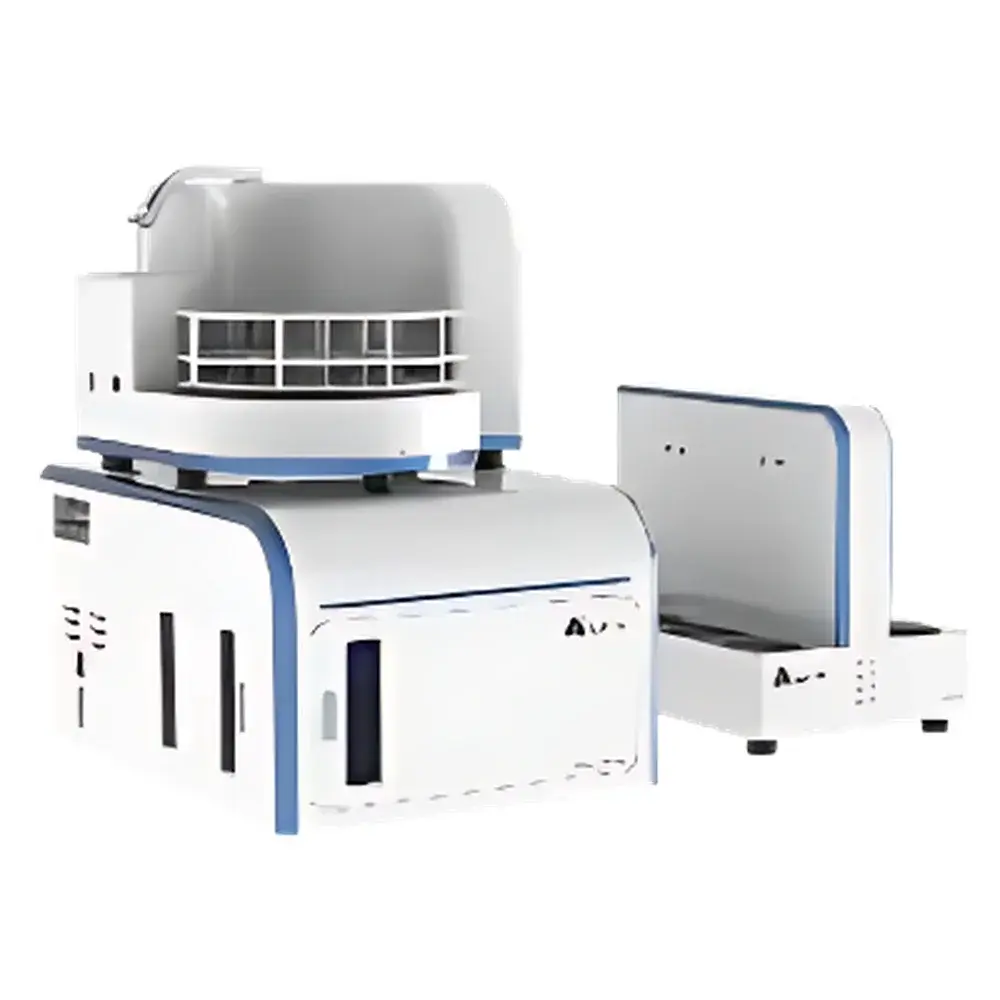
BEIYU TECHNOLOGIES HGMA390 Gas-Phase Molecular Absorption Spectrometer
| Brand | BEIYU TECHNOLOGIES |
|---|---|
| Origin | Shanghai, China |
| Model | HGMA390 |
| Compliance | HJ/T 195–2005 to HJ/T 200–2005 (China EPA) |
| Detection Targets | NH₃-N, Total N, NO₂⁻-N, NO₃⁻-N, Kjeldahl N, S²⁻ |
| Automation | Integrated auto-sampler, online digestion (Total N), auto-dilution, auto-dehydration, dual-needle aspiration, optical CCD detector, long-life light source |
| Software | LIMS-ready, GLP-compliant audit trail, customizable report templates, priority-based sample queue, multi-wavelength real-time absorbance logging |
Overview
The BEIYU TECHNOLOGIES HGMA390 Gas-Phase Molecular Absorption Spectrometer is a dedicated analytical platform engineered for trace-level nitrogen- and sulfur-containing species quantification in aqueous environmental matrices. It operates on the principle of gas-phase molecular absorption spectroscopy (GPMAS), wherein target analytes—ammonia nitrogen (NH₃-N), nitrite nitrogen (NO₂⁻-N), nitrate nitrogen (NO₃⁻-N), total nitrogen (TN), Kjeldahl nitrogen (KN), and sulfide (S²⁻)—are selectively converted into volatile molecular species (e.g., NO, NO₂, SO₂, NH₃) via controlled chemical reactions in solution. These gaseous products are then swept into an optical cell where their characteristic UV–visible absorption bands are measured with high spectral specificity. Unlike conventional colorimetric or electrochemical methods, GPMAS eliminates interferences from colored, turbid, or complex-matrix samples by physically separating the analyte molecule from the liquid phase prior to detection. The HGMA390 is designed specifically for compliance-driven water quality laboratories requiring routine, high-throughput analysis aligned with China’s Ministry of Ecology and Environment (MEE) standard methods HJ/T 195–2005 through HJ/T 200–2005.
Key Features
- Patented dual-needle autosampler with integrated needle cleaning trough and wash system—ensures cross-contamination-free aspiration across heterogeneous sample batches.
- Onboard ammonia oxidation module (patented rapid oxidation method) enabling direct NH₃-N determination without manual pretreatment.
- Dedicated online digestion unit for total nitrogen—fully integrated within the instrument chassis, eliminating external heating blocks or manual transfer steps.
- Automatic dehydration system using selective permeation membranes—removes water vapor from carrier gas streams to prevent condensation-induced optical noise and detector saturation.
- Programmable auto-dilution capability with 1:2 to 1:100 dilution ratios—maintains linear dynamic range across wide concentration spans (e.g., 0.01–10 mg/L NH₃-N).
- Multi-wavelength real-time absorbance monitoring—records simultaneous signals at up to four discrete wavelengths during each measurement cycle, generating interference-resolving spectral fingerprints.
- Intelligent power-loss recovery—resumes uncompleted sample sequences upon reboot, preserving raw absorbance logs and calibration history without data truncation.
- Compact stacked architecture—occupies ≤0.8 m² footprint with modular subsystems vertically aligned to optimize benchtop utilization in space-constrained QA/QC labs.
Sample Compatibility & Compliance
The HGMA390 accepts liquid samples directly from standard 10–50 mL vials or 40-position racks, accommodating both grab samples and continuous flow inputs from upstream pretreatment modules (e.g., filtration, pH adjustment). It supports matrix types including surface water, wastewater effluent, drinking water, leachate, and industrial process streams—with demonstrated robustness against common interferents such as chloride (≤5,000 mg/L), sulfate (≤2,000 mg/L), and humic substances (up to 20 mg/L DOC). All operational protocols and validation procedures align with HJ/T series standards issued by China’s MEE. Instrument firmware and data handling routines support audit-trail generation per GLP principles; electronic signatures, user access logs, and immutable metadata embedding comply with internal QA requirements for accredited environmental testing laboratories.
Software & Data Management
The embedded Windows-based control software provides ISO/IEC 17025-aligned workflow management: method setup, calibration curve generation (linear/nonlinear), QC check integration (spikes, duplicates, blanks), and automated limit checking against regulatory thresholds (e.g., GB 3838–2002, GB 5749–2022). Raw absorbance time-series data and processed concentration outputs are stored in structured SQLite databases with timestamped versioning. Export formats include CSV, PDF reports (user-customizable templates), and XML schemas compatible with LIMS platforms (e.g., LabVantage, Thermo Fisher SampleManager). An open TCP/IP API enables bidirectional communication with无人实验室 (unmanned lab) orchestration systems—supporting remote start/stop commands, status polling, and asynchronous result push. All data modifications are logged with operator ID, timestamp, and pre-/post-change values to satisfy FDA 21 CFR Part 11 read-only archive requirements.
Applications
- Regulatory monitoring of municipal wastewater treatment plants—daily TN/NH₃-N load verification per discharge permits.
- Drinking water safety surveillance—routine screening for nitrite breakthrough in distribution networks.
- Environmental impact assessment (EIA) field campaigns—on-site TN and sulfide profiling in riverine and estuarine systems.
- Industrial effluent compliance—multi-parameter nitrogen speciation in semiconductor, pharmaceutical, and food processing wastewater.
- Research-grade nutrient cycling studies—high-temporal-resolution tracking of nitrification/denitrification intermediates in bioreactor systems.
- Method validation and inter-laboratory comparison programs—serving as reference instrumentation in proficiency testing schemes coordinated by CNAS-accredited bodies.
FAQ
Does the HGMA390 require external gas cylinders or vacuum pumps?
No. It utilizes built-in diaphragm pumps and ambient air as carrier gas; no compressed gas supply or external vacuum infrastructure is needed.
Can the instrument perform simultaneous multi-analyte determination in a single run?
Not concurrently—but sequential analysis of NH₃-N, NO₂⁻-N, NO₃⁻-N, and S²⁻ is fully automated within one sample aspiration cycle via programmable reagent addition and reaction timing.
Is method validation documentation provided with the system?
Yes. Each shipment includes IQ/OQ documentation templates, linearity/ruggedness test protocols, and certified reference material (CRM) verification reports traceable to NIM (National Institute of Metrology, China).
What maintenance intervals are recommended for optical and fluidic components?
CCD detector and light source require no scheduled replacement within 5 years under normal operation; fluidic tubing and gas-permeation membranes are consumables with 6-month service life under continuous use.
How does the system handle high-salinity or particulate-laden samples?
Integrated inline filtration (5 µm) and acidification-controlled volatilization minimize particulate carryover; salinity tolerance is validated up to 35 g/L TDS without signal drift or memory effects.







