
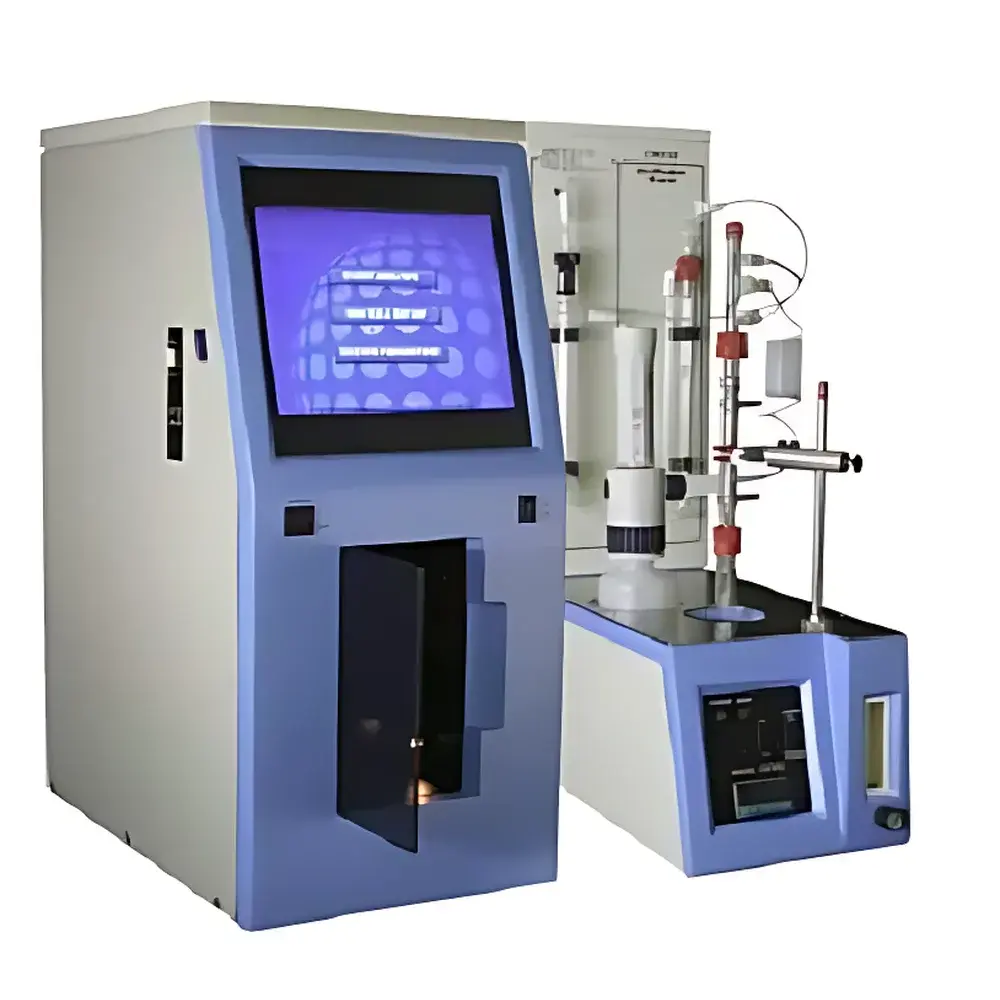
UIC CM140 Total Inorganic Carbon (TIC) Analyzer
| Brand | UIC (USA) |
|---|---|
| Origin | USA |
| Model | CM140 |
| Compliance | ASTM D513 |
| Detection Principle | Potentiometric CO₂ detection after acidification |
| Dynamic Range | 1 µg C to 10,000 µg C (absolute) |
| Resolution | 0.01 µg C |
| Sample Forms | Solid and liquid |
| Acid Digestion Volume Options | 10, 25, 50, or 100 mL |
| Analysis Time | 5–7 min typical |
| Calibration | Factory-calibrated |
| Data Storage | Internal memory + 3.5" floppy disk |
| Software Interface | Standalone instrument control with manual parameter entry |
Overview
The UIC CM140 Total Inorganic Carbon (TIC) Analyzer is a dedicated benchtop instrumentation system engineered for precise, trace-level quantification of inorganic carbon in heterogeneous sample matrices. It operates on the principle of controlled acidification followed by potentiometric detection of liberated CO₂ — a method grounded in Faraday’s law of electrolysis and validated under ASTM D513 for determination of total inorganic carbon in water and solid samples. Unlike combustion-based TIC analyzers, the CM140 employs a non-destructive, electrochemical measurement pathway that eliminates interference from organic carbon, halogens, or oxidizing agents. The system integrates two core modules: the CM5015 CO₂ analyzer — a zero-calibration-required potentiometric sensor with linear response across four orders of magnitude — and the CM5230 acid digestion module, which delivers programmable acid dosing, temperature-controlled reaction, and dual-stage gas purification. Designed for reproducibility in regulated environments, the CM140 supports GLP-compliant workflows through audit-ready data logging, sample metadata tagging, and deterministic signal processing.
Key Features
- Potentiometric CO₂ detection with factory-traceable calibration: no routine recalibration required; long-term stability verified per ASTM D513 Annex A.
- Wide dynamic range: linear response from 1 µg C to 10,000 µg C (absolute), with resolution of 0.01 µg C — enabling both environmental trace analysis and high-carbon geological applications.
- Modular acid digestion architecture: CM5230 module supports selectable reaction volumes (10/25/50/100 mL), adjustable acid delivery, integrated air pump with mass flow control, and dual CO₂ scrubbers (pre- and post-digestion) to eliminate atmospheric and reagent-derived interferences.
- Thermally assisted digestion: programmable sample heating and magnetic stirring accelerate CO₂ evolution from recalcitrant carbonates (e.g., CaCO₃ in sediment or pharmaceutical excipients).
- Flexible sample introduction: direct weighing of solids into reaction vials; septum-piercing syringe injection for liquids; optional autosamplers (CM5131–CM5134) available for unattended batch operation.
- Onboard data handling: stores up to 50 sample records with customizable fields (mass, volume, area, dilution factor); real-time display of raw potential signal and calculated TIC concentration; report generation with summary statistics.
Sample Compatibility & Compliance
The CM140 accommodates diverse sample types without derivatization or pre-treatment: aqueous solutions (seawater, process water, pharmaceutical buffers), slurries (soil extracts, geological digests), suspensions (algal cultures, activated sludge), and dry solids (pharmaceutical powders, coal ash, limestone). Its compliance with ASTM D513 ensures methodological equivalence for regulatory submissions in environmental monitoring and quality control labs. The system meets foundational requirements for FDA 21 CFR Part 11 readiness when paired with secure floppy disk archiving and manual operator log entries — though full electronic signature capability requires external LIMS integration. All wetted components are chemically inert (PTFE, borosilicate glass, stainless steel), minimizing adsorption losses and cross-contamination risks during high-throughput operation.
Software & Data Management
The CM140 operates via an embedded microcontroller interface with alphanumeric LCD and membrane keypad. Users input sample identifiers, masses, and volumetric parameters directly; the instrument computes final TIC values in µg C, mg C/L, or wt% using stoichiometric conversion factors stored in firmware. Data are retained in volatile RAM during analysis and archived to industry-standard 3.5″ floppy disk in ASCII format — compatible with spreadsheet software and laboratory information management systems (LIMS). Each record includes timestamp, operator ID (manually entered), raw electrode potential (mV), integration time, and calculated uncertainty based on signal-to-noise ratio. No proprietary drivers or OS-dependent software is required; raw files support third-party statistical validation per ISO/IEC 17025 clause 7.7.
Applications
- Pharmaceutical QA/QC: quantification of residual carbonate in active pharmaceutical ingredients (APIs) and excipients per USP guidance.
- Environmental testing: TIC in seawater, groundwater, and wastewater per EPA Method 415.3 and ISO 8245.
- Geological research: carbonate content in sediment cores, limestone, and volcanic tuffs using acid dissolution protocols aligned with ASTM D3613.
- Food & beverage: inorganic carbon in dairy products, carbonated beverages, and baking powders where CO₂ release kinetics impact shelf-life modeling.
- Academic laboratories: teaching instrumental analysis principles including acid–base stoichiometry, gas transport dynamics, and electrochemical sensor fundamentals.
FAQ
Does the CM140 require daily calibration?
No. The CM5015 CO₂ analyzer is factory-calibrated using NIST-traceable CO₂ standards and maintains linearity without user intervention over extended operational periods. Verification checks using certified reference materials (e.g., sodium carbonate solutions) are recommended weekly per ASTM D513 Section 8.3.
Can the CM140 measure dissolved inorganic carbon (DIC) directly?
Not without modification. The CM140 measures total inorganic carbon (TIC) only. To determine DIC, users must first remove particulate inorganic carbon (PIC) via filtration or centrifugation prior to acidification — a protocol outlined in ISO 10523 and adopted in marine chemistry labs.
What acid types are compatible with the CM5230 digestion module?
Hydrochloric acid (HCl) is standard; phosphoric acid (H₃PO₄) and nitric acid (HNO₃) may be used depending on sample matrix compatibility and interference profile — selection must account for volatility, oxidation potential, and chloride interference in potentiometric detection.
Is the CM140 compliant with GLP or GMP documentation requirements?
Yes, when operated with documented procedures, manual operator logs, and floppy-disk archival. Full 21 CFR Part 11 compliance (e.g., electronic signatures, audit trails) requires integration with validated LIMS software external to the instrument.
How is carryover minimized between high- and low-concentration samples?
Through automated dual-stage gas scrubbing (pre- and post-reaction), heated transfer lines, and configurable rinse cycles using CO₂-free air. Instrument validation per ASTM D513 Section 9.4 confirms residual carryover remains below 0.5% of previous high-level result.
Related Products






