
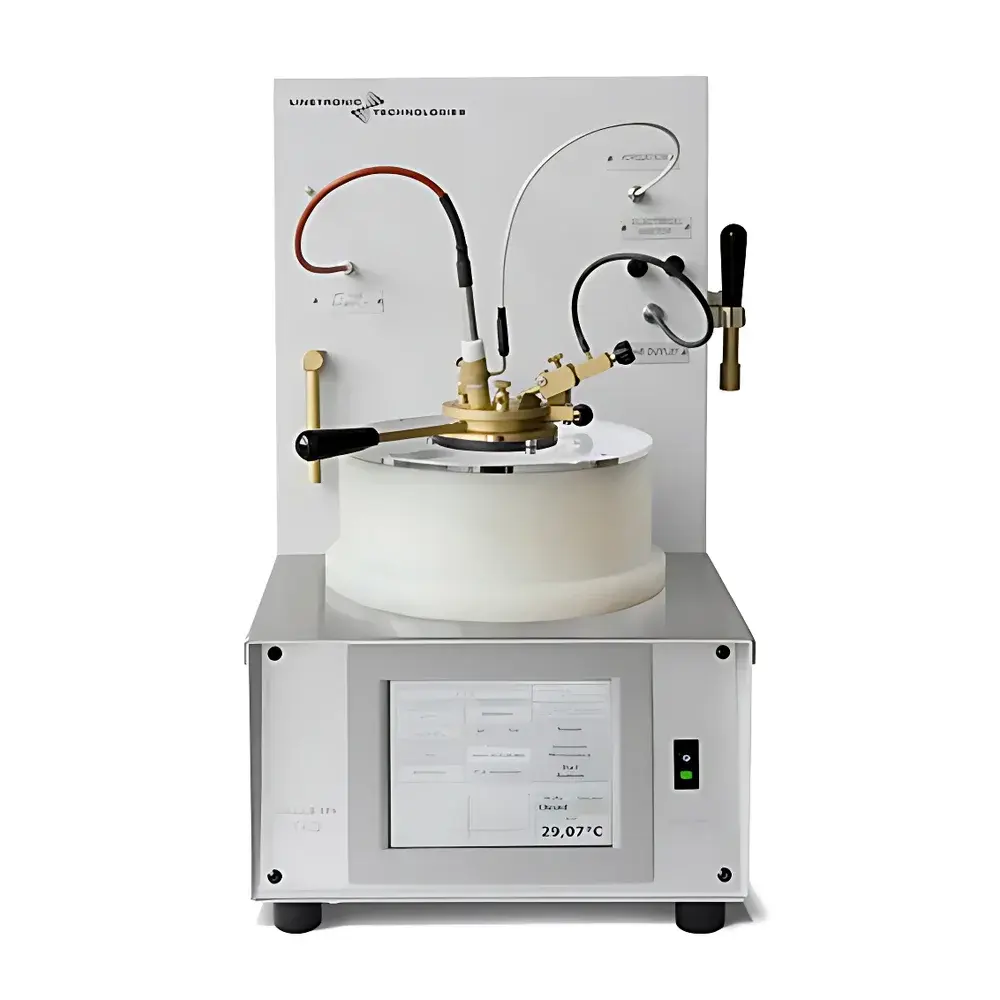
Linetechnic TAG 690 Automatic Closed-Cup Flash Point Analyzer
| Brand | Linetechnic |
|---|---|
| Origin | Switzerland |
| Model | TAG 690 |
| Compliance | ASTM D56, D3278, D3934, D3941 |
| Temperature Range | –50 °C to +100 °C |
| Temperature Resolution | 0.06 °C |
| Temperature Accuracy | ±0.1 °C |
| Temperature Probe | PT100 Class A |
| Sample Cup | Copper, with level mark and heat-resistant handle |
| Heating System | Electronic heater with overtemperature protection |
| Cooling System | Liquid refrigerant controlled by internal solenoid valve |
| Ignition Mechanism | Automatic mechanical ignition switch per standard protocol |
| Dimensions (W×D×H) | 48 cm × 37 cm × 61 cm |
| Weight | 32 kg |
| Power Supply | 220 V ±15%, 50/60 Hz |
| Operating Environment | ≤35 °C, ≤80% RH |
| Safety Certification | CE |
Overview
The Linetechnic TAG 690 Automatic Closed-Cup Flash Point Analyzer is a precision-engineered instrument designed for the accurate and repeatable determination of flash point in petroleum products, solvents, industrial chemicals, and waste streams according to internationally recognized closed-cup test methods. It implements the standardized Tagliabue (TAG) open-flame ignition principle within a fully enclosed measurement chamber, ensuring operator safety and method fidelity. The analyzer operates on the equilibrium method defined in ASTM D56 — the primary standard for low-flash-point volatile liquids — and maintains full compliance with parallel specifications including ASTM D3278 (for coatings), D3934 (for electrical insulating oils), D3941 (equilibrium method validation), and corresponding IP and ISO standards (IP 491, 492, 304; ISO 1516, 1523, 3679). Its core measurement architecture integrates a high-stability PT100 Class A temperature sensor, an electronically regulated heating system with dual-stage thermal cutoffs, and a precisely timed mechanical ignition actuator synchronized to incremental temperature ramping. This ensures thermodynamic equilibrium at each test step and eliminates subjective interpretation of flame response.
Key Features
- Full compliance with ASTM D56 and supplementary flash point standards (ASTM D3278, D3934, D3941; IP 491/492/304; ISO 1516/1523/3679)
- Wide operational temperature range from –50 °C to +100 °C, with 0.06 °C resolution and ±0.1 °C accuracy across the entire span
- Copper sample cup with calibrated fill line and ergonomic heat-resistant handle, optimized for thermal uniformity and operator safety
- Integrated electronic heating module with redundant overtemperature protection and automatic shutdown logic
- Active liquid-based cooling system regulated via solenoid valve, enabling rapid thermal recovery between sequential tests
- Automated mechanical ignition switch actuated in strict accordance with standard timing and positioning requirements
- Ionization-based flame detection circuitry for unambiguous, objective flash point identification without visual bias
- CE-marked design meeting IEC 61010-1 safety requirements for laboratory electrical equipment
Sample Compatibility & Compliance
The TAG 690 supports flash point analysis of a broad spectrum of samples beyond conventional petroleum distillates, including paint thinners, cleaning solvents, biofuels, used lubricants, and regulated hazardous waste streams. Its closed-cup configuration minimizes vapor loss and enhances reproducibility—critical for regulatory reporting under EPA, OSHA, and CLP/GHS frameworks. All measurement procedures are traceable to NIST-traceable reference materials, and the instrument’s performance validation protocols align with ISO/IEC 17025 requirements for testing laboratories. Routine calibration verification is supported through built-in probe diagnostics and dual-mode calibration routines (standard and advanced), with audit-ready records—including calibration date stamps, compensation values, and deviation plots—exportable in PDF or CSV format.
Software & Data Management
The TAG 690 is operated via LabLink software, a Windows-native application compatible with Windows 2000 through Windows 10 (32- and 64-bit). LabLink provides full method management, real-time monitoring, and GLP-compliant data handling. It supports up to ten independent analyzer heads in networked configurations. Key software capabilities include: user-defined method templates aligned with ASTM/IP/ISO/DIN standards; configurable result formatting for lab notebooks or LIMS integration; automated pass/fail evaluation against specification limits; timestamped audit trails with operator ID logging; and native Excel-compatible data export (CSV/XLSX) for statistical process control (SPC) or trending analysis. The software enforces 21 CFR Part 11 readiness through electronic signature support, role-based access control, and immutable record archiving — retaining over 60,000 test results locally with optional cloud backup.
Applications
This analyzer is routinely deployed in refinery QC labs, petrochemical R&D facilities, third-party testing laboratories, and environmental compliance units. Typical use cases include: specification release testing of gasoline, kerosene, diesel, and jet fuel per ASTM D56; flash point verification of solvent blends prior to packaging or transport (UN TDG/ADR/IMDG); stability assessment of reformulated biofuels and synthetic lubricants; and hazardous waste characterization per EPA Method 1010A. Its robust thermal control and ionization detection also make it suitable for research into flammability thresholds of novel electrolytes, battery fluids, and low-volatility organic compounds where traditional Pensky-Martens instruments lack sensitivity.
FAQ
What standards does the TAG 690 fully support?
ASTM D56 (primary), D3278, D3934, D3941; IP 491, 492, 304; ISO 1516, 1523, and 3679.
Can the instrument be integrated into a LIMS environment?
Yes — LabLink exports structured data in Excel-compatible formats and supports direct database push via ODBC or API-based middleware compliant with ASTM E1482 and ISO/IEC 17025 Annex A.2.
Is manual ignition possible?
No — ignition is strictly automated and mechanically timed per standard protocol to ensure repeatability and eliminate human variability.
How is calibration traceability maintained?
Each PT100 probe undergoes individual auto-calibration; calibration history, correction factors, and uncertainty budgets are stored and printable with NIST-traceable reference documentation.
What safety protections are built into the heating system?
Dual independent overtemperature sensors trigger immediate power cutoff, and the firmware enforces maximum ramp rate limits to prevent thermal runaway.






