
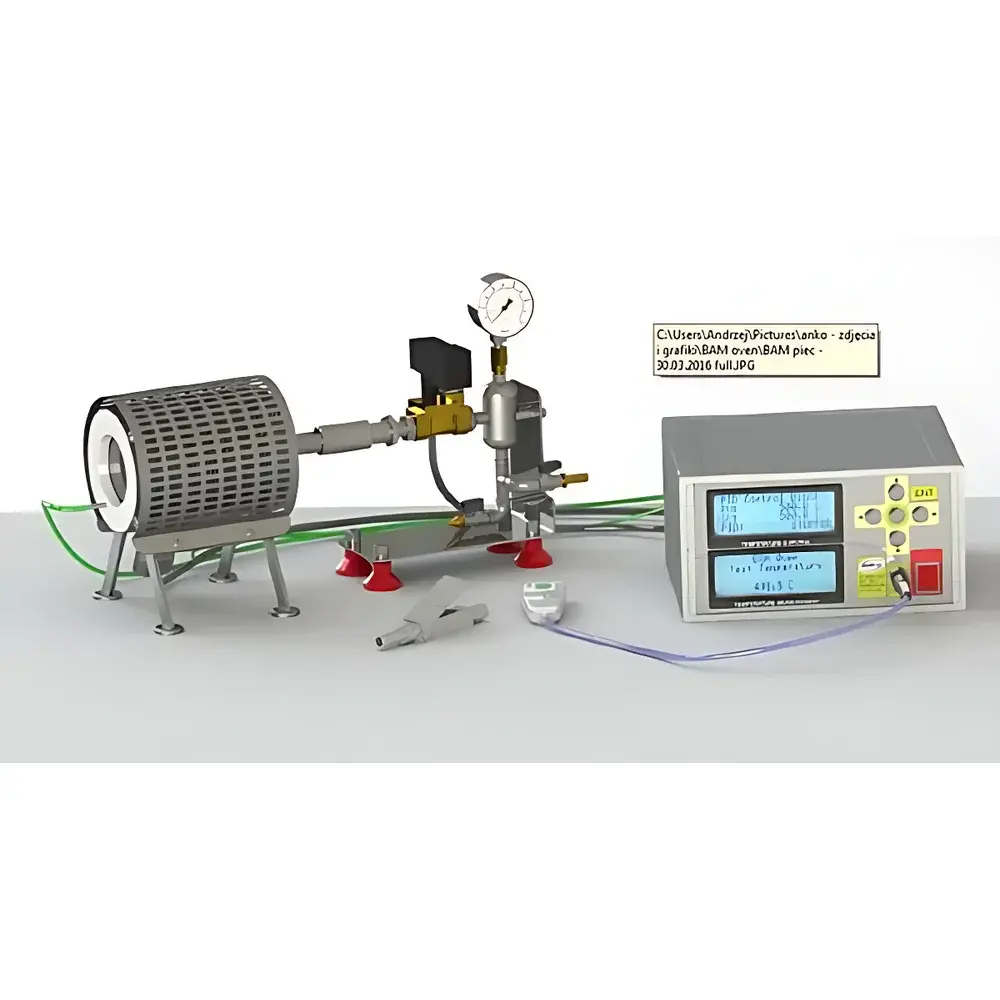
BAM-2 BAM Automatic Minimum Ignition Temperature Analyzer
| Origin | Poland |
|---|---|
| Manufacturer Type | Authorized Distributor |
| Origin Category | Imported |
| Model | BAM-2 |
| Price Range | USD 28,000 – 70,000 |
| Standard Compliance | VDI 2263 Part 1 Section 2.6.1.1, ASTM E1491-06 |
| Chamber Volume | 0.35 L |
| Max Operating Temperature | 600 °C |
| Power Supply | 110/230 V AC, 1200 W |
| Heating Element | Kanthal A1 wire in ceramic matrix |
| Temperature Sensors | Dual K-type thermocouples with Inconel sheaths and silicone-insulated leads |
| Dust Dispersion Nozzle | Precision-machined per ASTM E1491 specifications |
| Chamber Material | AISI 304 stainless steel |
Overview
The BAM-2 BAM Automatic Minimum Ignition Temperature Analyzer is an engineered laboratory instrument designed for the standardized determination of the Minimum Autoignition Temperature (MAIT) of combustible dust clouds under controlled thermal conditions. It implements the well-established BAM oven test principle—originally developed by the German Federal Institute for Materials Research and Testing (Bundesanstalt für Materialforschung und -prüfung, BAM)—in a fully automated, repeatable, and traceable configuration. The system operates on the fundamental principle that a dust cloud, when pneumatically dispersed into a heated 0.35 L cylindrical chamber with reflective interior surfaces, will ignite if the chamber wall temperature exceeds the material’s intrinsic autoignition threshold. Ignition is optically confirmed via observation of sustained flame propagation at the rear viewport—a criterion rigorously defined in both VDI 2263 Part 1 and ASTM E1491-06. Unlike empirical flash point or ignition delay methods, the BAM-2 delivers a thermodynamically grounded MAIT value essential for hazard classification (e.g., UN GHS Category 1–3), safety data sheet (SDS) authoring, and process safety management (PSM) under OSHA 1910.119.
Key Features
- Automated dust dispersion sequence synchronized with real-time chamber temperature ramping and optical ignition detection
- High-stability heating block composed of ceramic-encapsulated Kanthal A1 resistance wire, ensuring uniform radial heat distribution and long-term thermal consistency
- Dual redundant K-type thermocouples with Inconel 600 sheaths and high-temperature silicone insulation, calibrated to ±0.5 °C across 50–600 °C range
- Stainless steel (AISI 304) reaction chamber with polished interior surface to maximize radiant heat transfer and minimize localized hot spots
- Precision-engineered dispersion nozzle manufactured to exact dimensional tolerances specified in ASTM E1491-06, guaranteeing reproducible dust cloud density and morphology
- Integrated safety interlocks including overtemperature cutoff, pressure-relief venting, and purge-air pre-conditioning prior to each test cycle
Sample Compatibility & Compliance
The BAM-2 accommodates dry, free-flowing powders and granular solids with particle size distributions typically below 75 µm (D90), including metal powders (Al, Mg, Ti), organic dusts (wood, sugar, lactose), polymer flakes, and pharmaceutical excipients. It is not intended for liquid mists, aerosols, or agglomerated materials requiring prior deagglomeration. The analyzer fully conforms to internationally recognized test protocols: VDI 2263 Part 1 Section 2.6.1.1 (German guideline for dust explosion hazards), ASTM E1491-06 (Standard Test Method for Minimum Ignition Temperature of Dust Clouds), and supports alignment with IEC 60079-4, EN 13821, and NFPA 484 requirements. All test reports generated include full metadata (ambient RH/T, sample mass, dispersion pressure, dwell time, ignition confirmation timestamp), enabling audit readiness for ISO/IEC 17025-accredited laboratories.
Software & Data Management
The BAM-2 operates via embedded firmware with optional PC-based control software (Windows 10/11 compatible). The software enables programmable temperature ramps (e.g., 5 °C/min from 100 °C to 600 °C), automated pass/fail decision logic based on optical sensor output, and export of raw thermocouple traces, dispersion timing logs, and ignition event markers in CSV and PDF formats. Audit trails record operator ID, calibration history, method version, and system error flags—fully compliant with FDA 21 CFR Part 11 requirements when configured with electronic signatures and role-based access control. Data integrity safeguards include write-protected storage, automatic backup to external USB drives, and timestamped digital signatures for GLP/GMP-regulated environments.
Applications
- Hazard identification and classification of bulk powders during R&D and scale-up of chemical, pharmaceutical, and food manufacturing processes
- Supporting DSEAR (UK), ATEX (EU), and NFPA 70E compliance through documented ignition temperature thresholds
- Validation of inerting strategies (e.g., N₂ or CO₂ blanketing) by establishing baseline MAIT under oxidizing atmospheres
- Root cause analysis of dust fire incidents via comparative MAIT testing before/after material handling modifications (e.g., milling, drying)
- Regulatory submission dossiers for REACH registration, EPA TSCA reporting, and transport classification (UN Manual of Tests and Criteria, Part III, Section 33.2.1)
FAQ
What is the minimum sample mass required for a valid BAM-2 test?
Typical test protocols specify 0.5–2.0 g of dry, representative powder, depending on bulk density and dispersibility. Exact mass is logged per test and influences cloud concentration—critical for result reproducibility.
Can the BAM-2 be used for layered dust ignition temperature (LIT) testing?
No. The BAM-2 is exclusively configured for dust cloud MAIT determination. Layered ignition testing requires a separate hot-surface apparatus per IEC 60079-4 Annex C.
Is third-party calibration certification available?
Yes. Accredited calibration services—including NIST-traceable thermocouple verification and chamber temperature uniformity mapping—are offered annually or per ISO/IEC 17025 requirements.
Does the system support modified atmospheres (e.g., reduced O₂)?
Not natively. The standard BAM-2 operates under ambient air. Optional glovebox integration or custom inert-gas purge manifolds can be engineered upon request for specialized research applications.
How frequently must the dispersion nozzle be cleaned or replaced?
Visual inspection and ultrasonic cleaning in acetone are recommended after every 10–15 tests. Nozzle replacement is advised every 200 cycles or when SEM imaging reveals erosion exceeding 5 µm in critical orifice geometry.






