
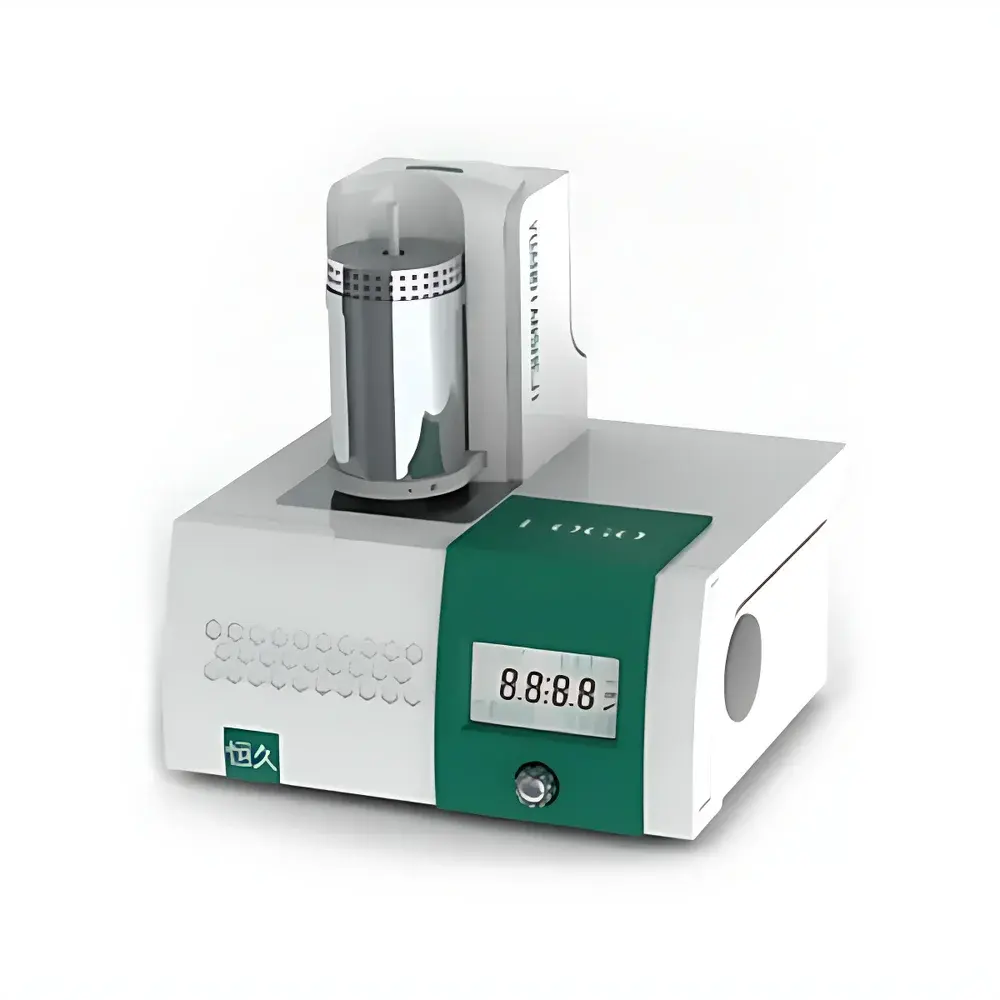
Henven HQC-4 Automated Differential Thermal Analyzer
| Brand | Henven |
|---|---|
| Origin | Beijing, China |
| Manufacturer Type | Direct Manufacturer |
| Regional Classification | Domestic (China) |
| Model | HQC-4 |
| Instrument Type | Differential Thermal Analyzer (DTA) |
| DSC Mode | Heat-Flow Type |
| Sample Capacity | Single |
| Temperature Range | Ambient to 1550 °C |
| Temperature Accuracy | ±0.1 °C |
| Temperature Precision | ±0.1 °C |
| Temperature Stability | ±0.1 °C |
| Heating/Cooling Rate | 0.1–100 K/min |
| Programmable Thermal Modes | Heating, Isothermal, Cooling |
| DSC Measurement Range | 0 to ±500 mW |
| DSC Sensitivity | ±0.1 μW |
| DTA Resolution | 0.01 μV |
| DTA Noise Level | <0.01 μV |
| Signal Range | ±10 μV to ±2000 μV (auto-ranging) |
| Atmosphere Control | Dual-channel Mass Flow Controller (MFC), corrosion-resistant options available |
| Vacuum Option | 2.5×10⁻² Pa (with optional vacuum unit) |
| Isothermal Hold Duration | Up to 72 h at any temperature within range |
| Standard Crucibles | Al₂O₃ (0.06 mL or 0.12 mL) |
| Optional Crucibles | Aluminum, Graphite, Quartz, Platinum |
| Interface | Integrated LCD display with dual thermocouples (furnace + sample) |
| Software Features | Oxidation Induction Time (OIT) analysis, crystallization kinetics modeling, step-cooling curve generation, enthalpy integration, activation energy calculation (multiple algorithms), Tg determination, specific heat comparison method, real-time screenshot capture, auto-scale signal acquisition |
Overview
The Henven HQC-4 Automated Differential Thermal Analyzer is a precision-engineered thermal analysis system designed for quantitative measurement of endothermic and exothermic transitions in solid and powdered materials under controlled atmospheric and thermal conditions. Operating on the fundamental principle of differential thermal analysis (DTA), the instrument continuously records the temperature difference (ΔT) between a sample and an inert reference material as both are subjected to identical, programmable thermal profiles. Unlike power-compensated DSC systems, the HQC-4 employs a heat-flow configuration—measuring thermal flux via thermopile detection—to deliver high signal-to-noise ratio data across its full 1550 °C operating range. Its robust furnace architecture, dual thermocouple monitoring (separate furnace and sample sensors), and active atmosphere management make it suitable for rigorous research and quality control applications in metallurgy, ceramics, polymers, pharmaceuticals, and advanced composites.
Key Features
- Fully automated lift mechanism for precise, repeatable crucible positioning—minimizing mechanical drift and enhancing inter-run reproducibility.
- Integrated dual-channel mass flow controller (MFC) enabling seamless, programmable switching between two gas streams (e.g., N₂/air, Ar/O₂) with <±1% full-scale accuracy and sub-second response time; optional corrosion-resistant MFC modules available for H₂S, Cl₂, NH₃, or HF environments.
- Real-time 7-inch LCD interface displaying furnace temperature, sample temperature, gas flow status, and system diagnostics—no external PC required for basic operation.
- Extended isothermal capability: stable temperature hold up to 72 hours at any point between ambient and 1550 °C, critical for oxidation induction time (OIT), sintering studies, and long-term stability assessment.
- Auto-ranging analog front-end with 24-bit resolution ADC supports dynamic signal capture from ±10 μV to ±2000 μV without manual gain adjustment; DTA noise floor <0.01 μV RMS ensures detection of subtle phase transitions.
- Modular software suite compliant with GLP documentation requirements—including audit trail, electronic signature support (21 CFR Part 11 ready), and raw-data immutability—enabling regulated lab deployment.
Sample Compatibility & Compliance
The HQC-4 accommodates standard ceramic (Al₂O₃) crucibles (0.06 mL and 0.12 mL), with interchangeable options including aluminum (for low-T polymer work), graphite (high-T inert applications), quartz (transparency-critical analyses), and platinum (corrosive or reducing atmospheres). All crucible mounts are thermally isolated and mechanically decoupled to reduce conduction artifacts. The system meets ASTM E793 (Enthalpy Measurements), ASTM E1269 (Heat Capacity), ISO 11357 series (Plastics—DSC), and USP (Thermal Analysis in Pharmaceutical Development). Optional vacuum integration (2.5×10⁻² Pa) enables high-purity inert environment testing aligned with ASTM F1877 (Vacuum DTA for Refractories).
Software & Data Management
Proprietary HenvenTherm v5.2 software provides full instrument control, real-time visualization, and post-processing workflows validated per ICH Q5C and ISO/IEC 17025 guidelines. Core analytical modules include: peak deconvolution using Gaussian-Lorentzian fitting; OIT onset determination per ASTM D3895; Avrami and Ozawa crystallization kinetics modeling; Kissinger, Friedman, and Ozawa-Flynn-Wall activation energy calculations; comparative specific heat evaluation via sapphire reference method; and Tg identification using second-derivative inflection or midpoint criteria. All raw data files (.htd) are timestamped, checksum-verified, and stored with metadata (operator ID, calibration history, gas log, thermal protocol). Export formats include CSV, TXT, and universal .tdms for third-party statistical platforms (JMP, MATLAB, Python Pandas).
Applications
- Determination of melting points, eutectic temperatures, and latent heats in alloys, salts, and organic compounds.
- Quantification of glass transition (Tg), cold crystallization, and devitrification behavior in amorphous metals and bio-polymers.
- Oxidation induction time (OIT) testing of polyolefins and antioxidants per ASTM D3895 and ISO 11357-6.
- Phase transformation mapping in refractory ceramics and cementitious systems under controlled O₂ partial pressure.
- Decomposition kinetics of energetic materials, battery cathodes (e.g., NMC, LFP), and catalyst precursors.
- Direct coupling to GC/MS via heated transfer line (optional 200 °C恒温带) for evolved gas analysis (EGA) of pyrolysis products.
FAQ
Is the HQC-4 compliant with FDA 21 CFR Part 11 for electronic records?
Yes—when deployed with HenvenTherm v5.2 in Audit Trail Mode, the system supports role-based access control, electronic signatures, and immutable raw data archiving meeting Part 11 requirements.
Can the instrument perform simultaneous DTA and DSC measurements?
No—the HQC-4 operates exclusively in DTA mode with heat-flow detection; however, its calibrated output permits quantitative enthalpy calculation equivalent to conventional DSC per ISO 11357-1 Annex B.
What calibration standards are supported for temperature and energy verification?
Indium (156.6 °C), tin (231.9 °C), lead (327.5 °C), and zinc (419.5 °C) are preloaded in calibration libraries; users may define custom reference materials with certified transition enthalpies.
Does the system support purge gas humidification for moisture-sensitive samples?
Yes—via optional integrated humidity generator module (0–95% RH, ±2% accuracy) compatible with the dual-MFC architecture.
Is remote monitoring and control possible?
Yes—Ethernet-enabled operation allows secure web-based supervision (HTTPS), real-time data streaming via MQTT, and scheduled unattended runs through Windows Task Scheduler integration.



