
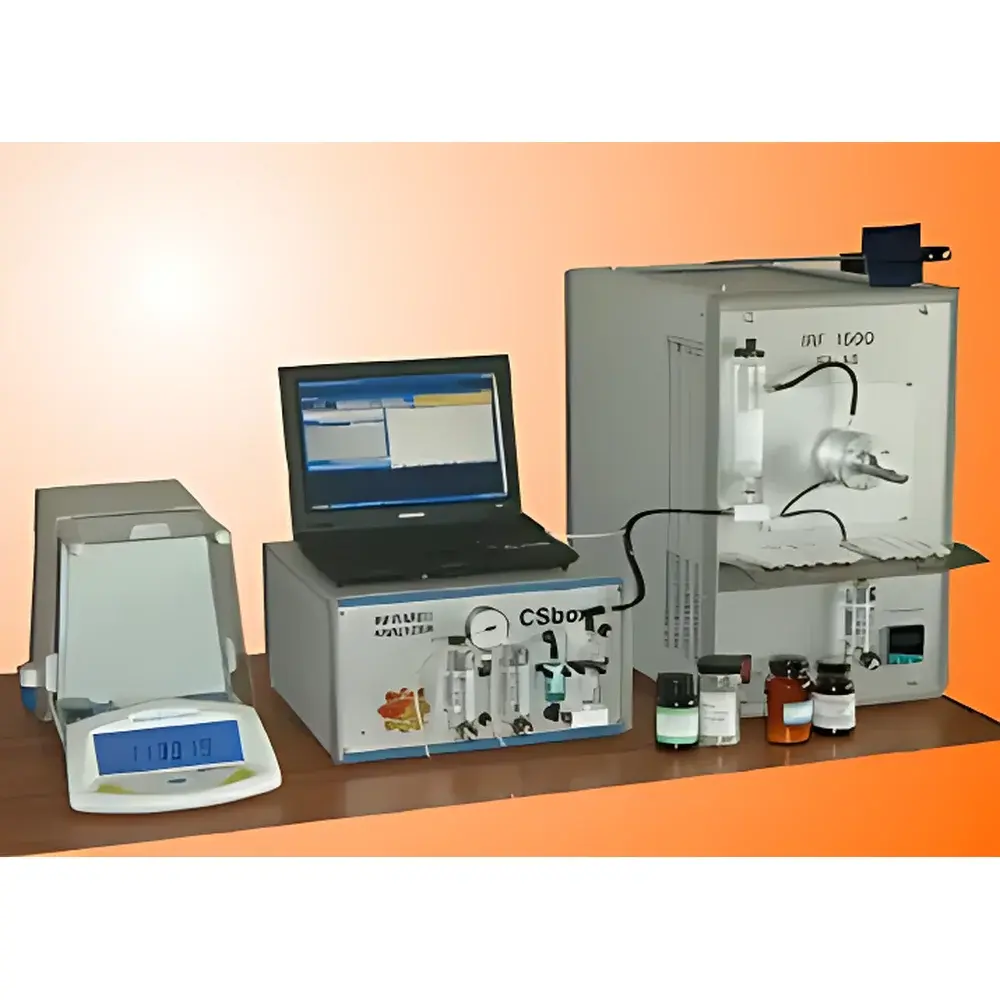
CSBox-Tube-CS Infrared Carbon-Sulfur Analyzer (Imported, France-Manufactured)
| Key | Origin: France |
|---|---|
| Detection Principle | Non-Dispersive Infrared (NDIR) |
| Measurement Range | C: 0–100%, S: 0–100% |
| Accuracy | ±1% relative (typical samples) |
| Sample Mass | 10–200 mg |
| Analysis Time | 40–300 s |
| Combustion Temperature | 800–1550 °C |
| Carrier Gas | O₂ or ambient air (for inorganic matrices) |
| Power Supply | 230 V, 0.75–2 A |
Overview
The CSBox-Tube-CS Infrared Carbon-Sulfur Analyzer is a high-reliability, benchtop combustion analyzer engineered for precise quantification of total carbon and sulfur in solid heterogeneous matrices—specifically optimized for coal, coke, cement, ores, soils, biomass, feedstuffs, and petroleum-derived fuels. It operates on the fundamental principle of high-temperature oxidative combustion followed by non-dispersive infrared (NDIR) spectroscopic detection. Samples (10–200 mg) are combusted in a controlled atmosphere—either pure oxygen or ambient air—at temperatures programmable between 800 °C and 1550 °C, depending on matrix recalcitrance. Gaseous combustion products (CO₂ and SO₂) are swept through a dust/moisture trap, pressure-regulated, and directed into dual-wavelength NDIR cells equipped with interference filters. Signal intensities are linearly correlated to analyte concentration via factory-calibrated response curves traceable to certified reference materials (CRMs). The system supports two distinct combustion geometries—vertical mode (optimized for refractory sulfides in minerals, using Sn-foil ignition at ~1200 °C) and inclined tubular mode (suited for volatile or organic-rich samples, minimizing consumable use via quartz spoon and Ni catalyst)—enabling method flexibility without hardware reconfiguration.
Key Features
- Modular combustion architecture: Selectable vertical or inclined tubular furnace configuration, each supporting independent thermal ramping and gas-flow profiles.
- Integrated weighing interface: Direct digital communication with industry-standard analytical balances (Sartorius, Mettler Toledo, OHAUS, Precia Molen) via RS-232 or USB; automatic sample mass logging with 90-entry buffer memory.
- Robust gas handling: German-sourced diaphragm pump with Viton® seals, external mounting for rapid maintenance; low-volume combustion chamber (¼–⅒ typical volume vs. conventional systems) enhances signal-to-noise ratio and detection sensitivity.
- Dedicated embedded computing platform: Advantech single-board computer running FreeDOS; password-protected HDD; multi-interface I/O (LPT, COM, USB 2.0, LAN RJ45) for peripheral integration and remote diagnostics.
- Eight preconfigured analysis modes: User-selectable protocols covering coal ash correction, low-sulfur mineral digestion, high-carbon fuel calibration, and field-deployable air-carrier operation.
- Self-diagnostics & predictive maintenance: Real-time monitoring of flow rate, pressure, detector baseline stability, and combustion efficiency; firmware-upgradable signal processing algorithms.
Sample Compatibility & Compliance
The CSBox-Tube-CS accommodates diverse sample forms—including powders, pellets, granules, and pressed briquettes—without mandatory homogenization for routine coal or cement testing. For regulatory compliance, its measurement workflow aligns with ASTM D3176 (Standard Practice for Ultimate Analysis of Coal and Coke), ISO 1171 (Solid Mineral Fuels — Determination of Ash), and USP (Sulfur Content in Pharmaceutical Excipients). When operated under validated SOPs with CRM-based calibration (e.g., NIST SRM 1632e, 1635a), data output meets GLP and GMP documentation requirements, including full audit trail capability for instrument parameters, operator ID, sample ID, and raw detector voltages. Air-carrier vertical-mode operation enables field deployment compliant with EPA Method 5B (Sulfur in Solid Fuels) under mobile laboratory conditions.
Software & Data Management
The embedded acquisition software provides real-time spectral visualization, peak integration, drift compensation, and auto-zero referencing. All measurement metadata—including combustion temperature profile, gas flow rate, detector gain settings, and balance timestamps—are stored in structured ASCII format (.csv) with ISO 8601 timestamping. Exported datasets support direct import into LIMS platforms (e.g., LabWare, Thermo Fisher SampleManager) via configurable ODBC drivers. Software updates are delivered as signed firmware packages; version control and change logs are retained per 21 CFR Part 11 Annex 11 guidelines. Optional audit trail module records all user actions (method edits, calibration events, report generation) with electronic signature capture.
Applications
- Coal quality assurance: Rapid determination of total sulfur for compliance with ISO 19599 (Clean Coal Technology) and EU Directive 2010/75/EU (Industrial Emissions).
- Cement clinker optimization: Quantitative C/S ratio monitoring to control kiln residence time and sulfate saturation factor.
- Mineral exploration geochemistry: Refractory sulfur speciation in pyritic ores using Sn-foil assisted vertical combustion.
- Biomass energy certification: Carbon content verification per EN 14918 for solid biofuels.
- Petroleum coke trading: Sulfur specification enforcement per ASTM D7042 (Sulfur in Petroleum Coke).
- Environmental soil screening: Total sulfur profiling in acid sulfate soil assessments per ISO 14852.
FAQ
What carrier gases are supported, and when is ambient air acceptable?
Oxygen is required for organic matrices (coal, biomass, fuels); ambient air may be used exclusively for inorganic samples (ores, soils, cement) in vertical combustion mode—eliminating gas cylinder dependency for field use.
Is the system compliant with 21 CFR Part 11 for regulated laboratories?
Yes—when configured with the optional audit trail and electronic signature modules, it satisfies electronic record and signature requirements for pharmaceutical and contract research applications.
How is calibration maintained across varying sample types?
Calibration is matrix-matched using certified reference materials traceable to NIST or BAM; the eight built-in methods include dedicated calibration curves for coal, coke, limestone, and silicate ores.
Can the analyzer be integrated into an existing LIMS environment?
Yes—via native CSV export, ODBC connectivity, or optional OPC-UA server add-on for real-time data streaming.
What maintenance intervals are recommended for the combustion tube and IR cell?
The quartz combustion tube requires inspection every 500 analyses; the NDIR cell optics are sealed and require no periodic cleaning under normal operating conditions.







