
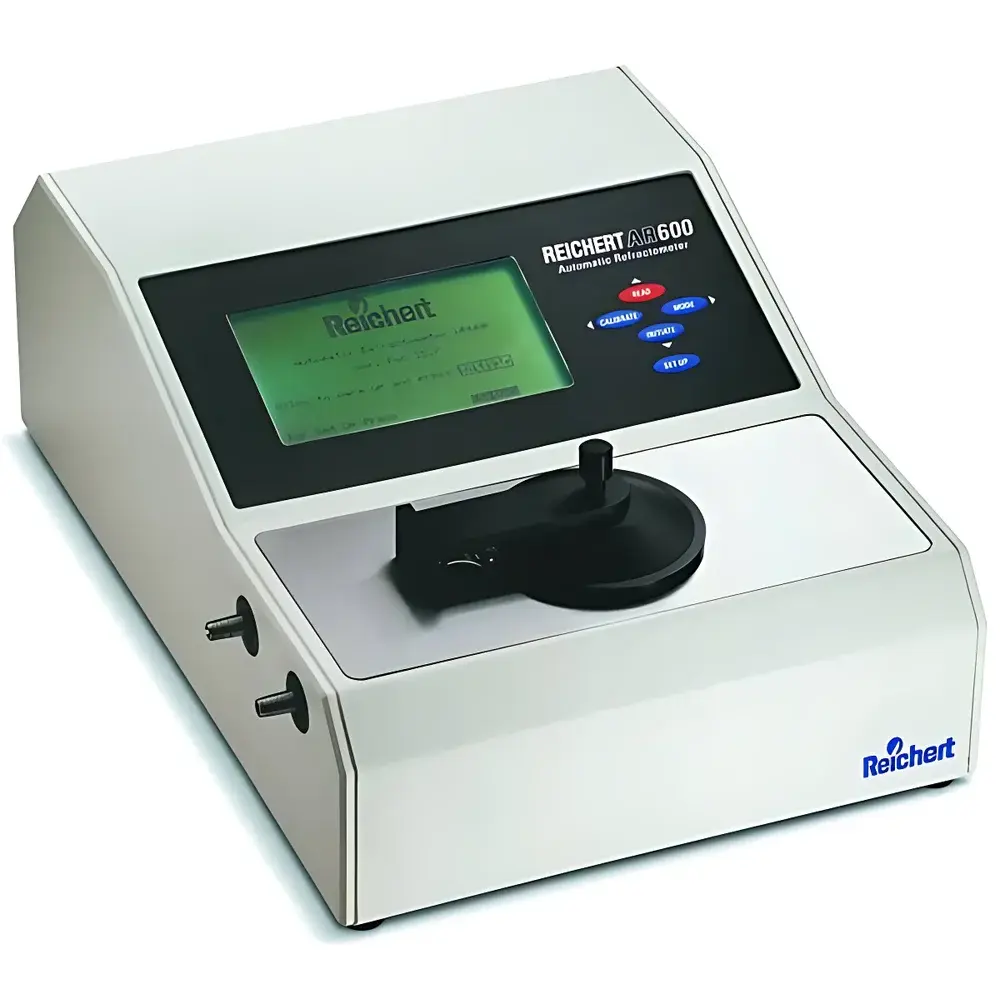
Reichert AR600 Automated Refractometer
| Brand | Reichert |
|---|---|
| Origin | USA |
| Model | AR600 |
| Type | Benchtop Refractometer |
| Temperature Control | Yes |
| Digital Display | Yes |
| Refractive Index Range | 1.32000–1.52000 nD |
| Refractive Index Accuracy | ±0.00002 nD |
| Brix Range | 0.00–90.00% |
| Brix Accuracy | ±0.01% |
| Light Source | 589 nm LED |
| Temp. Control Range | 10–60 °C |
| Temp. Compensation Range | 10–40 °C |
| Temp. Stability | ±0.01 °C |
| Prism Material | Sapphire |
| Sample Chamber | PTFE-lined 416 stainless steel |
| Display | LCD, 13.4 × 7.6 cm |
| Software | Multi-language (EN/DE/ES/FR), 14 programmable methods, password protection, auto-equilibration detection, factory reset capability |
Overview
The Reichert AR600 Automated Refractometer is a precision benchtop instrument engineered for high-accuracy refractive index (RI) and Brix measurements across demanding industrial, pharmaceutical, and food & beverage laboratories. It operates on the principle of total internal reflection at the prism–sample interface, using a stabilized 589 nm sodium-D line equivalent LED light source to determine the critical angle of refraction. This optical configuration—combined with a sapphire measuring prism and PTFE-lined 416 stainless steel sample chamber—ensures long-term dimensional stability, chemical resistance, and minimal thermal drift. Unlike traditional Abbe refractometers requiring manual interpolation or visual alignment, the AR600 employs fully automated digital image capture and real-time centroid analysis of the shadow line, eliminating operator subjectivity and delivering repeatable RI values to ±0.00002 nD. Its integrated solid-state temperature control architecture supports precise thermal equilibration of samples between 10 °C and 60 °C, with active compensation applied over 10–40 °C—critical for compliance with ASTM D1218, ISO 21745, and USP refractometry standards.
Key Features
- Fully automated measurement cycle: auto-focusing, shadow-line detection, RI/Brix calculation, and result validation without manual intervention
- Sapphire prism assembly with corrosion-resistant PTFE-sealed 416 stainless steel sample well—designed for aggressive solvents, viscous suspensions, and particulate-laden matrices
- High-stability 589 nm LED illumination system with >50,000-hour lifetime and spectral bandwidth <1 nm—eliminating lamp aging effects and calibration drift
- External water bath compatibility for extended temperature control (e.g., integration with Julabo or Huber circulators), enabling method transfer per ISO 2859-1 sampling plans
- Onboard temperature monitoring with ±0.01 °C resolution and PID-controlled thermal regulation—validated per EURACHEM/CITAC Guide CG4 requirements
- Large-format LCD display (13.4 × 7.6 cm) with adjustable contrast and backlight—optimized for glove-compatible operation in QC environments
Sample Compatibility & Compliance
The AR600 accommodates transparent, translucent, and opaque liquid samples—including turbid fruit pulps, emulsified sauces, crude glycerin, polymer melts, and biological fluids—without dilution or filtration. Its wide RI range (1.32000–1.52000 nD) covers applications from aqueous electrolytes to high-refractive-index organic solvents (e.g., ethylene glycol, propylene carbonate). The instrument meets functional requirements for GLP-compliant data integrity under FDA 21 CFR Part 11 when paired with Reichert’s optional Audit Trail Module, which logs user actions, method changes, calibration events, and result exports with electronic signatures. It is routinely deployed in facilities adhering to ISO/IEC 17025 accreditation for testing laboratories, particularly where refractometric quantification supports release testing of excipients (e.g., sucrose, dextrose), IV admixtures, and topical formulations.
Software & Data Management
Embedded firmware supports four language interfaces (English, German, Spanish, French) and stores up to 14 user-defined measurement protocols—including custom temperature ramp profiles, Brix-to-concentration conversion tables, and pass/fail tolerance windows. All results are timestamped and associated with operator ID, method name, and calibration status. Historical calibration data—including standard reference material (SRM) verification records—is retained indefinitely in non-volatile memory. Optional USB export enables direct CSV transfer to LIMS or statistical process control (SPC) platforms. Audit trail functionality—when enabled—records all configuration modifications, password resets, and data deletions with immutable timestamps, satisfying traceability mandates in GMP Annex 11 and ICH Q7.
Applications
- Food & Beverage: Quantitative sugar content (Brix) in juices, syrups, and concentrates; maturity assessment in tomato paste and apple puree; fat content estimation in dairy emulsions via RI correlation; alcohol-tolerance correction in fermented beverages
- Pharmaceuticals: Osmolality screening of parenteral solutions; concentration verification of API stock solutions; excipient identity testing (e.g., lactose vs. mannitol); stability-indicating assays for hydrolytic degradation
- Clinical & Diagnostics: Serum protein estimation via refractometric specific gravity; urine osmolality approximation in nephrology workflows; quality control of reagent kits containing glycerol or propylene glycol
- Chemicals & Polymers: Monomer purity verification in acrylic synthesis; solvent recovery efficiency monitoring; viscosity index prediction in lubricant base oils
FAQ
Does the AR600 require external temperature control for routine operation?
No—the instrument includes an integrated Peltier-based thermal module capable of precise sample conditioning from 10 °C to 60 °C. External water baths are optional for applications requiring tighter thermal uniformity or extended dwell times beyond onboard capacity.
Can the AR600 measure highly viscous or particulate-laden samples without clogging?
Yes—the open-access sample chamber design and chemically inert sapphire/PTFE interface allow direct loading of slurries, pastes, and suspensions up to 10,000 cP. Cleaning is performed via solvent rinse followed by air purge—no disassembly required.
Is Brix measurement traceable to NIST standards?
Yes—calibration is performed using certified sucrose reference standards (NIST SRM 84d or equivalent), and the instrument’s algorithm applies temperature-corrected Brix-to-RI conversion per ICUMSA Methods Book Chapter 8.
What software validation documentation is available for regulated environments?
Reichert provides a complete IQ/OQ protocol package, including installation qualification checklists, operational boundary testing reports, and electronic record integrity verification—aligned with GAMP 5 Category 3 software classification.



