
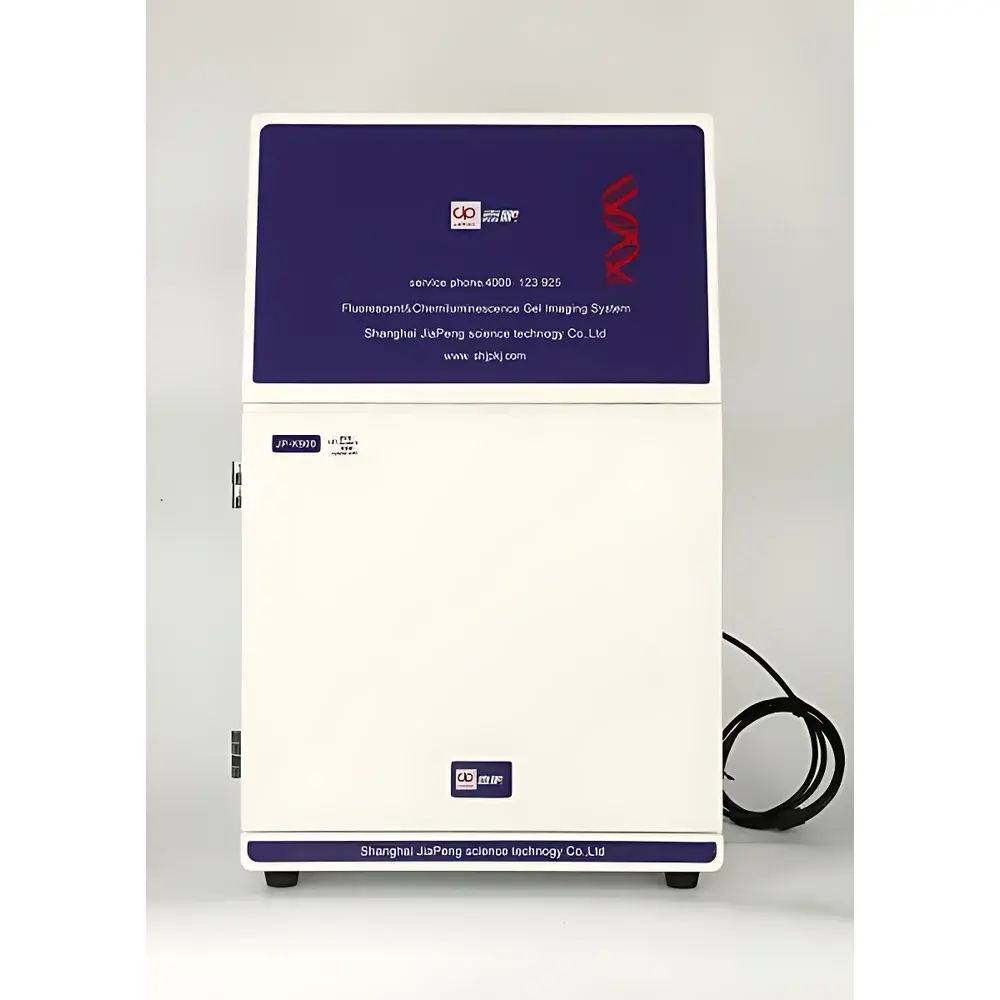
JP-K900 Chemiluminescence Gel Imaging System
| Brand | JiaPeng |
|---|---|
| Origin | Shanghai, China |
| Manufacturer Type | Authorized Distributor |
| Product Category | Domestic |
| Model | JP-K900 |
| Instrument Type | Chemiluminescence Gel Imaging System |
| CCD Resolution | 9 MP (3000 × 3000) |
| Bit Depth | 16-bit |
| Dynamic Range | 4.8 OD (0–65535 grayscale) |
| Pixel Binning Options | 1×1, 2×2, 3×3, 4×4, 6×6, 8×8 |
| Detection Sensitivity | <20 pg double-stranded DNA stained with ethidium bromide |
| Signal-to-Noise Ratio | ≥56 dB |
| Lens Aperture | F/0.95 fixed-focus lens |
| CCD Sensor | Sony IMX533CLK-D, 4/3″ format |
| Cooling Temperature | −45°C (ΔT ≈ −65°C vs ambient) |
| Pixel Size | 5.4 µm × 5.4 µm |
| Quantum Efficiency | >75% |
| Dark Current | <0.0005 e⁻/pixel/s |
| Transmission UV Source | 302 nm (standard), optional 254 nm / 365 nm reflectance UV |
| White Light Transilluminator | Integrated drawer-style uniform panel (200 × 200 mm) |
| Excitation Light Sources | UV transillumination (302 nm), optional UV reflectance (254/365 nm), blue/red/green LED fluorescence modules |
| Filter Wheel | Motorized 5-position (standard), optional 10-position |
| Imaging Area | Dual-stage—9.5 × 9.5 cm and 12.5 × 12.5 cm |
| Power Supply | AC 220 V, 50/60 Hz |
| Dimensions (W × D × H) | 390 × 440 × 735 mm |
| Weight | 18.3 kg |
Overview
The JP-K900 Chemiluminescence Gel Imaging System is a fully integrated, high-sensitivity digital imaging platform engineered for quantitative analysis of nucleic acids and proteins across multiple detection modalities. Built upon a cooled scientific CMOS architecture (Sony IMX533CLK-D sensor), the system operates on the principle of photon capture from low-intensity luminescent and fluorescent emissions—enabling reliable detection of chemiluminescent signals generated by enzyme-substrate reactions (e.g., HRP-luminol or AP-AMPPD systems), as well as fluorescence from UV-excited dyes (ethidium bromide, SYBR Safe, Cy dyes) and visible-light-stained gels or membranes. Its optical design centers on a large-aperture F/0.95 fixed-focus lens paired with a deep-cooled sensor (−45°C operational temperature), minimizing thermal noise and maximizing quantum efficiency (>75%)—a critical configuration for achieving sub-picomole detection limits in Western blotting, Northern/Southern blotting, and multiplex immunoassays.
Key Features
- Scientific-grade cooled sensor: Sony IMX533CLK-D, 4/3″ format, 9 MP resolution (3000 × 3000), with optional 23.65 MP upgrade (5376 × 4400)
- Ultra-low-noise imaging: Dark current <0.0005 e⁻/pixel/s; cooling delta up to −65°C below ambient ensures stable long-exposure acquisition
- High-dynamic-range digitization: 16-bit analog-to-digital conversion supporting 4.8 optical density (OD) range (0–65535 grayscale values)
- Flexible pixel binning: Configurable 1×1 through 8×8 binning modes to balance resolution, sensitivity, and acquisition speed
- Dual-stage sample platform: Drawer-style dual-area transilluminator (9.5 × 9.5 cm and 12.5 × 12.5 cm) with uniform white-light illumination (200 × 200 mm UV-transparent surface)
- Modular excitation sources: Standard 302 nm UV transillumination; optional 254/365 nm UV reflectance; programmable RGB LED fluorescence modules (blue, green, red)
- Automated filter wheel: Motorized 5-position (standard), expandable to 10-position; preloaded with precision bandpass filters (535 nm, 590 nm, 605 nm, 699 nm) for spectral separation
- User-configurable exposure logic: Programmable auto-shutdown timer (0–60 min) for light sources; anti-scatter sample stage reduces stray-light artifacts
Sample Compatibility & Compliance
The JP-K900 supports a broad spectrum of life science samples—including SDS-PAGE gels, agarose gels, nitrocellulose/PVDF membranes, microplates, and tissue sections—without mechanical modification. Its optical path accommodates both transmission (e.g., ethidium bromide–stained DNA) and reflection (e.g., chemiluminescent Western blots) geometries. The system meets essential laboratory compliance requirements for reproducible data generation: its 16-bit linear response enables accurate densitometric quantification per ASTM E2412-22 (Standard Practice for Quantitative Analysis of Gels), while audit-trail-capable software (via optional GLP/GMP module) supports alignment with FDA 21 CFR Part 11 electronic record integrity guidelines. All UV components comply with IEC 62471 photobiological safety standards for Class 1 LED/UV emission devices.
Software & Data Management
Bundled with proprietary JP-ImagePro Suite v5.x, the JP-K900 delivers end-to-end image acquisition, processing, and reporting functionality. The software provides real-time preview with live histogram adjustment, multi-channel overlay (chemiluminescence + fluorescence + white light), background subtraction using rolling-ball or polynomial algorithms, and lane/band identification with customizable thresholding. Quantitative outputs include integrated density (IDV), relative intensity (% of control), molecular weight estimation via calibration ladder fitting (linear/logarithmic), and batch export in TIFF, PNG, and vendor-neutral DICOM formats. Data integrity is preserved through embedded metadata (exposure time, binning mode, filter ID, lens aperture, temperature log), and optional network deployment allows centralized instrument management across core facilities.
Applications
- Western blot quantification of phosphorylated or ubiquitinated proteins using HRP- or AP-conjugated secondary antibodies
- DNA/RNA gel documentation with sub-20 pg sensitivity for ethidium bromide staining and SYBR-based alternatives
- Chemiluminescent ELISA and lateral flow assay readout with dynamic range sufficient for cytokine profiling
- Multiplex fluorescence detection on 2D gels or membrane arrays using spectrally resolved LED excitation
- Long-term kinetic imaging of bioluminescent reporter constructs (e.g., luciferase-expressing cell lines or transgenic organisms)
- Documentation of CRISPR-Cas9 editing efficiency via T7E1 or Surveyor nuclease assays
FAQ
What is the minimum detectable signal level for chemiluminescent Western blots?
The JP-K900 achieves routine detection of ≤20 pg of horseradish peroxidase (HRP)-conjugated antibody bound to target protein under standard luminol-based substrate conditions, validated using calibrated BSA-HRP dilution series.
Can the system perform simultaneous multi-color fluorescence imaging?
No—it acquires channels sequentially using the motorized filter wheel; however, spectral unmixing and co-localization analysis are supported in post-processing via JP-ImagePro Suite.
Is the UV transilluminator suitable for UV-sensitive dyes like SYBR Gold?
Yes—the 302 nm source is optimized for common nucleic acid stains; optional 365 nm reflectance mode reduces photobleaching during prolonged exposure of UV-labile fluorophores.
Does the system support automated focus calibration?
The standard drawer-style platform requires manual Z-axis positioning; however, an optional computer-controlled motorized lift stage (part #JP-ZLIFT-2) enables programmable focus mapping and repeatable height recall.
How is data traceability ensured for regulated environments?
With the optional GLP/GMP software add-on, all acquisitions are stamped with operator ID, timestamp, instrument serial number, and full parameter metadata; electronic signatures and change logs comply with 21 CFR Part 11 Annex 11 requirements.
Related Products





