
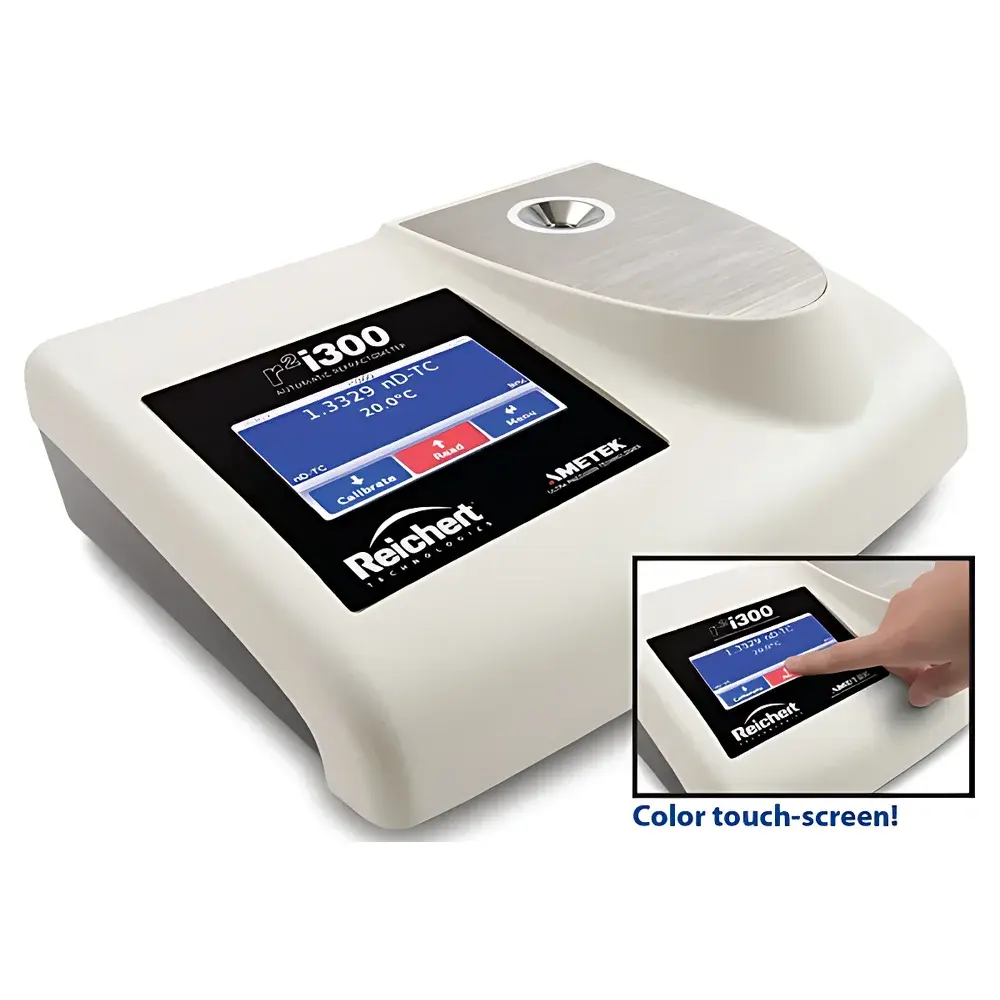
Reichert R2i300 Benchtop Automatic Refractometer
| Brand | Reichert |
|---|---|
| Origin | USA |
| Model | R2i300 |
| Type | Benchtop Refractometer |
| Temperature Control | Yes |
| Digital Display | Yes |
| Refractive Index Range | 1.3330–1.5600 nD |
| Brix Range | 0.0–95.0% |
| RI Accuracy | ±0.0001 nD |
| Brix Accuracy | ±0.1% |
| Light Source | High-intensity LED, 589 nm |
| Prism Material | Sapphire |
| Sample Chamber | PTFE-lined 416 stainless steel |
| Auto Temperature Compensation (ATC) | Yes |
| Calibration Modes | Fixed-point and user-defined range/point |
| Display | LCD, 11 × 6 cm |
| Predefined Measurement Modes | 7 |
Overview
The Reichert R2i300 Benchtop Automatic Refractometer is a compact, high-precision optical instrument engineered for reliable refractive index (RI) and Brix measurements in regulated and industrial laboratory environments. Operating on the principle of total internal reflection at the prism–sample interface, the R2i300 employs a monochromatic 589 nm sodium-D line-equivalent LED light source to determine RI with traceable accuracy. Its sapphire prism—four times more abrasion-resistant than standard optical glass and exhibiting 2.5× higher thermal conductivity—enables rapid thermal equilibration and superior ATC performance. This architecture ensures consistent measurement repeatability across ambient temperature fluctuations, making it suitable for environments where HVAC stability cannot be guaranteed. Designed as a benchtop system, the R2i300 maintains full metrological functionality within a footprint of just 30 × 22 cm—ideal for space-constrained QC labs, pilot production lines, or mobile analytical units.
Key Features
- Sapphire prism assembly with PTFE-sealed 416 stainless steel sample chamber—resistant to corrosion, scratching, and chemical degradation from aggressive solvents, viscous oils, or particulate-laden suspensions.
- High-stability 589 nm LED illumination with >50,000-hour lifetime—eliminates lamp drift and recalibration cycles associated with halogen or tungsten sources.
- Integrated Peltier-assisted temperature control (±0.1 °C stability) coupled with real-time ATC algorithm—ensures RI values are reported at standardized 20 °C or user-defined reference temperatures per ASTM D1218 and ISO 2859-1 protocols.
- Seven programmable measurement modes—including RI, Brix, % solids, NaCl, user-defined concentration curves—each configurable with custom units, tolerances, and pass/fail thresholds.
- LCD display (11 × 6 cm) with intuitive icon-driven interface—supports multilingual menus (English, German, French, Spanish, Chinese) and on-screen calibration guidance compliant with ISO/IEC 17025 documentation requirements.
- Non-destructive analysis capability for opaque, turbid, and semi-solid samples—including sauces, emulsions, polymer melts, and biological suspensions—without dilution or filtration.
Sample Compatibility & Compliance
The R2i300 accepts liquid, semi-liquid, and viscous samples ranging from aqueous solutions to high-viscosity oils (up to 10,000 cP), including black or light-absorbing matrices such as soy sauce, bitumen cutbacks, and pharmaceutical ointments. Its sapphire–PTFE interface eliminates wettability artifacts common with hydrophobic or surfactant-rich formulations. The instrument complies with key international standards for refractometric analysis: ASTM D1218 (petroleum products), AOAC 932.12 (Brix in fruit juices), USP (particulate matter in injectables, via indirect concentration correlation), and ISO 21527-1 (microbial enumeration support via media concentration verification). Full audit trail logging—including operator ID, timestamp, calibration history, and raw RI/Brix values—is available when paired with optional GLP-compliant software modules satisfying FDA 21 CFR Part 11 requirements.
Software & Data Management
The R2i300 supports RS-232 and USB host connectivity for direct integration into LIMS or MES platforms. Optional Reichert RefraLink Pro software provides secure data export (CSV, PDF, XML), customizable report templates aligned with ISO 15197 or ICH M7 guidelines, and electronic signature workflows. All measurement records include embedded metadata: ambient temperature, prism temperature, measurement duration, and deviation from calibration baseline. Instrument firmware is field-upgradable via signed binary packages, ensuring long-term compliance with evolving digital validation standards (e.g., Annex 11, GAMP 5 Category 3 classification).
Applications
In food & beverage QA, the R2i300 verifies Brix in fruit concentrates (AOAC 932.12), monitors sugar inversion during syrup processing, and quantifies alcohol content in fermented beverages via empirical RI–ethanol correlations. In pharma manufacturing, it validates excipient concentrations in oral suspensions, confirms isotonicity of IV admixtures (USP ), and supports stability-indicating assays for protein aggregation in biologics formulations. Chemical process labs use it for real-time monitoring of polymerization degree in acrylic resins, solvent recovery efficiency in distillation columns, and acid concentration in pickling baths. Additional validated use cases include glycol concentration in aircraft de-icing fluids (SAE AMS1424), coolant mixture ratios in EV battery thermal management systems, and urea content in diesel exhaust fluid (ISO 22241).
FAQ
Does the R2i300 require routine prism cleaning between samples?
Yes—though the sapphire surface resists scratching, residual films must be removed using lint-free wipes and approved solvents (e.g., isopropanol) prior to each measurement to maintain ±0.0001 nD accuracy.
Can the R2i300 measure samples below 0 °C or above 40 °C?
The instrument operates within 10–40 °C ambient; however, its ATC algorithm compensates for sample temperatures from 5–60 °C, enabling valid readings of chilled dairy products or warm process streams.
Is third-party calibration certification available?
Yes—NIST-traceable calibration reports (including uncertainty budgets per ISO/IEC 17025) are provided with optional annual service contracts.
How is user access controlled for GxP environments?
Role-based permissions (operator, supervisor, administrator) are enforced via password-protected login; all critical actions generate immutable audit entries with SHA-256 hash integrity verification.
What maintenance intervals are recommended for long-term accuracy?
Biannual verification against certified NIST SRM 14xx series refractive index standards is advised; prism surface inspection and LED intensity validation should occur quarterly.




