
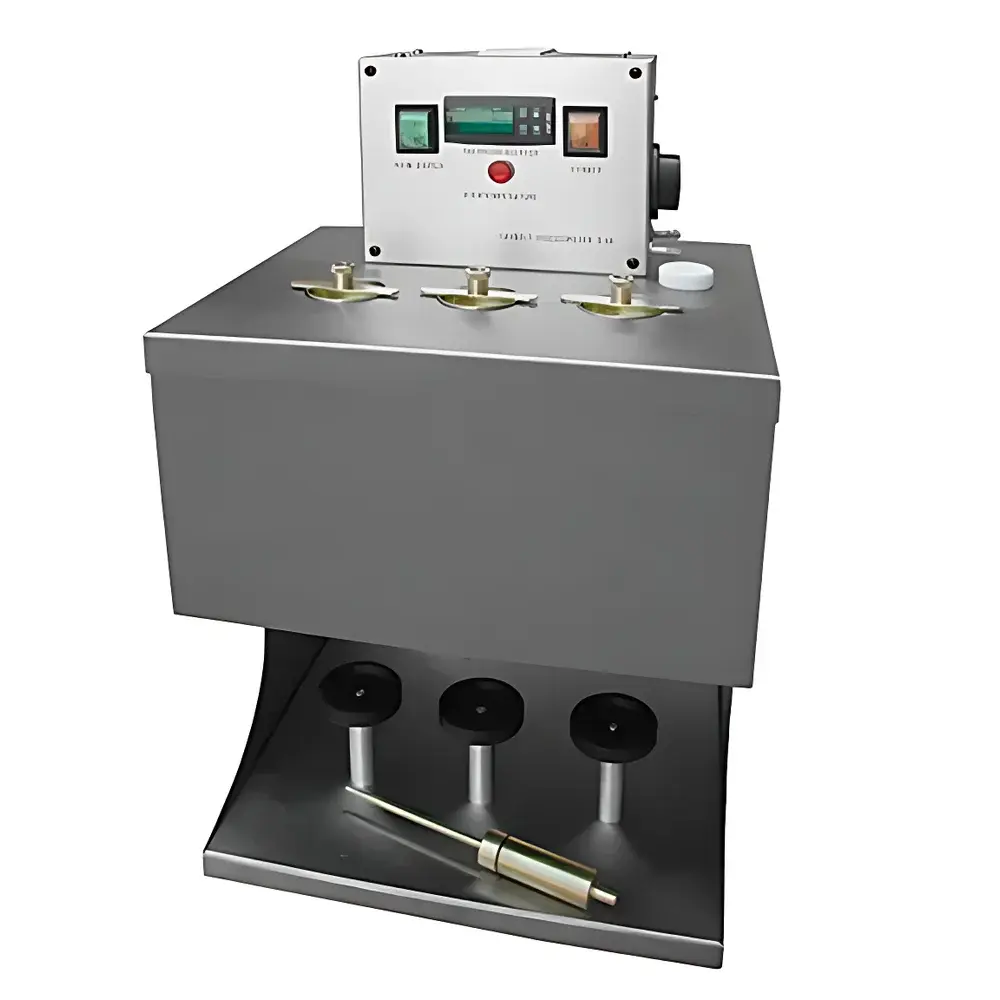
Sibert D88 Kinematic Viscosity Tester (ASTM D88 / ASTM E102 Compliant)
| Origin | Switzerland |
|---|---|
| Type | Kinematic Viscosity Tester |
| Standards | ASTM D88, ASTM E102, FTM 791-0304, JIS K 2207 |
| Temperature Range (D88 mode) | 21–99 °C (70–210 °F) |
| Temperature Range (E102 mode) | 121–232 °C (250–450 °F) |
| Power Supply | 220 V AC, 50/60 Hz |
| Dimensions | 50 × 50 × 69 cm |
| Weight | 25 kg |
| Orifice Diameters | 1.76 mm (standard), 3.15 mm (furfural) |
| Sample Positions | 1, 2 or 3 (model-dependent) |
Overview
The Sibert D88 Kinematic Viscosity Tester is a precision-engineered capillary viscometer system designed exclusively for the determination of kinematic viscosity in petroleum products and related hydrocarbon-based fluids. Based on the classical efflux time principle defined in ASTM D88 and ASTM E102, this instrument measures the time required for a fixed volume of liquid to flow under gravity through a calibrated glass or stainless-steel capillary tube at controlled, stabilized temperatures. The D88 configuration operates within the low-to-mid temperature range (21–99 °C), suitable for light distillates, lubricating oils, and transformer fluids, while the E102 variant extends operational capability to high-viscosity residues and heavy fuel oils at elevated temperatures (121–232 °C). Its robust thermal architecture—featuring double-walled stainless steel (18/8) bath construction, PID-controlled digital temperature regulation with PT100 sensing, overtemperature alarm, and integrated cooling coil—ensures thermal stability within ±0.02 °C across the full operating range, meeting stringent repeatability requirements outlined in ISO 3104 and ASTM D445 harmonized methodology.
Key Features
- Compliance with multiple international standards: ASTM D88, ASTM E102, FTM 791-0304, and JIS K 2207—enabling direct traceability for quality control laboratories under ISO/IEC 17025 accreditation.
- Dual-mode thermal platform supporting both low-temperature (D88) and high-temperature (E102) viscosity determinations without hardware modification.
- Stainless steel bath with double-layer insulation and front-opening sleeve design for ergonomic sample handling and reduced ambient heat loss.
- PID digital temperature controller with real-time display, programmable setpoint ramping, and audible/visual overtemperature alert.
- Integrated magnetic stirrer and copper cooling coil for rapid thermal equilibration and precise temperature maintenance during extended testing cycles.
- Calibrated orifice cups: standard 1.76 mm (Art. LAB-100-165) and furfural-grade 3.15 mm (Art. LAB-100-166), both manufactured from polished stainless steel and certified per ASTM D445 Annex A2.
- Modular configurations available: single-position (LT/SV-18000-1/M), dual-position (LT/SV-18000-2/M), and triple-position (LT/SV-18000-3/M) variants to optimize throughput in routine QC environments.
Sample Compatibility & Compliance
The Sibert D88 accommodates a broad spectrum of petroleum-derived samples—including naphthas, kerosenes, diesel fuels, base oils, residual fuels, and bituminous materials—provided they are free of particulates and volatile fractions that could compromise efflux timing accuracy. All sample preparation follows ASTM D1298 (density) and ASTM D4057 (sampling) guidelines. The instrument’s mechanical design and thermal performance support GLP-compliant operation when paired with validated stopwatch protocols (e.g., LAB-100-332 digital timer with ±0.01 s resolution) and documented calibration records. Optional accessories—including ASTM-certified thermometers (T-AS17C through T-AS109F series), stainless steel filtration funnels (LAB-100-161), and recovery tubes (LAB-100-164)—ensure full alignment with method-defined procedural controls. CE marking confirms conformity with EU Machinery Directive 2006/42/EC and Electromagnetic Compatibility Directive 2014/30/EU.
Software & Data Management
While the core D88 system operates as a manual or semi-automated benchtop unit, its measurement workflow integrates seamlessly into regulated laboratory data systems. Efflux times are recorded externally using NIST-traceable digital timers (LAB-100-332) or analog equivalents (LAB-100-331), then processed via standardized calculation engines compliant with ASTM D445 Equation 1 (ν = C × t). For laboratories implementing electronic records, the instrument supports audit trail documentation through LIMS interfaces when paired with timestamped test logs, operator IDs, and calibration certificate references. All temperature sensors (PT100 probe, Art. LAB-140-001/A) and heating elements (Art. LAB-11-0012) are individually serialized and maintained under documented calibration schedules aligned with ISO/IEC 17025 clause 6.5. Software-independent operation ensures compliance with FDA 21 CFR Part 11 where electronic signatures are not required—making it suitable for legacy GMP environments with paper-based SOPs.
Applications
- Refinery process control: monitoring viscosity changes in crude assay fractions and cut-point verification.
- Lubricant manufacturing: verifying kinematic viscosity grades (ISO VG, SAE J300) for engine oils, hydraulic fluids, and gear oils.
- Fuel specification testing: confirming conformance to ASTM D975 (diesel), ASTM D3606 (gasoline), and ASTM D7462 (biodiesel blends).
- Research & development: characterizing thermal degradation effects on polymer-modified bitumens and synthetic ester-based lubricants.
- Third-party certification labs: supporting API Monogram licensing, EN 14214 biodiesel certification, and customs clearance documentation for bulk petroleum shipments.
FAQ
What standards does the Sibert D88 explicitly support?
ASTM D88, ASTM E102, FTM 791-0304, and JIS K 2207. It is also compatible with ISO 3104 methodology for kinematic viscosity determination.
Can the same instrument be used for both low- and high-temperature measurements?
Yes—the D88 platform is configured to operate in either D88 mode (21–99 °C) or E102 mode (121–232 °C) via selection of appropriate orifice cups, thermometer ranges, and thermal bath parameters.
Is the instrument supplied with calibration documentation?
Each unit ships with a factory calibration report for the temperature control system (traceable to NIST), and optional UKAS-accredited calibration certificates are available upon request for individual components including orifice cups and thermometers.
How is thermal uniformity verified across the bath?
The double-walled stainless steel construction, combined with magnetic stirring and PID-regulated heating, achieves axial and radial thermal gradients of ≤0.03 °C—verified per ASTM D445 Annex B procedures.
Are spare orifice cups and certified thermometers available separately?
Yes—full accessory catalog includes ASTM-certified orifices (LAB-100-165, LAB-100-166), calibrated thermometers (T-AS17C through T-AS109F), and replacement parts such as PT100 probes (LAB-140-001/A) and static relays (LAB-150-015).
Related Products





