
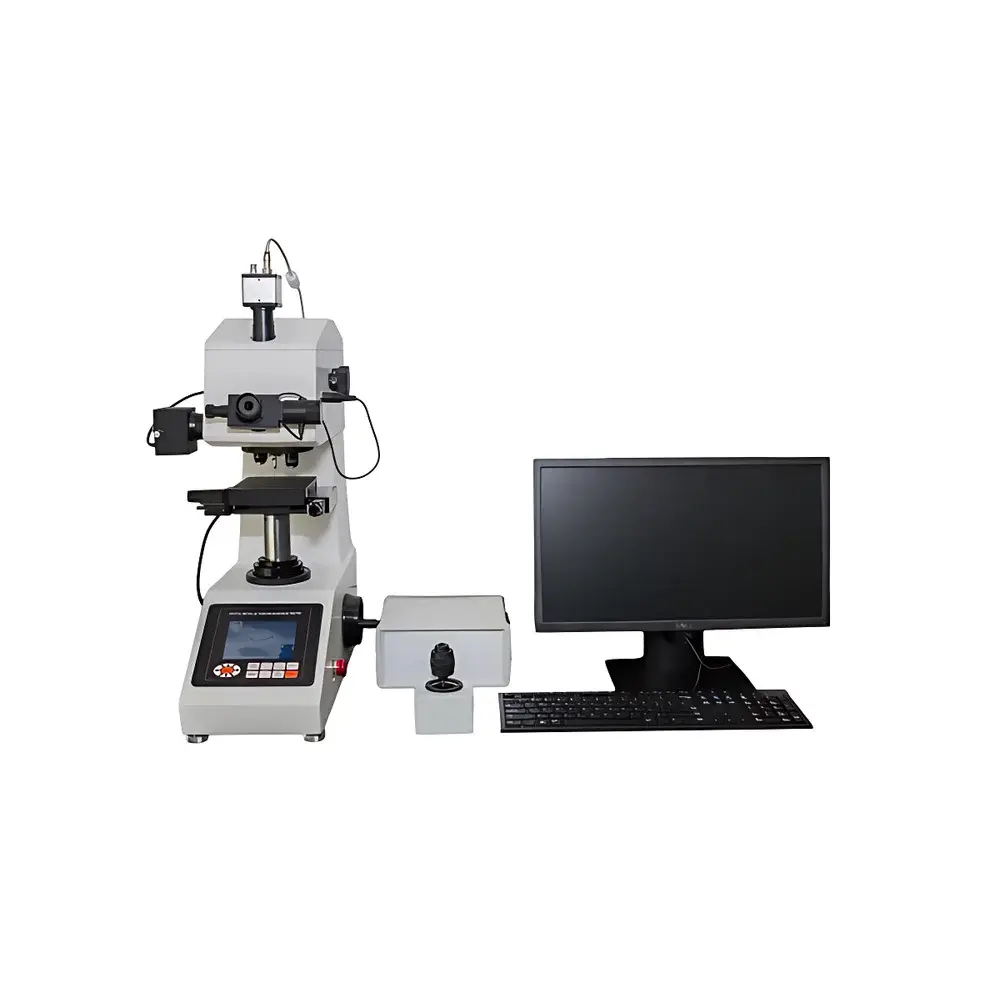
BRIGHT Cratos W50S Intelligent Digital Microhardness Testing System
| Brand | BRIGHT |
|---|---|
| Origin | United Kingdom |
| Model | Cratos W50S |
| Instrument Type | Microhardness Tester |
| Test Force Range | 0.098–9.80 N (10–1000 gf) |
| Hardness Range | 1–2967 HV |
| Measurement Modes | HV / HK |
| Compliance | ISO 6507, ASTM E384, JIS Z2244, GB/T 4340.2 |
| Resolution | 0.025 µm |
| Dwell Time | 0–60 s |
| Illumination | Halogen |
| Max Specimen Height | 185 mm |
| Dimensions | 560 × 335 × 675 mm |
| Weight | 52 kg |
Overview
The BRIGHT Cratos W50S Intelligent Digital Microhardness Testing System is a fully automated microindentation hardness analyzer engineered for high-precision Vickers and Knoop hardness measurements under low test loads. Based on the principle of optical indentation metrology—where a diamond pyramid indenter (Vickers) or rhombic-based pyramidal indenter (Knoop) is applied to the sample surface under controlled force, followed by high-resolution digital imaging and geometric analysis of the residual impression—the Cratos W50S delivers traceable, repeatable hardness values in the range of 1–2967 HV. Designed for applications requiring minimal surface disruption, it supports quantitative mechanical characterization of thin films, case-hardened layers, electroplated coatings, brittle ceramics, metallurgical cross-sections, and micro-scale components where conventional macro-hardness methods are unsuitable. Its integrated architecture eliminates manual eyepiece alignment and subjective interpretation, replacing them with deterministic image capture, sub-micron pixel calibration, and algorithmic diagonal measurement—ensuring compliance with international standards governing microhardness testing methodology.
Key Features
- Fully motorized operation: automatic loading, dwell, unloading, turret rotation, objective switching (10× observation / 40× measurement), and focus adjustment
- Embedded industrial tablet PC running Windows 7 OS with Intel Core i5 CPU, 8 GB RAM, and 128 GB SSD—hosting proprietary hardness analysis software with touchscreen interface
- 130-watt high-sensitivity CCD imaging system with real-time dynamic indentation preview and auto-lock functionality
- Motorized X-Y stage (110 × 110 mm platform, 50 × 50 mm travel range) with 0.002 mm positioning resolution and programmable multi-point grid mapping
- Dual-mode hardness evaluation: Vickers (HV) and Knoop (HK), with seamless conversion across 18 standardized hardness scales including Rockwell (A–K, N/T series), Brinell (HBW), Shore (HS), and superficial Rockwell variants
- Optical path with halogen illumination, calibrated 10× digital eyepiece, and 0.025 µm measurement resolution per pixel
- Configurable dwell time (0–60 s), eight selectable test forces (0.098–9.80 N), and automatic hardness value calculation with statistical summary (mean, SD, min/max)
Sample Compatibility & Compliance
The Cratos W50S accommodates specimens up to 185 mm in height and 110 × 110 mm in footprint, supporting diverse material classes—including ferrous and non-ferrous metals, carbides, sintered powders, layered composites, semiconductor wafers, and polymer-coated substrates. Its low-force capability (down to 10 gf) enables valid hardness profiling of diffusion zones, nitrided cases, PVD/CVD coatings (<1 µm thick), and MEMS structures without substrate interference. All measurement protocols conform to ISO 6507-1 (Metallic materials — Vickers hardness test — Part 1: Test method), ASTM E384 (Standard Test Method for Knoop and Vickers Hardness of Materials), JIS Z2244, and GB/T 4340.2. The system supports GLP-compliant data integrity through timestamped audit trails, user access control, and encrypted report generation—facilitating FDA 21 CFR Part 11 readiness when deployed in regulated QC/QA environments.
Software & Data Management
The embedded software provides a unified workflow from test setup to reporting. Users define test parameters—including force, dwell time, grid pattern, number of repeats, and optical magnification—via intuitive touchscreen menus. Post-indentation, the system performs edge-detection-based diagonal measurement, applies standard area correction factors, and outputs hardness values with uncertainty estimation. Data is stored locally in structured SQLite databases and exportable in native .xlsx and .docx formats. Hardness-depth profiles, scatter plots, histograms, and statistical process control (SPC) charts can be generated directly. USB 2.0, VGA, and Ethernet interfaces enable peripheral connectivity—including thermal printers, external monitors, and LIMS integration via TCP/IP or OPC UA protocols. Raw image files (.bmp/.tiff) retain full metadata (force, time, position, lens ID) for retrospective reanalysis.
Applications
- Case depth analysis of carburized, nitrided, or induction-hardened steel components
- Quality assurance of electroless nickel, chromium, zinc, and DLC coatings
- Microstructural hardness mapping of weld zones, heat-affected zones (HAZ), and intermetallic phases
- R&D validation of additive manufacturing (AM) build layers and post-process heat treatments
- Failure analysis of brittle fracture origins in ceramics and thin-film devices
- Calibration verification of reference blocks per ISO 6507-3 and ASTM E92
- Educational use in materials science laboratories for hands-on indentation mechanics instruction
FAQ
Does the Cratos W50S support ASTM E92-compliant Brinell hardness conversion?
Yes—it includes certified algorithms for HV-to-HBW conversion per ASTM E140 Annex A1, with matrix-based interpolation validated against NIST-traceable reference materials.
Can the system perform sequential multi-load hardness profiling on a single specimen?
Yes—programmable test sequences allow automated force ramping (e.g., 25 gf → 100 gf → 500 gf) at predefined coordinates, generating load-dependent hardness curves.
Is remote diagnostics or firmware update capability available?
Yes—via secure Ethernet connection using HTTPS-based OTA (over-the-air) update protocol; remote session support requires prior authorization and TLS 1.2+ encryption.
What maintenance intervals are recommended for the indenter and optical path?
Indenter verification is advised every 6 months or after 5,000 indentations using certified reference blocks; halogen lamp replacement is recommended annually or after 2,000 hours of operation.
Does the software comply with FDA 21 CFR Part 11 requirements for electronic records?
Out-of-the-box configuration includes electronic signatures, audit trail logging, and role-based access control—fully configurable to meet Part 11 predicate rule expectations when deployed with validated IT infrastructure.



