
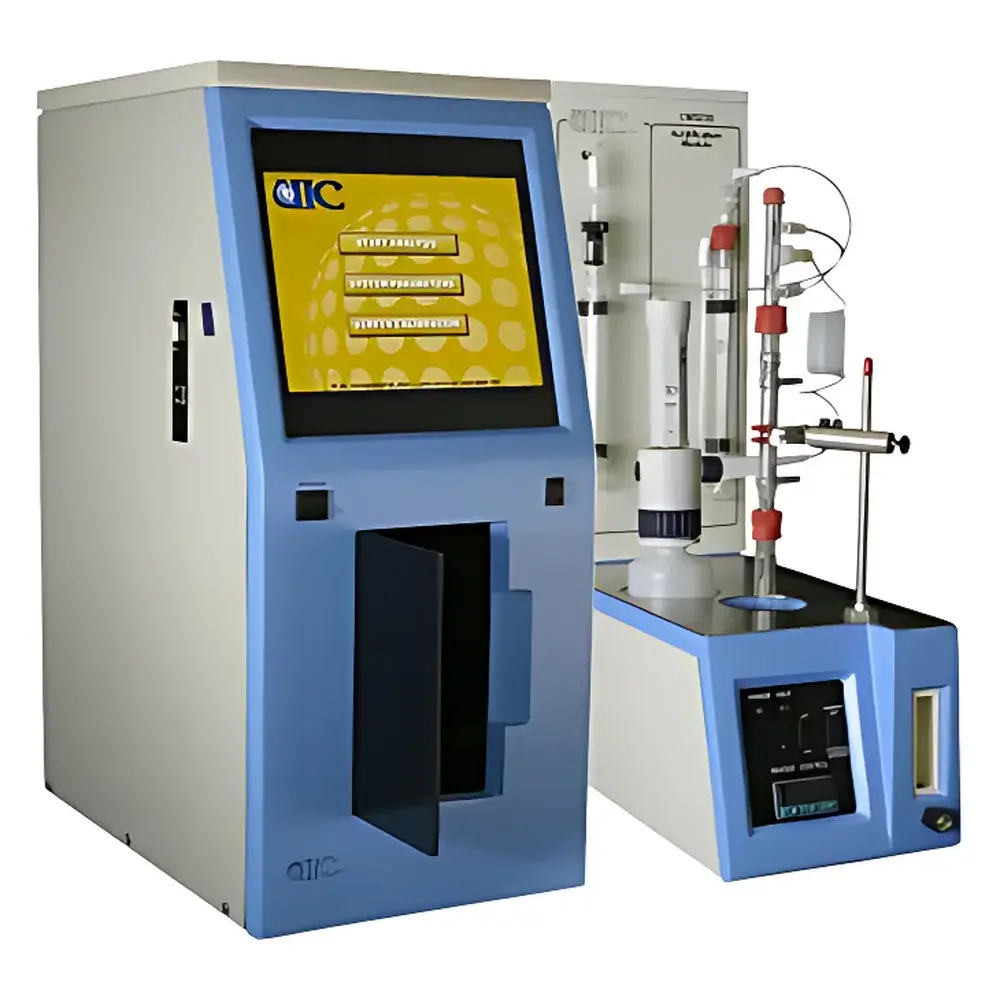
UIC CM340 Coulometric Sulfur Analyzer
| Brand | UIC (USA) |
|---|---|
| Origin | USA |
| Model | CM340 |
| Detection Principle | Coulometric Titration (Faraday-based SO₂/H₂S Quantification) |
| Dynamic Range | 1 µg to 10,000 µg total sulfur |
| Resolution | 0.01 µg S |
| Sample Forms | Solid and liquid |
| Acid Digestion Volume Options | 10, 25, 50, or 100 mL |
| Analysis Time | ~5–7 min per sample (temperature- and matrix-dependent) |
| Data Storage | Internal memory for up to 50 samples + 3.5" floppy disk export |
| Compliance | Designed for GLP/GMP environments |
Overview
The UIC CM340 Coulometric Sulfur Analyzer is a dedicated benchtop instrument engineered for precise, trace-to-high-level quantification of total sulfite, free and bound SO₂, and hydrogen sulfide (H₂S) in diverse matrices. It operates on the fundamental electrochemical principle of controlled-potential coulometric titration—based on Faraday’s law—where sulfur-containing species liberated during acid digestion are swept by ultra-pure carrier gas into a dual-electrode SO₂/H₂S detection cell. In this cell, SO₂ and H₂S undergo stoichiometric oxidation at a platinum working electrode, generating a current directly proportional to the mass of sulfur atoms oxidized. No user calibration is required; absolute quantification is achieved through real-time integration of charge (coulombs), enabling high reproducibility and inherent accuracy across a 1 µg–10,000 µg sulfur range. The system eliminates interference from atmospheric sulfur compounds via inert gas purging prior to acid addition, ensuring baseline stability and measurement integrity.
Key Features
- Fully automated coulometric detection module (CM5014S) with self-calibrating electrochemical cell—no routine standardization needed
- Integrated acid digestion unit (CM5130) featuring programmable heating, magnetic stirring, and precision acid dispensing with selectable reaction vessel volumes (10, 25, 50, or 100 mL)
- Carrier gas purification system with pre-acid scrubbers to remove ambient SO₂ and H₂S, minimizing background drift
- High-resolution sulfur quantification (0.01 µg S) and linear response over four orders of magnitude
- Flexible sample introduction: direct solid weighing into Teflon-lined vials or syringe injection through septum for liquids
- Onboard data management supporting up to 50 sample records—including mass/volume inputs, method selection, and result calculation—with 3.5″ floppy disk export capability
- Modular design allowing configuration for specific throughput and matrix requirements via optional sample introduction modules (CM5131–CM5134)
Sample Compatibility & Compliance
The CM340 accommodates heterogeneous sample types without derivatization or pre-concentration: foodstuffs (e.g., wine, dried fruits, processed meats), environmental solids (soils, sediments, gypsum board), industrial scrubber solutions (amine-based desulfurization liquors), and geological specimens. Its robust acid digestion protocol tolerates moderate organic load and particulate content. From a regulatory standpoint, the instrument’s fixed electrochemical endpoint, absence of consumable reagents, and deterministic Faraday-based quantification align with ASTM D5816 (sulfur in petroleum products), AOAC Official Method 990.11 (sulfites in foods), and ISO 5775-1 (SO₂ in beverages). When operated under documented procedures with electronic record retention (via floppy disk or external PC interface), it supports GLP and GMP compliance frameworks, including traceability, audit trails, and data integrity requirements referenced in FDA 21 CFR Part 11.
Software & Data Management
The CM5014S analyzer incorporates embedded firmware that manages method sequencing, real-time coulomb integration, and concentration calculation using user-entered sample mass or volume. Up to 50 sample identifiers, weights, dilution factors, and analysis parameters can be stored internally. Results display digitally in selectable units (µg S, mg/kg, ppm, % w/w, or mmol/L). Post-run summary reports—including mean, SD, and RSD—are printable via integrated thermal printer. Raw coulombic current profiles and endpoint detection timestamps are retained for review. While native floppy disk export provides basic data portability, integration with laboratory information management systems (LIMS) is achievable via RS-232 serial output, enabling structured transfer of calibrated results and metadata for centralized QA/QC tracking.
Applications
- Quantification of total sulfite in wines, beers, and fruit juices per OIV and EU regulatory thresholds
- Determination of residual SO₂ in pharmaceutical excipients and active ingredients (ICH Q5C-aligned stability testing)
- Analysis of H₂S in biogas scrubbing solutions and refinery amine loops for process control
- Measurement of sulfur species in coal ash, fly ash, and flue gas desulfurization (FGD) sludge for environmental reporting
- Research-scale investigation of sulfur redox speciation in sediment pore water and hydrothermal vent fluids
- Educational use in analytical chemistry laboratories to demonstrate electrochemical stoichiometry and Faraday’s law applications
FAQ
Does the CM340 require daily calibration with certified standards?
No. The coulometric cell operates on Faraday’s law, where sulfur quantification is derived from integrated charge—making it inherently absolute. Only periodic verification with traceable sulfur standards (e.g., potassium metabisulfite) is recommended for quality assurance.
Can the instrument distinguish between SO₂ and H₂S in the same sample?
No. The CM5014S detects total electroactive sulfur as SO₂-equivalents. Speciation requires selective trapping or prior chemical separation (e.g., lead acetate scrubbers for H₂S removal).
What carrier gas is required, and what purity level is necessary?
Ultra-high-purity nitrogen or argon (≥99.999% purity, sulfur-free certified) is mandatory. Oxygen must be excluded to prevent oxidative side reactions and electrode passivation.
Is the CM340 compliant with modern electronic record requirements (e.g., 21 CFR Part 11)?
The base configuration supports audit-ready operation when paired with validated procedural controls. Full Part 11 compliance (e.g., electronic signatures, role-based access) requires external LIMS integration and documented system validation.
How is carryover managed between high- and low-sulfur samples?
The CM5130 module includes an automated post-digestion purge cycle and integrated scrubber regeneration. Vial washing protocols and blank runs are recommended for trace-level work following high-concentration analyses.




