
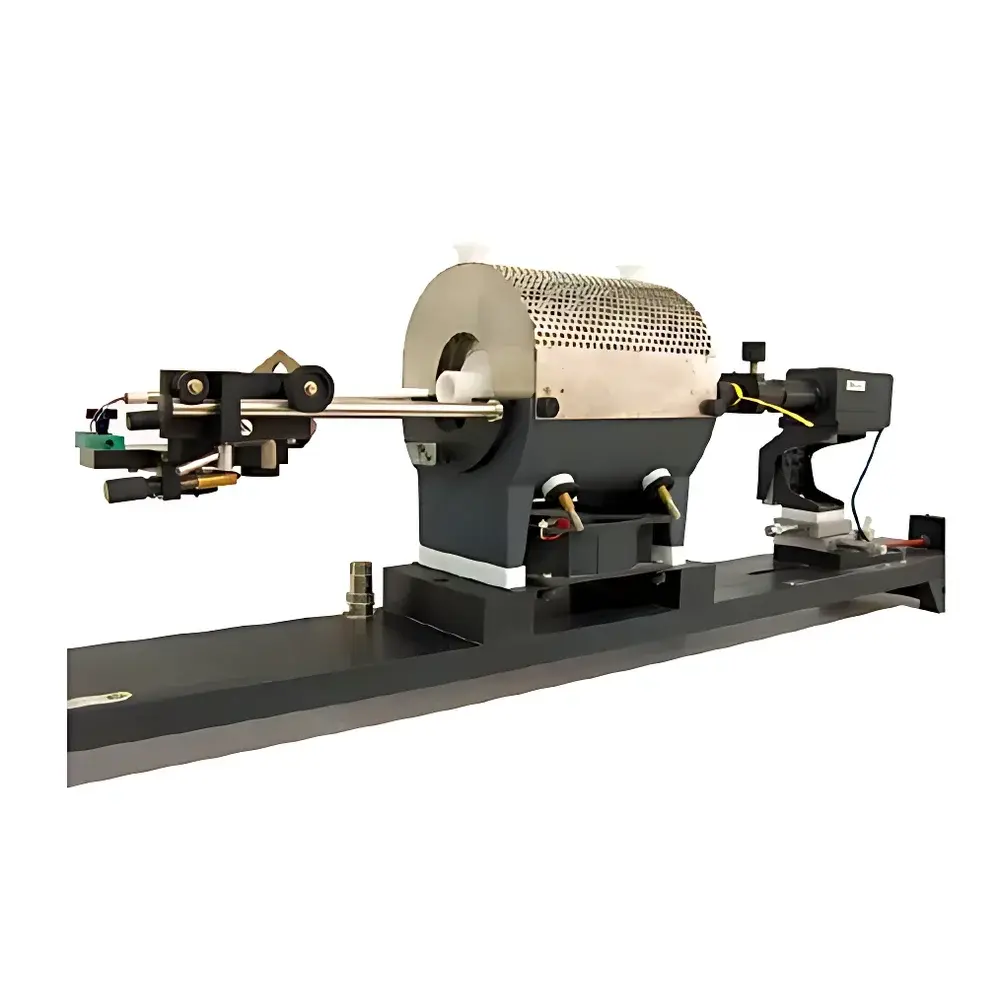
HTM1600 High-Temperature Microscope (Imported, Italy)
| Origin | Italy |
|---|---|
| Manufacturer Type | Authorized Distributor |
| Origin Category | Imported |
| Model | HTM1600 |
| Pricing | Available Upon Request |
Overview
The HTM1600 High-Temperature Microscope is an advanced thermal analysis instrument engineered for in-situ optical observation and quantitative morphological characterization of materials under controlled high-temperature conditions. Based on direct visual monitoring combined with high-resolution digital imaging and precise thermocouple-based temperature control, the system enables real-time tracking of structural transformations—including sintering onset, softening, hemispherical deformation, spherical formation, melting, and viscous flow—across a calibrated thermal range up to 1550 °C (with furnace rating to 1600 °C). Its operational principle integrates optical metrology with thermal kinetics: sample geometry changes are captured via a color-filtered CCD camera mounted on a rigid optical path, while temperature is measured using a Type S thermocouple positioned in close proximity to the sample stage. The resulting image sequences are processed to extract dimensional parameters (e.g., height, width, contact angle) as functions of temperature, supporting rigorous interpretation of thermal behavior per ISO 540:1995 and complementary industrial standards.
Key Features
- High-temperature furnace module (Type C) rated to 1600 °C, with stable operation up to 1550 °C and maximum sample temperature of 1500–1550 °C
- Controlled heating rate ≤70 °C/min below 1000 °C; total power consumption: 4 kW
- Optical system featuring color-filtered CCD camera with continuous frame acquisition and real-time digital output
- Automated detection and temperature assignment of critical thermal events: sintering point, softening point, sphere point, hemisphere point, and melting point
- Integrated software algorithms for contact angle measurement and viscosity estimation based on Young–Laplace equation and sessile drop shape analysis
- No calibration or geometric correction required—dual-precision optical design ensures inherent measurement consistency
- Reduced sample preparation time through optimized crucible placement and thermal gradient management
- Temperature repeatability: ±2–5 °C across repeated cycles; dimensional reproducibility: height/width ≤0.3%, contact angle ≤2°
Sample Compatibility & Compliance
The HTM1600 accommodates a broad spectrum of inorganic and ceramic materials, including but not limited to silicate glasses, glazes, refractories, coal ash, metallurgical slags, and advanced ceramics. Samples are typically prepared as cylindrical pellets or standardized ash cones (per ISO 540:1995), placed directly on inert alumina or graphite substrates. The system supports both static heating profiles and dynamic thermal cycling protocols relevant to industrial firing schedules. All thermal event definitions align with ASTM D1896, ISO 540, and IEC 60695-6-2 methodologies. Temperature measurement traceability conforms to ITS-90, and the furnace’s thermal uniformity profile is validated per EN 60519-12 requirements for laboratory resistance furnaces.
Software & Data Management
The proprietary Windows-based application provides full control over image acquisition, temperature ramping, event annotation, and post-processing analytics. Users can define custom thermal protocols, assign timestamps to individual frames, and export synchronized datasets (temperature vs. pixel coordinates, contact angle, aspect ratio, area) in CSV or HDF5 format. Image sequences are stored with embedded metadata—including thermocouple readings, shutter speed, gain settings, and user-defined annotations—to support audit-ready documentation. The software architecture complies with data integrity principles outlined in FDA 21 CFR Part 11 for electronic records, including role-based access control, electronic signatures, and immutable audit trails for all measurement sessions.
Applications
- Determination of ash fusion temperatures (AFT) in coal and biomass combustion research
- Characterization of glass transition, softening, and working ranges in optical and container glass development
- Optimization of ceramic body formulation and kiln schedule validation in tile and sanitaryware manufacturing
- Viscosity profiling of molten slags in metallurgical process modeling
- Surface tension quantification of oxide melts via axisymmetric drop shape analysis (ADSA)
- Thermal stability assessment of refractory linings and insulating ceramics under simulated service conditions
- Quality assurance of raw material batches in cement and lime production
FAQ
What is the maximum operating temperature for sample analysis?
The HTM1600 supports continuous operation at up to 1550 °C; the furnace is rated to 1600 °C for short-term exposure.
Does the system require periodic recalibration of the optical path?
No—its dual-precision optical design eliminates the need for geometric correction or routine optical recalibration.
Can the software generate reports compliant with ISO 540:1995?
Yes—the reporting module includes preformatted templates aligned with ISO 540:1995 Annex A, including cone deformation stage classification and temperature annotation.
Is the system compatible with GLP/GMP laboratory environments?
Yes—software features include electronic signatures, audit trail logging, and user permission levels to meet GLP and GMP documentation requirements.
What type of thermocouple is used for temperature measurement?
A calibrated Type S (Platinum–10% Rhodium / Platinum) thermocouple is integrated into the furnace assembly, referenced to ITS-90.





