
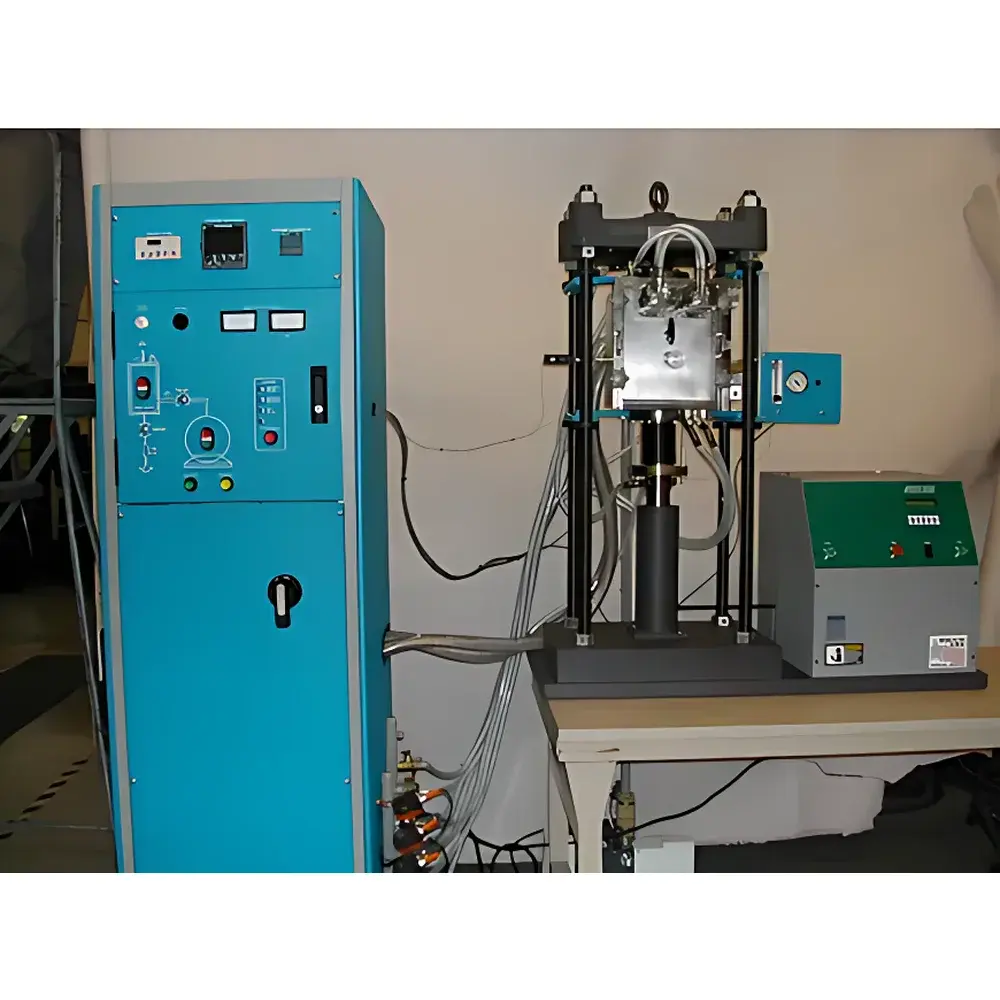
UHP1800 High-Temperature Vacuum Hot Press Furnace
| Origin | USA |
|---|---|
| Manufacturer Type | Authorized Distributor |
| Origin Category | Imported |
| Model | UHP1800 |
| Instrument Type | Box-Type Furnace |
| Max Temperature | 1800 °C |
| Temperature Control Accuracy | ±3 °C |
| Max Power | 25 kW |
| Ramp Time to Max Temp | 60 min |
| Heating Method | Resistive Wire (Molybdenum/Tungsten/Graphite/Tantalum) |
| Internal Chamber Dimensions | 2.54–35.56 cm (diameter/height adjustable per die configuration) |
| Max Applied Pressure | 30 ton (US short ton) |
| Base Vacuum Level | ≤5 × 10⁻⁵ Torr (with ion pump option) |
| Operating Atmosphere | High vacuum, N₂, H₂, Ar, or custom gas mixtures |
Overview
The UHP1800 High-Temperature Vacuum Hot Press Furnace is an engineered solution for advanced solid-state synthesis and densification under precisely controlled thermal, mechanical, and atmospheric conditions. Based on the Couette-type uniaxial hot pressing principle, it integrates resistive heating with hydraulic force application within a high-vacuum or reactive-gas environment—enabling simultaneous sintering, diffusion bonding, and microstructural consolidation of refractory ceramics, metal-matrix composites, and ultra-high-temperature materials. Designed for laboratory-scale R&D in academic, national, and industrial research settings, the UHP1800 supports process development aligned with ASTM C1161 (flexural strength), ISO 2738 (density measurement), and USP (thermal stability profiling). Its modular architecture allows seamless integration into GLP-compliant workflows, with full audit trail capability when paired with optional data logging modules compliant with FDA 21 CFR Part 11.
Key Features
- Uniaxial hot pressing system rated for up to 30 ton (272 kN) compressive load, with LVDT-controlled displacement resolution of ±1 µm
- Triple-zone heating configuration using high-purity graphite, molybdenum, tungsten mesh, or tantalum heating elements—fully encapsulated for extended service life and contamination control
- Dual-wall 304L stainless steel chamber with electropolished interior surfaces, achieving base vacuum levels down to 5 × 10⁻⁵ Torr using a hybrid pumping system (turbo-molecular + dry scroll + optional ion pump)
- Programmable temperature controller with dual-sensor redundancy (Type S thermocouple + optical pyrometer), supporting ramp-hold-cool profiles with ±3 °C accuracy across 500–1800 °C
- Water-cooled pressure rams constructed from 17-4PH stainless steel; thermally isolated from the hot zone via ISO-63 graphite spacers and ceramic insulation barriers
- Integrated gas handling manifold supporting inert (N₂, Ar), reducing (H₂/N₂ blends), or custom atmospheres—with mass flow controllers, pressure transducers, and purge interlocks meeting NFPA 86 (2003 edition) safety requirements
Sample Compatibility & Compliance
The UHP1800 accommodates cylindrical dies ranging from Ø25 mm to Ø75 mm × 100 mm height, suitable for consolidated samples of oxides (Al₂O₃, ZrO₂), nitrides (Si₃N₄, BN), carbides (SiC, TiC), borides (TiB₂), and intermetallics (NiAl, FeAl). All wetted components comply with ASTM F899 (medical-grade stainless steels) and ASME BPVC Section VIII Div. 1 for pressure boundary integrity. Vacuum chamber certification includes helium leak testing (<1 × 10⁻⁹ mbar·L/s), and electrical systems conform to UL 508A and CE/EMC directives. Optional hydrogen compatibility packages include flame arrestors, catalytic recombiners, and explosion-proof enclosures certified to ATEX Zone 1 / IECEx standards.
Software & Data Management
The furnace operates via a PLC-based control interface with touchscreen HMI, supporting up to 99 programmable thermal cycles with real-time logging of temperature, pressure, displacement, vacuum level, and gas flow rates. Data export formats include CSV and XML for traceability in LIMS environments. Optional PC software enables remote monitoring, alarm notification via email/SMS, and automated report generation compliant with ISO/IEC 17025 documentation requirements. Audit trails record user login/logout events, parameter modifications, and emergency stop activations—fully satisfying FDA 21 CFR Part 11 electronic record and signature criteria when configured with digital certificate authentication.
Applications
- Densification of nanostructured ceramics toward theoretical density (>99.5% TD) without grain coarsening
- Diffusion bonding of dissimilar materials (e.g., SiC-to-titanium alloys) for aerospace structural components
- Synthesis of MAX-phase compounds (e.g., Ti₃SiC₂) via reactive hot pressing under controlled nitrogen partial pressures
- Thermal shock resistance evaluation of oxide-dispersion-strengthened (ODS) steels under cyclic loading
- Preparation of transparent polycrystalline spinel (MgAl₂O₄) for infrared window applications using vacuum-assisted sintering
- Processing of thermoelectric materials (Bi₂Te₃, Skutterudites) requiring low-oxygen environments to preserve stoichiometry
FAQ
What vacuum level can the UHP1800 achieve without optional ion pump?
Standard configuration reaches ≤1 × 10⁻² Torr using turbo-molecular and dry scroll pumps; ion pump upgrade extends performance to ≤5 × 10⁻⁵ Torr.
Is the furnace compatible with hydrogen atmospheres above 4% concentration?
Yes—when equipped with the optional H₂ safety package, including automatic purge sequencing, flame arrestors, and catalytic recombination units per NFPA 86 Annex D.
Can the pressure ram be operated independently of heating?
Yes—the hydraulic system supports isothermal compression, cold pressing, and creep testing protocols with full decoupling from thermal control loops.
What calibration standards are supported for temperature verification?
Traceable calibration against NIST SRM 1750a (graphite fixed-point cell at 2345 °C) and ITS-90 reference thermocouples is supported through third-party accredited labs.
Does the system meet GMP documentation requirements for pharmaceutical excipient processing?
While primarily designed for materials science, optional 21 CFR Part 11-compliant software, IQ/OQ documentation kits, and vendor-supervised validation support enable qualification for USP analytical instrument qualification pathways.
Related Products



