
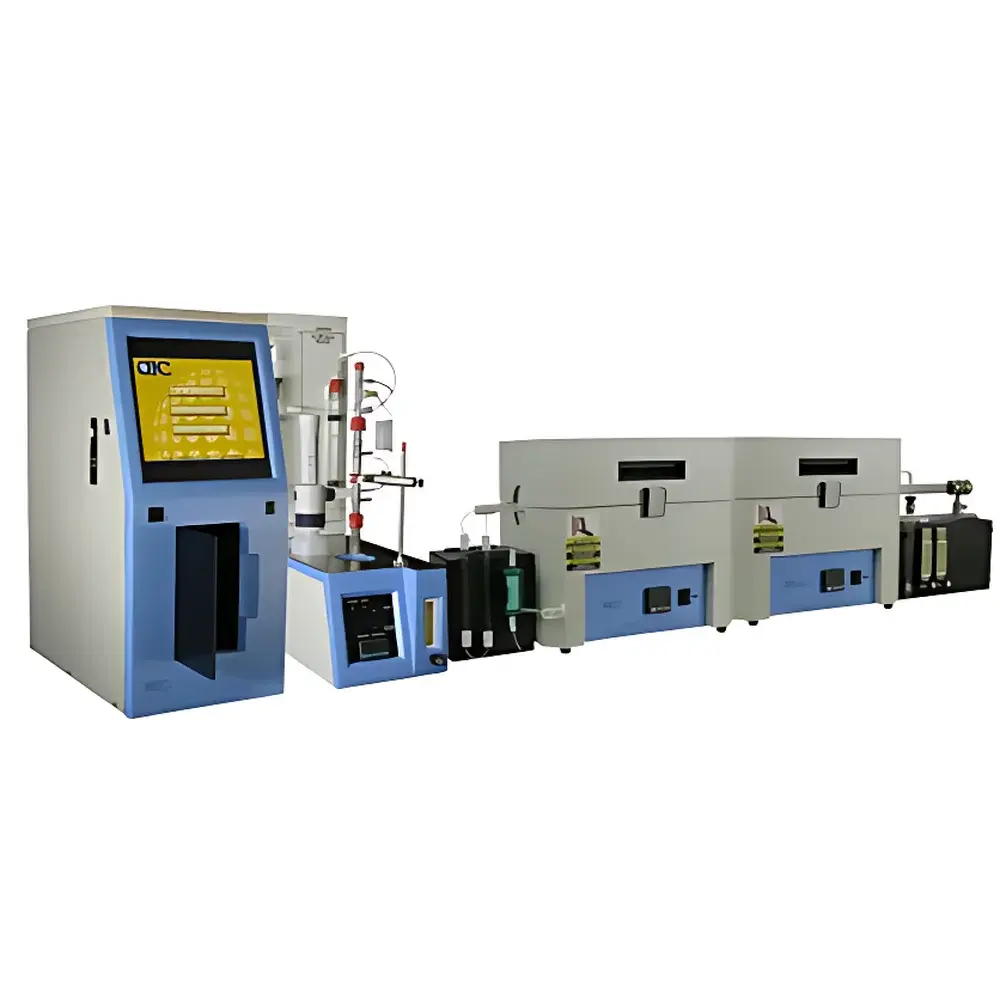
UIC CM350 Coulometric Total Sulfur Analyzer
| Brand | UIC (USA) |
|---|---|
| Origin | USA |
| Model | CM350 |
| Instrument Type | Laboratory Benchtop Analyzer |
| Measurement Principle | Coulometric Titration (Faraday-based SO₂/H₂S Detection) |
| Dynamic Range | 1 µg – 10,000 µg S per sample |
| Detection Limit | ~1 µg S (absolute) |
| Linear Range | 0.2% RSD or better for certified standards |
| Sample Forms | Solids (0.5 mg – 10 g) and Liquids |
| Total Analysis Time | 5–7 min (combustion mode) |
| Combustion Temperature | Up to 1100 °C (dual-zone furnace) |
| Acid Digestion | Modified Monier-Williams method with programmable heating & gas purging |
| Data Storage | Internal memory + 3.5″ floppy disk (CM5014S unit) |
| Compliance Support | ASTM D3120, D3246, D5453 |
Overview
The UIC CM350 Coulometric Total Sulfur Analyzer is a laboratory-grade, fully integrated benchtop system engineered for precise, trace-to-high-concentration sulfur quantification in diverse matrices. It employs coulometric titration—based on Faraday’s law of electrolysis—to deliver absolute, calibration-free measurement of total sulfur and total sulfite (SO₂-releasable sulfur) in solid and liquid samples. Unlike photometric or electrochemical sensors requiring frequent recalibration, the CM350 relies on stoichiometric charge integration during the electrochemical oxidation of SO₂ and H₂S at a platinum working electrode in an iodide–triiodide redox system. This principle ensures inherent accuracy, long-term stability, and immunity to drift—critical for regulatory compliance and inter-laboratory reproducibility. The system combines three core modules: a dual-chamber high-temperature combustion furnace (CM5380), an acid digestion module (CM5130), and a high-sensitivity coulometric SO₂/H₂S detector (CM5014S). Its architecture supports both oxidative combustion (for total sulfur) and controlled acid liberation (for sulfite, bound SO₂, and labile H₂S), enabling method flexibility across environmental, petrochemical, food, pharmaceutical, and geological applications.
Key Features
- Dual-mode operation: Simultaneous support for high-temperature combustion (up to 1100 °C) and acid digestion (Monier-Williams modification) within a single platform.
- Coulometric detection with no user calibration required: Measures total sulfur from 1 µg to 10,000 µg per sample with ≤0.2% relative standard deviation on certified reference materials.
- Dual-zone combustion furnace (CM5380): Split-body design for rapid maintenance; programmable temperature ramping; separate catalytic reduction zone (Cu-packed, 825 °C) to quantitatively convert SO₃ → SO₂ prior to detection.
- Acid digestion module (CM5130): Integrated air pump with flow control; selectable reaction vessel volumes (10, 25, 50, or 100 mL); PTFE-coated heating element and magnetic stirrer for accelerated sulfite release.
- CM5014S analyzer: Resolution of 0.01 µg sulfur; selectable display units (µg S, ppm, wt%, mg/kg); built-in 3.5″ floppy drive for raw data export; internal storage for up to 50 sample records including mass, volume, and area parameters.
- Robust gas handling: Sulfur-free carrier gas (N₂ or O₂/N₂ mix) purification; automated purge cycles to eliminate ambient SO₂/H₂S interference during sulfite analysis.
Sample Compatibility & Compliance
The CM350 accommodates heterogeneous sample types without derivatization or pre-concentration: coal, petroleum coke, catalysts, soils, sediments, polymers, foodstuffs (e.g., dried fruits, wine, beer), beverages, pharmaceutical excipients, and biological tissues. Solid samples (0.5 mg–10 g) are combusted in ceramic boats with V₂O₅ flux; liquids are introduced via calibrated syringe or autosampler-compatible vials. For sulfite analysis, aqueous or semi-solid samples undergo acid-triggered decomposition under inert atmosphere, ensuring quantitative recovery of volatile sulfur species. The system aligns with multiple international test methods—including ASTM D3120 (trace sulfur in gasoline), D3246 (sulfur in natural gas), D5453 (UV fluorescence alternative), ISO 20846 (petroleum products), ISO 29842 (water), and USP (heavy metals/sulfide limits in pharmaceuticals). Its fixed stoichiometric detection principle satisfies GLP and GMP documentation requirements when paired with operator-maintained analytical logs and instrument use records.
Software & Data Management
Data acquisition and calculation are managed locally via the CM5014S unit’s embedded firmware. Users input sample identifiers, masses, dilution factors, and vessel volumes directly via membrane keypad; results are computed in real time using stored stoichiometric constants (1 mole e⁻ = 1/8 mole S). Up to 50 samples can be queued sequentially, with automatic result tabulation and summary reporting. All measurements—including raw coulomb counts, elapsed time, temperature profiles (furnace zones), and gas flow rates—are timestamped and storable on removable 3.5″ floppy media. While the system lacks network connectivity or cloud export, its ASCII-formatted output files are compatible with standard spreadsheet and LIMS import protocols. Audit-ready documentation is supported through manual logging of calibration verification runs (using NIST-traceable sulfur standards), maintenance events, and daily system suitability checks per internal SOPs.
Applications
- Environmental labs: Quantifying total sulfur in soil, fly ash, and wastewater sludge per EPA Method 9060A analogs.
- Fuel testing: Determining ultra-low sulfur content (<10 ppm) in diesel and gasoline in accordance with ASTM D5453 and ISO 20846.
- Food safety: Validating sulfite preservative levels (e.g., in wines, dried fruits) against FDA 21 CFR §101.100 and EU Regulation (EC) No 1333/2008.
- Pharmaceutical QC: Verifying residual sulfite in parenteral formulations and excipients per USP and Ph. Eur. 2.2.36.
- Geological research: Measuring pyritic vs. organic sulfur fractions in coal and shale using sequential combustion protocols.
- Materials science: Monitoring sulfur contamination in catalysts, battery electrodes, and polymer additives.
FAQ
Does the CM350 require daily calibration with standard reference materials?
No. Coulometric detection is inherently absolute and does not rely on external calibration curves. Routine verification using NIST SRM 1632c (coal) or SRM 1633b (coal fly ash) is recommended weekly or per batch, but no user calibration is performed during analysis.
Can the CM350 distinguish between sulfate, sulfite, and elemental sulfur?
It measures total sulfur (via combustion) and total sulfite (via acid liberation). Speciation requires complementary techniques (e.g., IC-MS or XANES); the CM350 reports only operationally defined fractions.
What maintenance is required for the CM5380 furnace?
The split-body design allows quarterly inspection of quartz liners and Cu catalyst beds. Ash accumulation in the primary chamber should be removed after every 50–100 runs; catalyst replacement is typically needed every 6–12 months depending on sample matrix.
Is the CM5014S detector sensitive to humidity or CO₂ interference?
No. The electrolyte cell is sealed and temperature-controlled; carrier gas drying (via Mg(ClO₄)₂ or similar desiccant) is optional but not mandatory for routine operation.
Can data be exported to modern LIMS systems?
Yes—via ASCII files written to floppy disk. These files contain tab-delimited fields (sample ID, mass, result, units, date/time) and are readily parsed by most LIMS import modules or Python/Pandas scripts.







