
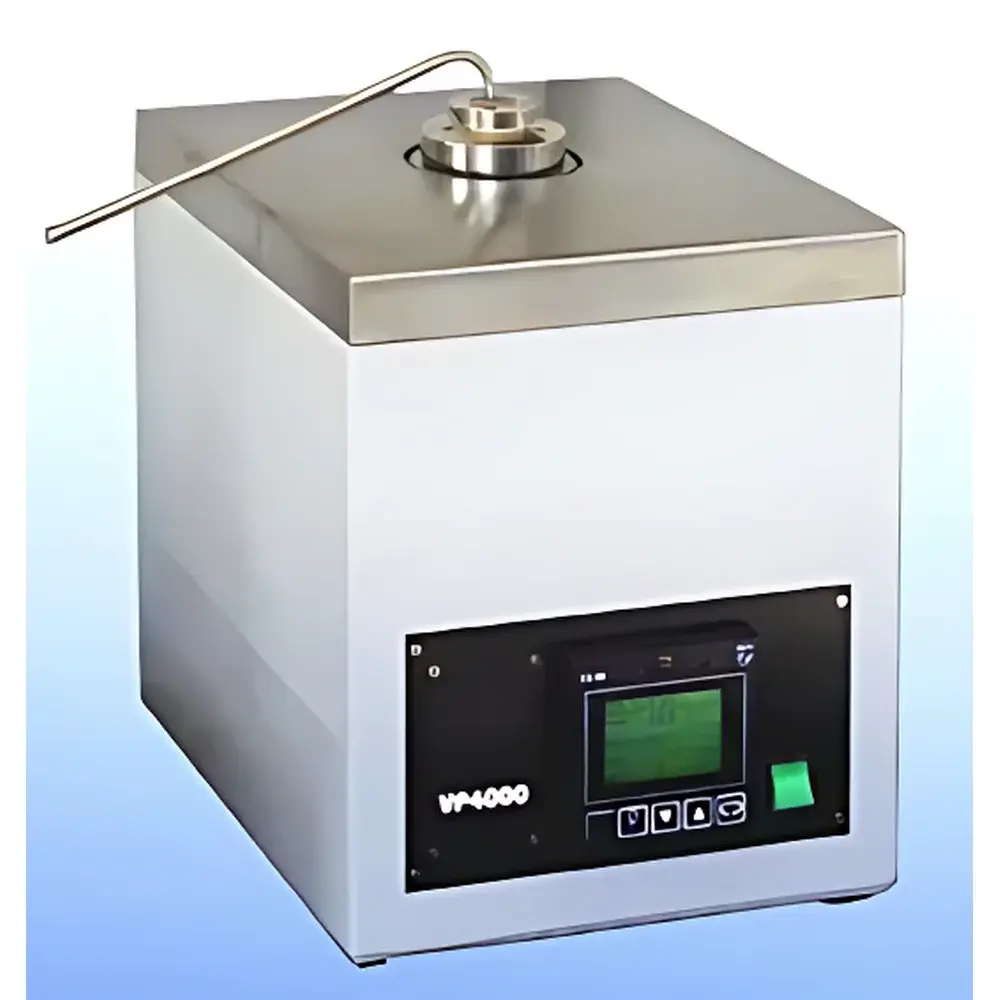
R&P VP4000 Noack Volatility Analyzer for Lubricating Oils
| Brand | R&P |
|---|---|
| Origin | Germany |
| Manufacturer Status | Authorized Distributor |
| Origin Category | Imported |
| Model | VP4000 |
| Pricing | Upon Request |
| Standards Compliance | DIN 51581, CEC L-40-A-93, ASTM D5800 |
| Temperature Range | 150–260 °C |
| Temperature Accuracy | ±0.2 °C |
| Temperature Resolution | 0.1 °C |
| Temperature Stability | < ±0.5 °C at Setpoint |
| Air Flow Control | Adjustable via valve or flowmeter |
| Max Differential Pressure | 21 mmWS |
| Pressure Accuracy | ±0.02 mmWS |
| Test Duration | Fixed 60 min |
| Display | LCD showing real-time temperature, pressure, and elapsed time |
| Dimensions (W×D×H) | 278 × 300 × 316 mm |
| Net Weight | 14 kg |
| Gross Weight | 23 kg |
| Included Components | Main unit, vacuum pump with oil filter, evaporation crucible, test ball, differential pressure controller |
Overview
The R&P VP4000 Noack Volatility Analyzer is a precision-engineered instrument designed to quantify the evaporation loss of lubricating oils under controlled high-temperature, forced-air conditions—directly aligned with the fundamental thermophysical behavior of engine oils during extended service life. Based on the standardized Noack volatility test principle, the system subjects a precisely weighed oil sample to sustained thermal stress in a heated crucible while a regulated stream of ambient air sweeps volatile components into a cooled condensation trap. The mass loss after 60 minutes at a user-defined temperature (typically 250 °C ± 0.5 °C for motor oils) is gravimetrically determined and reported as percent volatilization. This measurement directly correlates with operational risks including increased oil consumption, viscosity drift, deposit formation, and accelerated oxidation—all critical parameters in OEM engine oil specifications and long-drain formulation development.
Key Features
- Microprocessor-based PID temperature control ensuring thermal stability better than ±0.5 °C at setpoint across the full 150–260 °C operating range
- High-resolution LCD interface displaying real-time temperature (0.1 °C resolution), differential pressure (±0.02 mmWS accuracy), and elapsed test time
- Differential pressure regulation system enabling precise, repeatable air flow control—critical for inter-laboratory reproducibility per ASTM D5800 protocol requirements
- Integrated vacuum pump equipped with an oil mist filter to prevent contamination of downstream components and ensure long-term system integrity
- Modular hardware architecture: includes evaporation crucible, calibrated test ball, differential pressure controller, and all necessary fixtures—excluding hazardous Wood’s metal alloys per RoHS and REACH compliance
- RS-232 serial interface for external logging of temperature and pressure data streams, supporting traceable GLP/GMP documentation workflows
Sample Compatibility & Compliance
The VP4000 is validated for use with mineral, semi-synthetic, and fully synthetic engine oils—including low-SAPS (Sulfated Ash, Phosphorus, Sulfur) formulations used in modern gasoline direct injection (GDI) and diesel particulate filter (DPF)-equipped powertrains. It meets the mechanical and procedural specifications of three internationally recognized standards: DIN 51581 (German Institute for Standardization), CEC L-40-A-93 (Coordinating European Council), and ASTM D5800 (American Society for Testing and Materials). Its design supports audit-ready operation in regulated environments—data logging capability, temperature calibration traceability to NIST-traceable references, and stable thermal performance align with FDA 21 CFR Part 11 expectations for electronic records when integrated with compliant software platforms.
Software & Data Management
While the VP4000 operates as a standalone benchtop analyzer with embedded firmware, its RS-232 port enables seamless integration with laboratory information management systems (LIMS) or custom data acquisition software. Time-stamped temperature and pressure logs can be captured at user-defined intervals (e.g., every 10 seconds), generating CSV-compatible output suitable for statistical process control (SPC) analysis. When deployed in quality assurance laboratories, the instrument supports full audit trails—including operator ID, calibration history, and environmental condition metadata—facilitating compliance with ISO/IEC 17025 accreditation requirements for testing laboratories.
Applications
- Formulation screening of base oil blends and additive packages for volatility resistance
- Batch release testing in lubricant manufacturing per OEM technical data sheets (e.g., ACEA, API SP, ILSAC GF-6)
- Stability assessment of re-refined and bio-based lubricants under thermal aging protocols
- Root-cause analysis of excessive oil consumption in field-failure investigations
- Supporting regulatory submissions requiring Noack data for EPA Tier 3 or EU REACH registration dossiers
- Research into volatility-driven changes in boundary lubrication film strength using complementary tribometer correlation studies
FAQ
What is the maximum allowable test temperature for the VP4000?
The instrument is rated for continuous operation up to 260 °C, with standard Noack testing conducted at 250 °C ± 0.5 °C per ASTM D5800.
Does the VP4000 include a built-in gravimetric balance?
No—the VP4000 performs the thermal and airflow-controlled evaporation step only; sample weighing before and after testing requires an external analytical balance meeting ASTM E1133 requirements (typically 0.1 mg readability).
Can the air flow rate be validated independently?
Yes—air flow is adjustable via calibrated needle valve and/or inline flowmeter; differential pressure across the test chamber is continuously monitored and logged to verify consistency between runs.
Is the vacuum pump oil-free?
No—the included rotary vane vacuum pump uses mineral oil and incorporates an integral oil mist filter to protect the system from backstreaming and meet ISO 8573-1 Class 3 purity requirements for instrument air supply.
How often does the VP4000 require recalibration?
Temperature sensors should be verified annually against a NIST-traceable reference thermometer; pressure transducers are factory-calibrated and require verification only if physical damage or performance deviation is observed.





