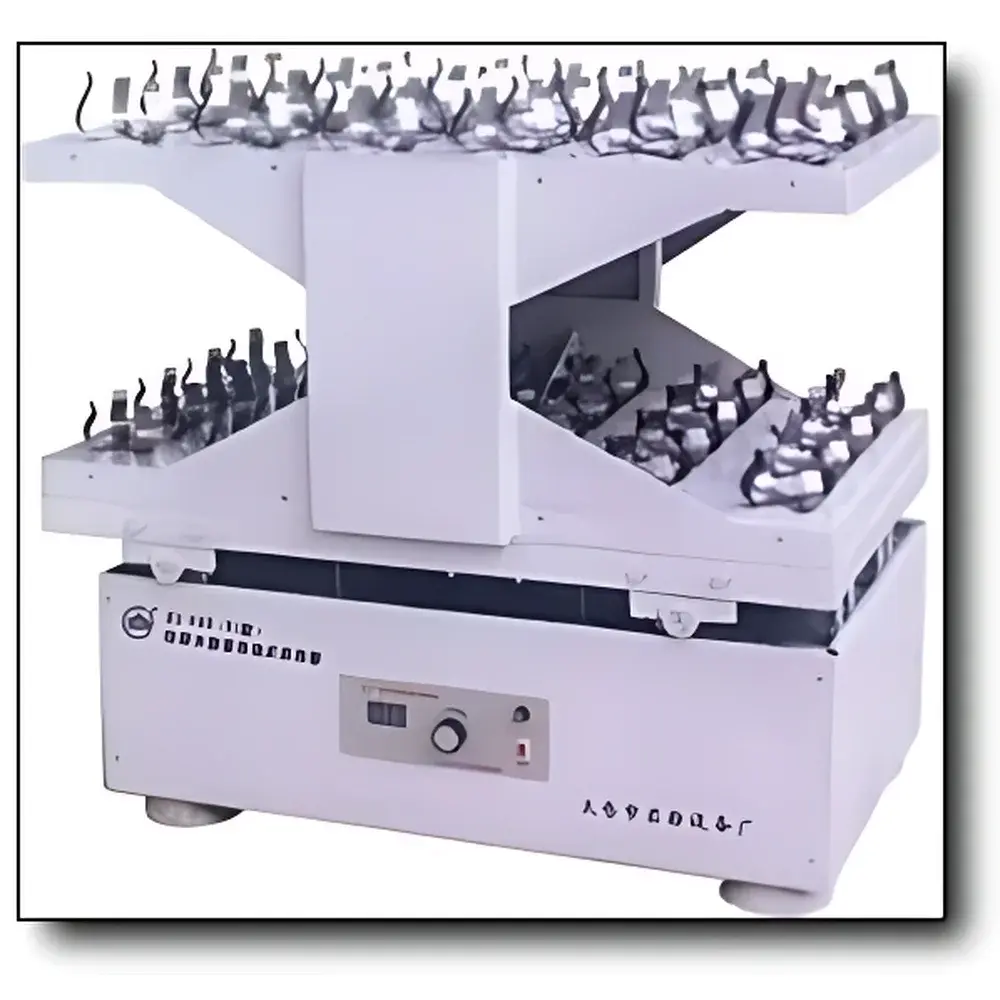
DZ-9001 Single-Layer High-Capacity Floor-Standing Orbital Shaker
| Origin | Jiangsu, China |
|---|---|
| Manufacturer Type | Authorized Distributor |
| Origin Category | Domestic (PRC) |
| Model | DZ-9001 |
| Price | USD 1,230 (FOB Jiangsu) |
| Speed Range | 50–250 rpm |
| Operating Temperature | Ambient (15–30 °C) |
| Platform Capacity | 60 × 250 mL Erlenmeyer flasks |
| Display | LED digital interface |
| Drive Mechanism | Brushless DC motor with eccentric drive |
| Orbit Diameter | 25 mm |
| Dimensions (W×D×H) | 720 × 720 × 850 mm |
| Net Weight | 85 kg |
Overview
The DZ-9001 Single-Layer High-Capacity Floor-Standing Orbital Shaker is engineered for robust, continuous-duty operation in microbiology laboratories, bioprocessing development facilities, and academic research settings requiring scalable liquid culture agitation. It operates on the principle of orbital shaking—generating a consistent circular motion (25 mm orbit diameter) that promotes uniform oxygen transfer, suspension homogeneity, and cell growth across large-volume cultures. Designed for ambient-temperature environments (15–30 °C), the unit delivers precise speed control from 50 to 250 rpm with ±2 rpm repeatability, ensuring reproducible aeration kinetics critical for aerobic fermentation, microbial propagation, and suspension-based mammalian cell expansion. Its floor-standing architecture eliminates benchtop space constraints while providing structural stability during extended runs—essential for overnight or multi-day incubation protocols.
Key Features
- High-load platform engineered to accommodate up to sixty 250 mL Erlenmeyer flasks simultaneously—optimized for parallel strain screening, media optimization studies, and bioreactor seed train preparation.
- Brushless DC motor with microprocessor-controlled feedback loop ensures torque consistency across the full speed range and extends service life beyond 20,000 hours of operation.
- LED digital display with intuitive keypad interface enables real-time monitoring and adjustment of speed; parameters are retained after power cycling.
- Reinforced steel frame with vibration-damping rubber feet minimizes transmission to adjacent equipment and maintains alignment under asymmetric loading conditions.
- IP20-rated enclosure provides protection against solid ingress during routine lab use; no internal cooling fans—reducing particulate generation in cleanroom-adjacent workflows.
- Compliance-ready design supports integration into GLP-compliant documentation systems via manual log entry of operational parameters (speed, duration, date/time).
Sample Compatibility & Compliance
The DZ-9001 accommodates standard laboratory glassware including borosilicate Erlenmeyer flasks (100–500 mL), baffled flasks, and compatible shaker bottles secured via universal clamp kits (sold separately). It is validated for use with aqueous microbial growth media (e.g., LB, TB, M9), yeast extract–peptone–dextrose (YPD), and low-viscosity mammalian suspension media (e.g., FreeStyle™ CHO, EX-CELL® ACF). While not certified to ISO/IEC 17025 or FDA 21 CFR Part 11, its mechanical performance aligns with ASTM E1249-22 guidelines for orbital shaker verification and supports adherence to internal SOPs governing culture agitation consistency. Users performing regulated work must implement supplementary procedural controls—including operator training records, calibration logs (performed annually using traceable tachometer), and maintenance history tracking.
Software & Data Management
The DZ-9001 operates as a standalone instrument without embedded data logging or PC connectivity. All operational parameters are set and monitored locally via the LED interface. For laboratories requiring audit trails, integration with external environmental monitoring systems (e.g., DeltaTRAK, DicksonOne) is achievable through optional analog output modules (0–10 V or 4–20 mA signal conversion kits). Raw run data—including start/stop timestamps and nominal speed settings—must be manually recorded in bound lab notebooks or electronic lab notebooks (ELNs) compliant with ALCOA+ principles. No firmware updates or cloud synchronization capabilities are provided; hardware revision control is maintained via serial-numbered nameplate and distributor-supplied service bulletins.
Applications
- Microbial culture scaling: Escherichia coli, Bacillus subtilis, Pseudomonas putida, and Saccharomyces cerevisiae propagation in early-stage process development.
- Antibiotic susceptibility testing (AST) where standardized aeration influences zone-of-inhibition interpretation per CLSI M07-A11.
- Enzyme production studies involving extracellular protein expression in shake-flask bioreactors.
- Preparation of inocula for benchtop bioreactors (e.g., 3–10 L stirred-tank reactors) used in upstream process characterization.
- Environmental microbiology: enrichment cultures for heterotrophic plate count (HPC) analysis and biodegradation assays per EPA Method 1681.
FAQ
Is the DZ-9001 suitable for use inside an incubator or environmental chamber?
No. The unit is rated for ambient-temperature operation only (15–30 °C) and lacks insulation or condensation management features required for controlled-humidity or elevated-temperature enclosures.
Can it support flask clamps for 1-L vessels?
The platform is mechanically rated for loads up to 60 × 250 mL. Use of larger vessels requires validation of center-of-gravity stability and may void warranty due to increased moment arm stress.
Does it meet electromagnetic compatibility (EMC) standards for EU export?
It complies with GB/T 18268.1–2010 (Chinese national EMC standard for laboratory equipment), but CE marking is not affixed. Export to EU markets requires third-party notified body assessment per EN 61326-1:2013.
What maintenance intervals are recommended?
Lubrication of the eccentric drive mechanism every 12 months; visual inspection of motor mounting bolts and platform leveling prior to each quarterly preventive maintenance cycle.
Is a calibration certificate included with shipment?
No. A factory-verified speed accuracy report (±2 rpm at 100/200 rpm) is supplied; formal ISO/IEC 17025 calibration must be arranged separately through accredited metrology providers.