
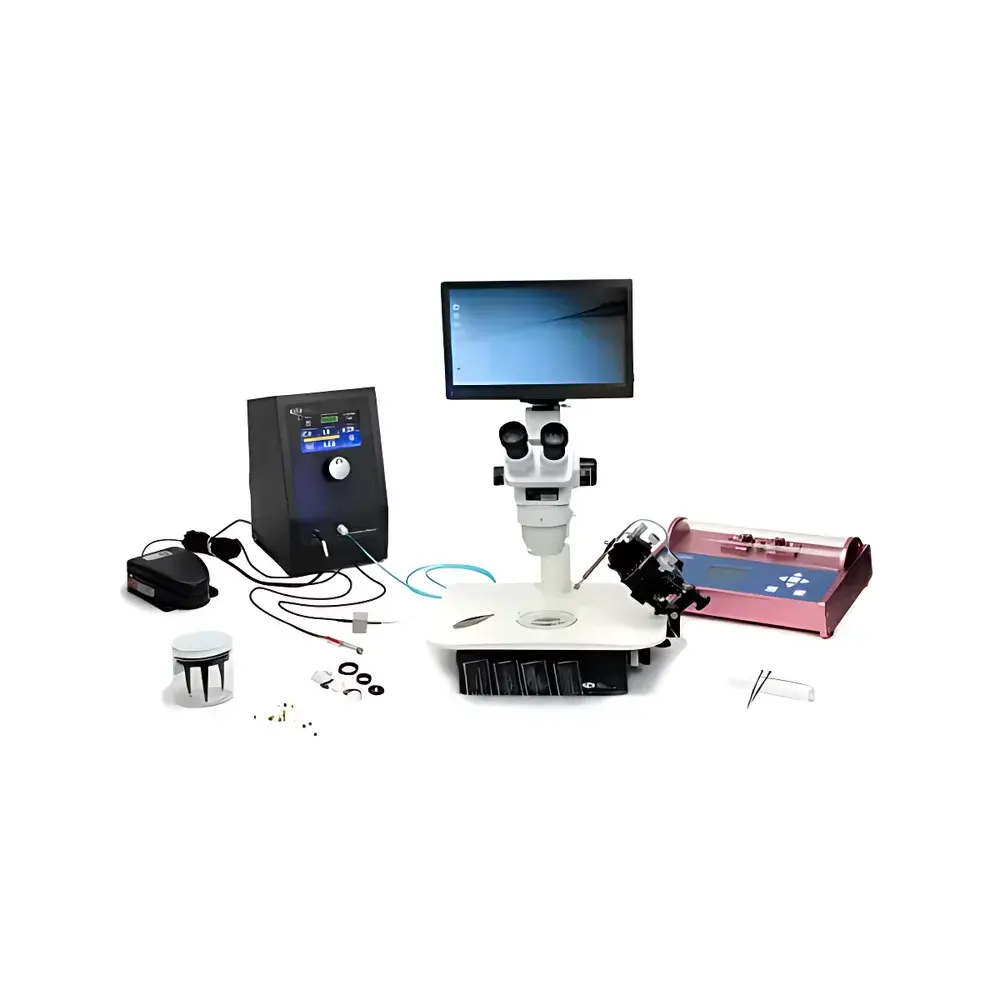
WPI SYS-PV840 Pneumatic Picoliter Microinjection System
| Brand | WPI (World Precision Instruments) |
|---|---|
| Origin | USA |
| Model | SYS-PV840 |
| Type | Automated Microinjection & Electroporation System |
| Operating Pressure | Up to 87 PSI |
| Pulse Duration | 0.5 s |
Overview
The WPI SYS-PV840 Pneumatic Picoliter Microinjection System is an integrated, benchtop platform engineered for high-precision intracellular delivery in sensitive embryonic and oocyte applications. It combines regulated pneumatic pressure-driven microinjection with synchronized point-contact electroporation — a dual-function architecture specifically developed to address the mechanical fragility of mammalian and rodent zygotes at the 2-cell stage. Unlike conventional pressure-based injectors, the SYS-PV840 incorporates real-time membrane modulation via transient, localized electrical pulses applied directly through the injection pipette tip. This electrophysiological coupling reduces membrane rupture probability by transiently increasing lipid bilayer fluidity and lowering effective Young’s modulus — thereby enabling reliable delivery of nucleic acids (e.g., CRISPR/Cas9 ribonucleoprotein complexes), dyes, or proteins into delicate embryos without compromising viability. The system operates on a closed-loop pneumatic circuit powered by an ultra-low-noise (<35 dB[A]) onboard compressor, eliminating dependency on external gas cylinders and ensuring stable, reproducible picoliter-scale volume delivery across extended experimental sessions.
Key Features
- Integrated point-contact electroporation module synchronized with injection timing — enables membrane softening immediately prior to pipette penetration
- High-resolution LED touchscreen interface displaying real-time parameters: injection pressure (PSI), compensation pressure, pulse duration (ms), number of injections, electroporation voltage amplitude (V), and pulse frequency (Hz)
- On-device parameter storage for three independent protocol configurations — supports rapid reconfiguration between mouse, rat, porcine, primate, or marine oocyte protocols
- Dual-stage footswitch: first press initiates electroporation; second press triggers precise pressure-driven injection — minimizing hand movement and positional drift
- Automated needle clearance function: single-touch activation delivers a calibrated 87 PSI, 0.5-second purge pulse to clear capillary blockages without manual intervention
- Compact footprint (24 × 18 × 12 cm) with vibration-damped base — designed for integration beneath upright or inverted microscopes without obstructing optical paths or manipulator range
- Compatible with standard 1.0–1.5 mm OD borosilicate capillaries and commercially available motorized or manual micromanipulators (e.g., Sutter MP-285, Narishige MO-202)
Sample Compatibility & Compliance
The SYS-PV840 is validated for use with fragile biological specimens requiring sub-nanoliter volumetric control and low-mechanical-stress delivery. It supports microinjection into murine and rat 2-cell embryos, porcine zygotes, non-human primate oocytes, marine model organisms (e.g., Ciona intestinalis, grouper), and plant protoplasts. Its electroporation waveform parameters adhere to established biophysical thresholds for reversible electroporation (typically 10–50 V across 1–10 µm gap distances, pulse widths ≤1 ms), ensuring compliance with GLP-aligned laboratory practices. While not FDA-cleared for clinical use, the system meets CE marking requirements for laboratory instrumentation (2014/30/EU EMC Directive, 2014/35/EU LVD Directive) and supports audit-ready operation when paired with WPI’s optional data logging software compliant with 21 CFR Part 11 electronic record integrity standards.
Software & Data Management
The SYS-PV840 operates autonomously via its embedded firmware but integrates seamlessly with WPI’s optional MicroInjControl software suite (Windows 10/11 compatible). This application enables remote parameter scripting, time-stamped event logging, and export of injection/electroporation metadata in CSV and HDF5 formats. Audit trails include operator ID, timestamp, pressure setpoint, electroporation voltage, pulse count, and system status flags (e.g., “needle cleared”, “pressure fault”). All stored protocols are encrypted and password-protected, supporting multi-user lab environments under ISO/IEC 17025 documentation requirements. Raw pressure transducer output is sampled at 10 kHz and archived for post-hoc fidelity verification.
Applications
- Transgenic model generation: Co-delivery of Cas9 mRNA and sgRNA into mouse/rat zygotes with >65% embryo survival post-injection (published benchmark data)
- Large-animal cloning: Enhanced nuclear transfer efficiency in canine, feline, and porcine somatic cell nuclear transfer (SCNT) protocols via pre-injection membrane conditioning
- Marine developmental biology: Successful microinjection into Styela clava and Epinephelus coioides oocytes exhibiting high cortical rigidity
- Plant biotechnology: Delivery of CRISPR constructs into rice and tobacco protoplasts without enzymatic cell wall digestion
- Neurodevelopmental studies: Targeted loading of calcium indicators (e.g., Fluo-4 dextran) into single blastomeres of early-stage embryos for live imaging
FAQ
What is the maximum recommended injection volume per pulse?
The system achieves repeatable delivery from 0.5 pL to 500 pL per pulse, dependent on pipette geometry, pressure setting, and duration — calibrated using fluorescent microbeads and verified via gravimetric assay.
Can the electroporation parameters be independently adjusted from injection settings?
Yes. Voltage amplitude (5–45 V), pulse width (0.1–2.0 ms), and number of pulses (1–10) are fully decoupled from pneumatic pressure and timing parameters.
Is nitrogen gas required for operation?
No. The integrated oil-free diaphragm compressor provides clean, dry air at regulated pressure — eliminating gas cylinder logistics and associated safety certifications.
Does the system support synchronization with third-party imaging hardware?
Yes. TTL-compatible trigger I/O ports enable hardware-level coordination with camera acquisition, laser ablation systems, or piezoelectric stage controllers.
What maintenance is required for long-term reliability?
Annual calibration of the pressure transducer and electroporation voltage output is recommended; filter cartridges in the air intake require replacement every 12 months under continuous use.




