
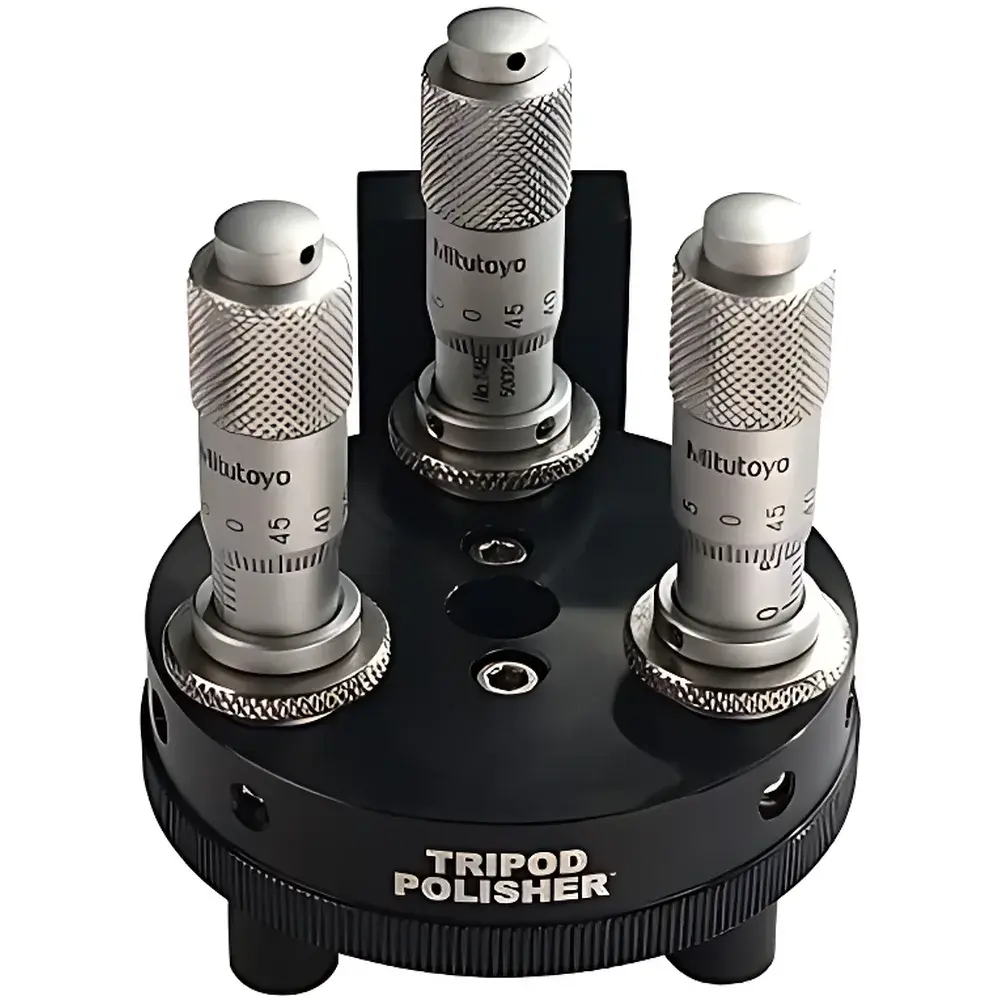
Ted Pella Tripod Polisher 590
| Brand | Ted Pella |
|---|---|
| Origin | USA |
| Manufacturer Type | Authorized Distributor |
| Origin Category | Imported |
| Model | Tripod Polisher 590 |
| Dimensions (L×W×H) | 50 × 50 × 100 cm |
| Number of Polishing Stations | 3 |
| Platen Diameter | 20 mm |
| Drive Type | Manual Rotation |
Overview
The Ted Pella Tripod Polisher 590 is a precision mechanical sample preparation instrument engineered for the reproducible, controlled thinning and polishing of solid-state specimens destined for transmission electron microscopy (TEM) and scanning electron microscopy (SEM) cross-sectional analysis. Developed originally at IBM’s East Fishkill laboratory, its tripod-based kinematic design enables deterministic control over specimen orientation relative to the polishing surface—leveraging three-point contact geometry to constrain rotational and lateral degrees of freedom while permitting fine angular adjustment via dual micrometer-driven rear supports. Unlike conventional freehand grinding or automated planar polishers, the Tripod Polisher 590 operates on a fixed-axis, manually rotated platen system that ensures consistent material removal rates and minimizes edge rounding, chipping, or subsurface damage. Its core function is to produce electron-transparent TEM lamellae or artifact-free SEM cross-sections with high geometric fidelity—particularly critical for interface analysis in semiconductors, ceramics, metal alloys, geological composites, and multilayer thin-film structures.
Key Features
- Tripoint kinematic mounting system with dual rear micrometers for sub-micron angular alignment and iterative plane parallelism verification
- Three independent 20-mm-diameter polishing stations accommodating diamond lapping films (15 µm to 0.5 µm), silica suspensions, and soft polishing cloths (e.g., MultiTex Cloth, Cat. No. 816-12)
- L-shaped slotted bracket for SEM sample holder integration—enabling direct transfer from polishing stage to ion mill or SEM chamber without re-mounting
- Pyrex® wedge-insert accessory (optional) for producing continuous thickness gradients—from >1 µm at the base to <10 nm at the apex—eliminating reliance on ion milling for electron transparency
- Compatibility with inverted optical microscopy for real-time monitoring of thinning progress and feature exposure during both planar and wedge-mode operation
- Modular configuration supporting three dedicated operational modes: 590TEM (TEM lamella thinning), 590SEM (planar cross-section polishing), and 590TS (dual-mode capability)
Sample Compatibility & Compliance
The Tripod Polisher 590 accommodates rigid, non-ferromagnetic specimens up to 10 mm in height and 8 mm in width—including silicon wafers, sapphire substrates, alumina ceramics, tungsten carbide composites, stainless steel sections, and silicate rock thin sections. It requires no vacuum, cooling, or electrical power beyond standard benchtop lighting for optical inspection. While not certified to ISO/IEC 17025 or ASTM E1558, its methodology aligns with established TEM sample preparation protocols referenced in ASTM E1558 (Standard Guide for Preparation of Transmission Electron Microscopy Specimens by Mechanical Thinning) and ISO 16700 (Electron backscatter diffraction — Specification for specimen preparation). The manual drive architecture inherently complies with GLP audit requirements for traceable, operator-documented procedural steps; all adjustments are recorded via micrometer scale readings and verified optically—supporting full process documentation for FDA 21 CFR Part 11–aligned workflows when integrated into validated lab information management systems (LIMS).
Software & Data Management
The Tripod Polisher 590 is a fully manual, analog instrumentation platform with no embedded microcontroller, firmware, or digital interface. Consequently, it generates no electronic data logs, sensor outputs, or exportable metadata. Process documentation—including micrometer settings, film grit sequence, suspension concentration, polishing duration per step, and optical inspection timestamps—is maintained externally in laboratory notebooks or electronic lab notebooks (ELNs) compliant with 21 CFR Part 11. Its design prioritizes mechanical repeatability and operator-controlled determinism over automation—making it suitable for regulated environments where algorithmic black-box processing is discouraged. Integration with inverted microscope imaging systems allows capture of serial optical images for thickness calibration (e.g., interference fringe counting), which may be archived alongside procedural notes in LIMS or ELN platforms.
Applications
- Pre-thinning of TEM specimens to ≤1 µm prior to final ion milling—reducing typical ion milling time from 2–4 hours to ≤15 minutes
- Preparation of planar SEM cross-sections with minimal topographical distortion, eliminating hand-grinding-induced tilt errors in device layer profiling
- Interface characterization in heterostructured materials (e.g., GaN-on-Si, Cu/Ta/SiO₂ stacks) via wedge-mode polishing to expose buried interfaces without preferential sputtering artifacts
- Routine quality control of metallurgical grain structure, interfacial delamination, solder joint integrity, and coating adhesion in failure analysis labs
- Geological thin section refinement for cathodoluminescence (CL) and electron probe microanalysis (EPMA) where crystallographic orientation preservation is essential
- Research-scale fabrication of site-specific TEM lamellae from FIB-prepared lift-outs, enabling complementary structural and chemical analysis
FAQ
Is the Tripod Polisher 590 compatible with automated ion milling systems?
Yes—the SEM sample holder used on the 590SEM and 590TS configurations is mechanically standardized to fit common ion mill stages (e.g., Gatan Precision Ion Polishing System, Fischione 1040), enabling seamless transfer without remounting.
What consumables are required for routine operation?
Diamond lapping films (15 µm, 9 µm, 3 µm, 1 µm, 0.5 µm), colloidal silica suspension (e.g., OP-S), MultiTex polishing cloth (Cat. No. 816-12), Pyrex® wedge inserts (Cat. No. 59150), and TEM grid-adhesive carbon tape.
Can the instrument prepare samples for EBSD analysis?
Yes—when operated in planar mode with final polishing using 0.05 µm colloidal silica and vibration-free mounting, the 590SEM produces deformation-free surfaces suitable for high-resolution EBSD pattern acquisition.
Does Ted Pella provide application support or training?
Yes—Ted Pella offers documented SOPs, video tutorials, and on-site or virtual application assistance for method development, particularly for semiconductor cross-sectioning and wedge-mode TEM preparation.
Is maintenance required beyond routine cleaning?
No scheduled maintenance is specified; however, periodic inspection of micrometer threads, platen flatness, and bracket alignment is recommended to preserve angular reproducibility across extended use cycles.



