
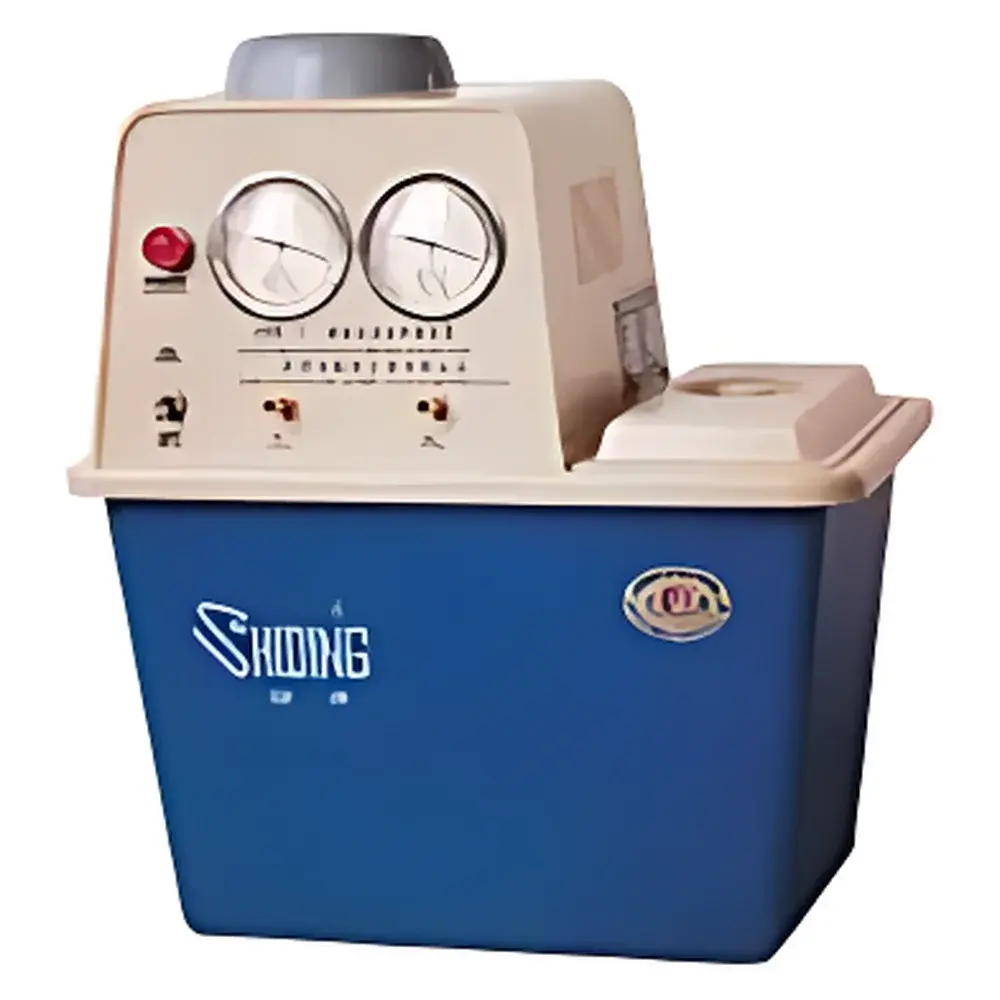
SHB-III Circulating Water Vacuum Pump
| Origin | Henan, China |
|---|---|
| Manufacturer Type | Authorized Distributor |
| Origin Category | Domestic (China-made) |
| Model | SHB-III |
| Price | USD 240 (FOB) |
| Power | 180 W |
| Voltage/Frequency | 220 V / 50 Hz |
| Flow Rate | 80 L/min |
| Max. Head | 10 m |
| Max. Vacuum | −0.098 MPa (≈735 mmHg) |
| Single-Head Suction Capacity | 10 L/min |
| Dual Suction Ports | Yes |
| Water Tank Volume | 15 L |
| Tank Material | Chemically Resistant Engineering Plastic (resistant to acetone, diethyl ether, chloroform) |
| Pump Body Material | Stainless Steel (AISI 304, equivalent to 1Cr18Ni9Ti) |
| Housing Material | Impact-Resistant Engineering Plastic |
| Dimensions (L×W×H) | 385 × 280 × 420 mm |
| Net Weight | 15 kg |
| Noise Level | <55 dB(A) |
| Optional Accessories | Vacuum Regulating Valve, External Recirculation Kit |
Overview
The SHB-III Circulating Water Vacuum Pump is a compact, benchtop-rated vacuum generation system engineered for continuous, low-maintenance operation in analytical chemistry, rotary evaporation, vacuum filtration, and solvent recovery applications. It operates on the principle of water-jet aspiration—using a centrifugal impeller to accelerate circulating water through precision-machined ejector nozzles, thereby generating vacuum via the Venturi effect. Unlike oil-sealed mechanical pumps, this system eliminates hydrocarbon contamination risks and requires no lubricants, making it ideal for labs adhering to GLP-compliant workflows or handling moisture-sensitive or volatile organic compounds. Its dual-port configuration supports independent or parallel vacuum lines, enabling simultaneous operation of multiple apparatuses—such as two rotary evaporators or a combination of filtration and distillation setups—without cross-pressure interference. The integrated external recirculation interface allows connection to an auxiliary chiller or closed-loop cooling system, ensuring stable vacuum performance during extended operation (>8 hr) and preventing water temperature drift above 35 °C.
Key Features
- Dual independent suction ports with individual vacuum gauges for real-time pressure monitoring and load balancing
- Corrosion-resistant pump head constructed from AISI 304 stainless steel (1Cr18Ni9Ti), certified per ASTM A240 for chemical exposure resilience
- Chemically inert water reservoir fabricated from proprietary high-performance engineering plastic—validated for compatibility with acetone, ethyl ether, chloroform, and dilute acidic/basic aqueous solutions
- Patented fluid-damped acoustic silencer integrated into the water circulation path, reducing cavitation-induced noise to ≤55 dB(A) at 1 m distance
- Modular design supporting field-upgradable options: vacuum regulating valve (0–100 kPa adjustable range), external coolant inlet/outlet ports, and G1/4″ BSP vacuum port adapters
- Thermally stable housing made from UL94 V-0 rated flame-retardant engineering plastic, compliant with IEC 61010-1 for laboratory electrical safety
Sample Compatibility & Compliance
The SHB-III is routinely deployed in environments governed by ISO/IEC 17025, USP , and EPA Method 502.2 protocols where non-contaminating vacuum sources are mandatory. Its all-wetted parts—ejector, check valve, three-way manifold, and suction nozzles—are either stainless steel (SHB-IIIA variant) or chemically stabilized polymer (SHB-IIIS/SHB-III), eliminating leachable metals or plasticizers. The water reservoir’s resistance to halogenated solvents enables safe use in extraction workflows involving chlorinated solvents without degradation or swelling. Units are CE-marked and meet EMC Directive 2014/30/EU and Low Voltage Directive 2014/35/EU. Documentation includes Factory Calibration Report (traceable to NIST standards) and RoHS 2.0 compliance certificate.
Software & Data Management
While the SHB-III operates as a standalone analog device, its vacuum output is fully compatible with third-party digital monitoring systems via optional 0–10 V analog output (available upon request). When integrated with lab information management systems (LIMS) or ELN platforms such as LabArchives or Benchling, vacuum status and runtime data can be logged using external pressure transducers (e.g., MKS Baratron 627B) connected via standard 4–20 mA interfaces. Audit trails for maintenance intervals—including water replacement logs, filter inspections, and seal replacements—are supported under FDA 21 CFR Part 11 when paired with validated electronic logbook software.
Applications
- Routine vacuum-assisted filtration of precipitates in inorganic synthesis and environmental sample preparation
- Rotary evaporation of heat-labile natural product extracts under controlled sub-atmospheric conditions
- Vacuum desiccation of hygroscopic reference standards prior to gravimetric analysis
- Gas-phase sampling support for GC-FID and GC-MS systems requiring stable, oil-free vacuum backing
- Thin-film deposition pre-chamber evacuation in materials science laboratories
- Teaching labs: Demonstrating gas laws, vapor pressure relationships, and fluid dynamics principles
FAQ
What is the maximum allowable operating temperature of the circulating water?
The pump is rated for continuous operation with inlet water temperatures between 5 °C and 30 °C. Sustained inlet temperatures above 35 °C may reduce vacuum stability and accelerate elastomer aging in seals.
Can this pump be used with aggressive solvents like nitric acid or sodium hydroxide solutions?
The standard SHB-III reservoir is resistant to organic solvents but not concentrated mineral acids or strong alkalis. For such applications, specify the SHB-IIIA variant with full stainless-steel wetted components and consult the chemical compatibility chart prior to use.
Is routine maintenance required beyond water replacement?
Yes. Quarterly inspection of the impeller clearance, annual replacement of the silicone suction tube (if used), and biannual verification of check valve integrity are recommended per ISO 5171 maintenance guidelines.
Does the pump include overheat protection?
Yes. An embedded thermal cutoff switch interrupts power at 95 °C motor winding temperature, complying with IEC 60335-1 Annex BB requirements.
How is vacuum level adjusted during operation?
Vacuum regulation is achieved via the optional vacuum control valve, which modulates backpressure on the discharge side—enabling fine-tuned setpoints between 10 kPa and 98 kPa absolute without altering flow rate or water temperature.



