EVOM3 Epithelial Volt-Ohmmeter
| Brand | WPI (World Precision Instruments) |
|---|---|
| Model | EVOM3 |
| Origin | USA |
| Type | Epithelial/Endothelial Transepithelial Electrical Resistance (TEER) Measurement System |
| Measurement Principle | AC-based impedance spectroscopy with constant-current excitation (40 Hz, 2–10 µA) |
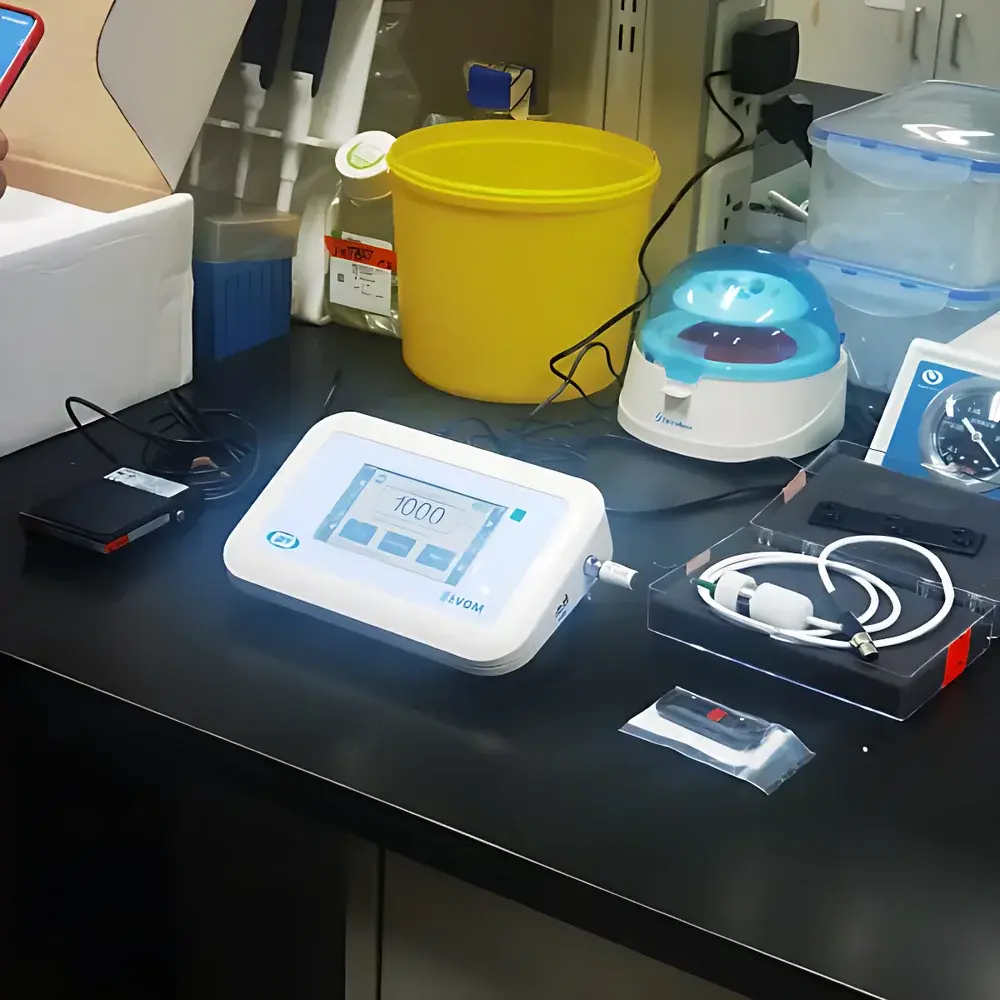
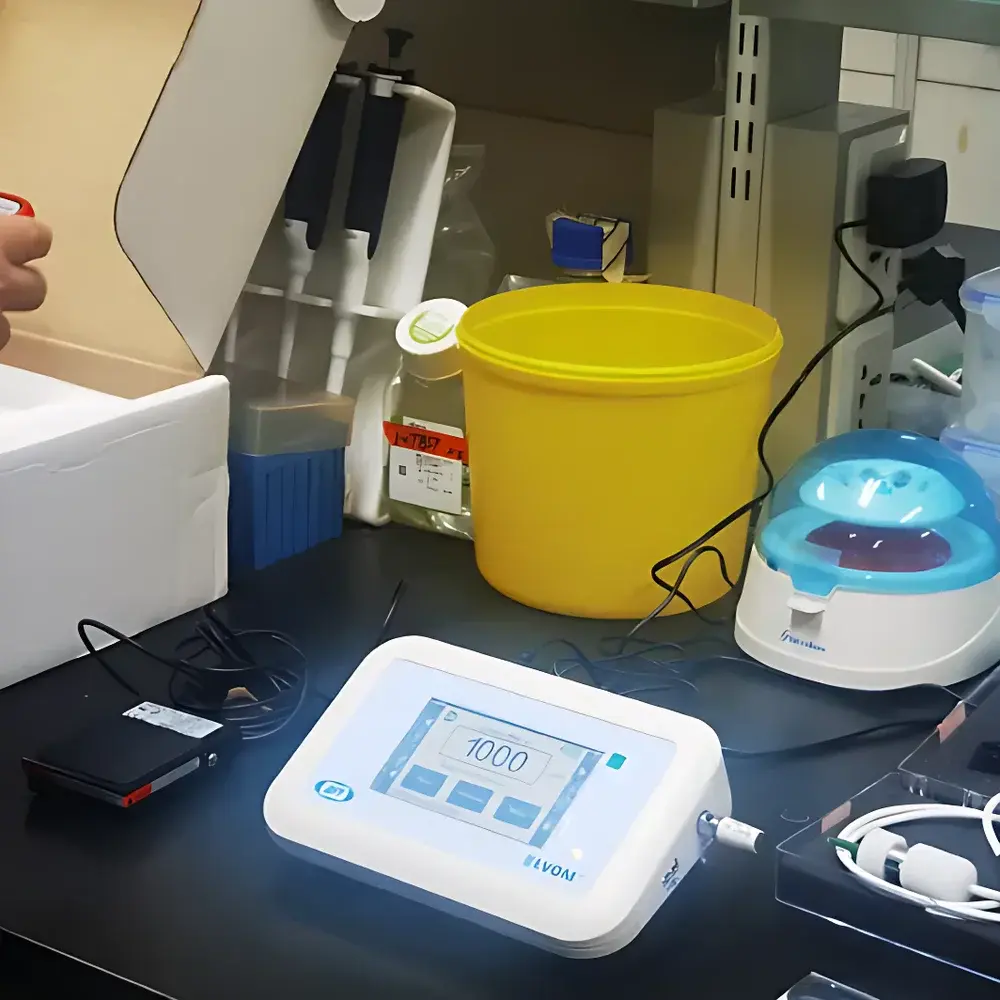
| Display | 7-inch capacitive touchscreen |
| Data Output | USB-stored CSV files with timestamped TEER (Ω·cm²), voltage (mV), and temperature (°C) |
| Current Ranges | 2 µA, 4 µA, 10 µA (user-selectable fixed-current mode) |
| Resistance Range | 1 Ω to 100 kΩ (auto-ranging or fixed-range optimized for barrier integrity assays) |
| Resolution | 0.1 Ω at 200 Ω |
| Compliance | Designed for GLP-compliant in vitro barrier function studies |
Overview
The EVOM3 Epithelial Volt-Ohmmeter is a precision-engineered, microprocessor-controlled instrument designed for quantitative assessment of transepithelial or transendothelial electrical resistance (TEER) across cultured cell monolayers. Built upon World Precision Instruments’ legacy of electrophysiological instrumentation, the EVOM3 implements a low-voltage, low-frequency (40 Hz) constant-current AC excitation method—optimized to minimize electrochemical polarization, electrode corrosion, and ion transport artifacts while preserving monolayer integrity. Unlike DC-based ohmmeters, this approach ensures high reproducibility in repeated measurements across porous supports such as Transwell® inserts, Snapwell™ chambers, and custom microfluidic barrier devices. The system is calibrated traceably to NIST standards and engineered for stability under ambient lab conditions (20–25 °C, <60% RH), making it suitable for longitudinal barrier integrity monitoring in applications ranging from drug permeability screening to tight junction modulation studies.
Key Features
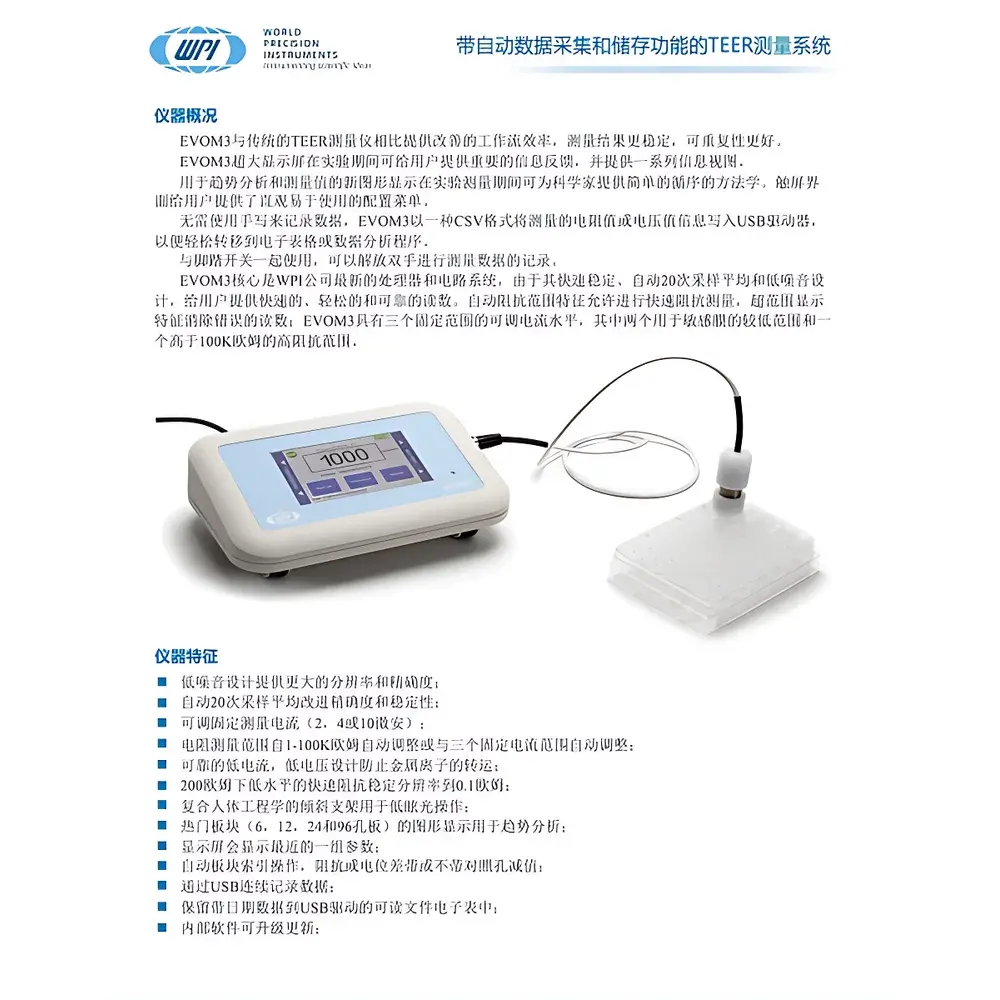
- 7-inch high-resolution capacitive touchscreen interface with ergonomic tilt stand for glare-free operation and glove-compatible interaction
- Three user-selectable fixed current outputs (2 µA, 4 µA, 10 µA) — enabling optimization for sensitive primary cultures, high-resistance epithelia (e.g., MDCK II, Caco-2), or low-impedance endothelial models
- Auto-averaging of 20 sequential impedance samples per measurement, reducing noise-induced variance without compromising temporal resolution
- Real-time graphical display of TEER trends across multi-well formats (6-, 12-, 24-, and 96-well plates), with optional reference well subtraction and auto-indexing
- On-device USB storage of timestamped CSV files containing TEER (Ω·cm²), applied voltage (mV), sample temperature (°C), and operator ID metadata
- Low-noise analog front-end architecture achieving 0.1 Ω resolution at 200 Ω load and <0.5% full-scale measurement uncertainty
- Firmware-upgradable architecture supporting future protocol enhancements and regulatory compliance updates (e.g., enhanced audit trail logging)
Sample Compatibility & Compliance
The EVOM3 is validated for use with standard commercial culture inserts (Corning®, Greiner Bio-One®, Falcon®) and custom barrier platforms incorporating polyester or polycarbonate membranes (0.4–3.0 µm pore size). It accommodates both apical-basal and side-by-side electrode configurations and integrates seamlessly with temperature-controlled incubators via optional external probe input. All measurements adhere to established physiological modeling conventions: TEER values are automatically normalized to membrane surface area (Ω·cm²) using user-defined insert geometry parameters. The instrument conforms to ISO/IEC 17025-recommended practices for measurement uncertainty estimation and supports documentation workflows aligned with GLP (Good Laboratory Practice) and early-phase GMP (Good Manufacturing Practice) preclinical studies. When deployed within validated IT infrastructures, its CSV export format facilitates 21 CFR Part 11-compliant electronic records when paired with appropriate signature and audit trail controls.
Software & Data Management
No proprietary software installation is required: raw measurement data are written directly to FAT32-formatted USB drives in plain-text CSV format—ensuring compatibility with Excel®, Python pandas, GraphPad Prism®, and laboratory information management systems (LIMS). Each file includes header metadata (date/time stamp, operator ID, current setting, temperature reading, and insert type), enabling automated parsing and batch analysis. Optional footswitch integration enables hands-free acquisition during multi-insert assays—critical for maintaining sterility and workflow continuity. Firmware updates are delivered via USB and include version-locked checksum verification to ensure integrity and traceability.
Applications
- Quantitative evaluation of tight junction formation and disruption in epithelial/endothelial monolayers (e.g., Caco-2, MDCK, hBMEC, HUVEC)
- Permeability screening of biologics, nanocarriers, and small-molecule therapeutics across biological barriers
- Functional validation of CRISPR-edited tight junction protein knockouts (e.g., claudin-5, occludin, ZO-1)
- Assessment of inflammatory cytokine effects (e.g., TNF-α, IFN-γ) on barrier integrity over time
- Quality control of induced pluripotent stem cell (iPSC)-derived organoid monolayers prior to compound testing
- Standardized TEER endpoint measurement in OECD TG 497 (in vitro skin absorption) and similar regulatory assay frameworks
FAQ
How does the EVOM3 differ from earlier TEER meters like the EVOM2?
The EVOM3 introduces a modern touchscreen interface, real-time multi-well trend visualization, enhanced noise rejection via 20-sample averaging, and direct USB CSV export—eliminating manual transcription errors and improving audit readiness.
Can the EVOM3 measure TEER in 96-well formats?
Yes—the graphical display supports 96-well plate mapping with automatic well indexing and optional reference well normalization for high-throughput barrier assays.
Is calibration required before each experiment?
The EVOM3 performs self-calibration at power-on and retains calibration coefficients across sessions; annual verification against certified resistors (e.g., 100 Ω, 1 kΩ, 10 kΩ) is recommended per ISO/IEC 17025 guidelines.
Does the EVOM3 support temperature compensation?
Yes—integrated temperature sensing allows real-time correction of TEER values based on media conductivity changes, with optional external probe input for chamber-integrated monitoring.
What electrode types are compatible with the EVOM3?
Standard STX2 chopstick electrodes (WPI P/N STX2) are recommended; the system also supports custom Ag/AgCl electrodes with 2 mm tip spacing and shielded coaxial cabling to minimize electromagnetic interference.