
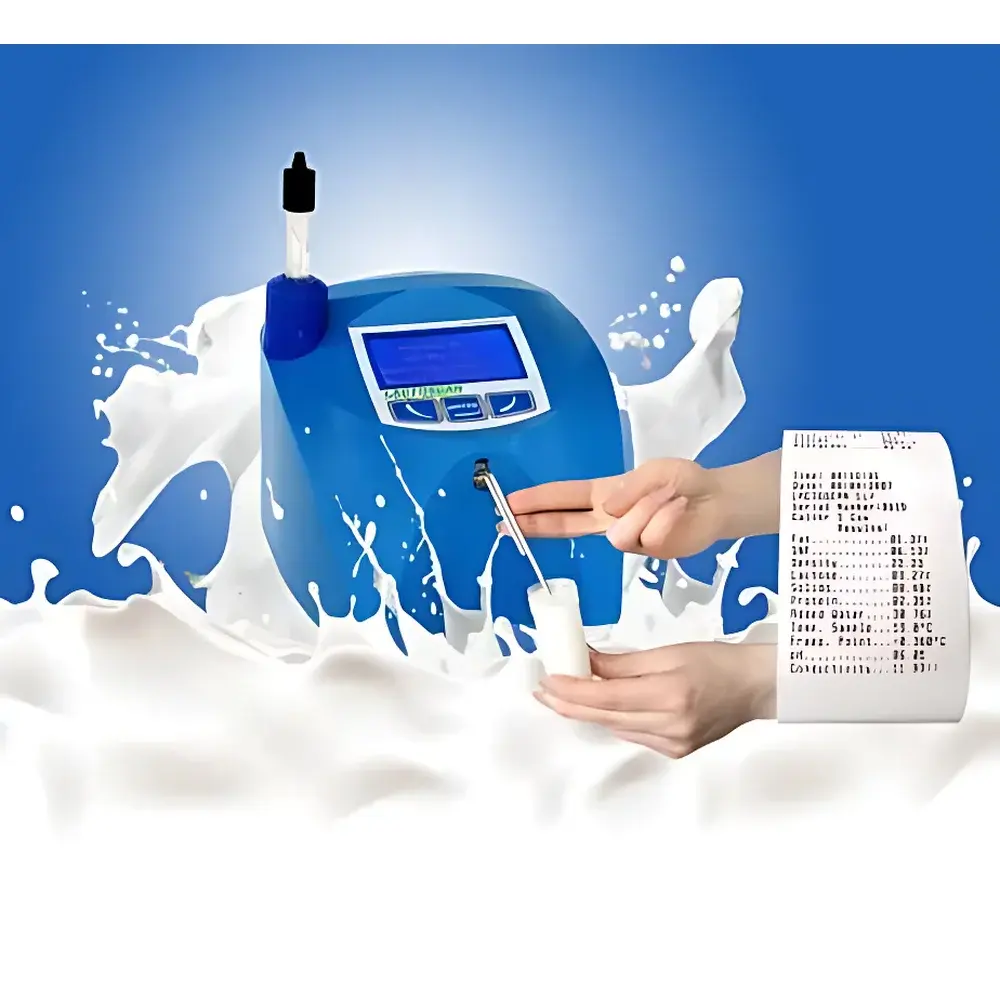
Lactoscan_SP Dairy Composition Analyzer
| Origin | Bulgaria |
|---|---|
| Manufacturer Type | Authorized Distributor |
| Origin Category | Imported |
| Model | Lactoscan_SP |
| Price | USD 1,150 (FOB) |
| Measurement Parameters | Fat, Protein, Lactose, Non-Fat Solids, Density, Water Content, Freezing Point, Sample Temperature |
| Automation Level | Semi-Automatic |
| Throughput | ≥60 samples/hour |
| Detection Range | Fat 0.01–45 % |
| Repeatability | ±0.06 % (Fat) |
| Accuracy | Same as Repeatability |
| Operating Ambient | 10–40 °C, 30–80 % RH |
| Sample Temp Range | 1–40 °C |
| Power Supply | AC 110/220 V ±10 %, 50/60 Hz or DC 12–14.2 V |
| Power Consumption | ≤30 W |
| Dimensions (W×D×H) | 100 × 223 × 216 mm |
| Weight | <3.5 kg |
Overview
The Lactoscan_SP Dairy Composition Analyzer is a compact, semi-automatic near-infrared (NIR) and ultrasonic-based instrument engineered for rapid, non-destructive quantification of key compositional parameters in raw and processed dairy matrices. Designed in accordance with international dairy quality standards—including ISO 9622 (IDF 141), ISO 5725 (accuracy and precision), and IDF Standard 103A for freezing point depression—it delivers laboratory-grade results directly at the farm gate, collection center, or small-to-mid-scale processing facility. Its dual-technology architecture combines broadband NIR spectroscopy (for fat, protein, lactose, and non-fat solids) with high-resolution ultrasonic velocity measurement (for density and freezing point determination), enabling simultaneous multi-parameter analysis without chemical reagents or sample preparation. The system operates on the principle of calibration transfer using robust PLS (Partial Least Squares) regression models pre-validated across diverse bovine, ovine, caprine, buffalo, and camelid milk types—ensuring analytical consistency regardless of species-specific compositional variability.
Key Features
- Multi-parameter analysis in ≤60 seconds per sample: Fat, protein, lactose, non-fat solids (NFS), density, water content, freezing point, and sample temperature.
- Semi-automatic workflow with intuitive touchscreen interface and minimal operator training requirements—ideal for routine QC in resource-constrained environments.
- Compact benchtop design (100 × 223 × 216 mm; <3.5 kg) optimized for mobility between farms, co-ops, and mobile labs.
- Flexible power options: Operates on standard AC mains (110/220 V) or vehicle-mounted DC supply (12–14.2 V), supporting off-grid deployment.
- Integrated thermal stabilization module ensures consistent optical path performance across ambient temperatures from 10 °C to 40 °C and sample temperatures from 1 °C to 40 °C.
- Optional thermal printer support enables real-time hardcopy generation compliant with GLP documentation requirements.
Sample Compatibility & Compliance
The Lactoscan_SP accepts liquid dairy samples in their native state—including raw cow, goat, sheep, buffalo, and camel milk—as well as processed variants such as skim milk, whey, cream, concentrated milk, yogurt, flavored milk, and reconstituted milk powder solutions. No homogenization, centrifugation, or filtration is required. All calibrations are traceable to reference methods defined in ISO 9622 (fat by Gerber, protein by Kjeldahl, lactose by HPLC), and freezing point measurements comply with ISO 5764 for detection of adulteration (e.g., water addition). Instrument validation reports include linearity, limit of detection (LOD), limit of quantitation (LOQ), intermediate precision (within-lab reproducibility), and ruggedness testing per ICH Q2(R2) guidelines. Data integrity meets ALCOA+ principles, with optional audit trail configuration available for FDA 21 CFR Part 11 readiness.
Software & Data Management
The embedded firmware supports data logging for up to 10,000 test records with timestamp, operator ID, sample ID, and environmental metadata. Export formats include CSV and Excel-compatible .xlsx for integration into LIMS or ERP systems. Calibration management tools allow user-defined model updates using certified reference materials, with version control and change history tracking. Software architecture supports multi-language UI (English, Spanish, Russian, Arabic, Chinese) and configurable report templates aligned with regional regulatory reporting formats (e.g., EU Regulation (EC) No 853/2004 Annex III, Chapter XII for raw milk classification).
Applications
- On-farm payment grading based on fat, protein, and freezing point compliance.
- Real-time monitoring of pasteurization efficiency via post-heat treatment protein denaturation indices.
- Adulteration screening: Detection of water dilution (via density + freezing point deviation), reconstitution errors (lactose:NFS ratio anomalies), and whey powder addition (abnormal lactose/protein correlation).
- Process control in cheese and yogurt manufacturing—tracking casein-to-whey protein ratios and lactose depletion kinetics.
- Research applications in ruminant nutrition trials requiring high-throughput compositional phenotyping of milk from experimental herds.
FAQ
What regulatory standards does the Lactoscan_SP comply with?
It conforms to ISO 9622, ISO 5725, ISO 5764, IDF 103A, and supports audit-ready operation under GLP/GMP frameworks.
Can it analyze frozen or powdered milk samples?
No—it requires liquid-phase samples at 1–40 °C; powdered samples must be fully reconstituted prior to analysis.
Is method validation documentation provided?
Yes—each unit ships with a Certificate of Conformance, factory calibration report, and full validation dossier including PLS model statistics and inter-laboratory comparison data.
How often does the system require recalibration?
Under routine use, annual recalibration against certified reference materials is recommended; verification checks should be performed daily using control samples.
Does it support network connectivity for remote diagnostics?
Standard Ethernet and USB interfaces are included; optional Wi-Fi module enables secure cloud-based firmware updates and remote support via TLS-encrypted channel.






